

Forget wearables that count steps. Levels combines labs, macros, and glucose to build a metabolic blueprint for better performance and long-term health.
If you missed Part 1 of the Biomarker Boom, check that out here. It’s wild how fast things are changing.
Have you noticed that small white patch showing up on people’s upper arms lately? It’s not nicotine, and it’s not a medical badge of honor either. For years, I assumed those little discs were just for diabetics quietly managing their glucose.
But these days, I’m seeing them everywhere—on runners at the track, cyclists grabbing post-ride coffee, and weekend warriors logging early miles before sunrise.
The health-tracking world has evolved. It’s no longer just about health—it’s about performance.
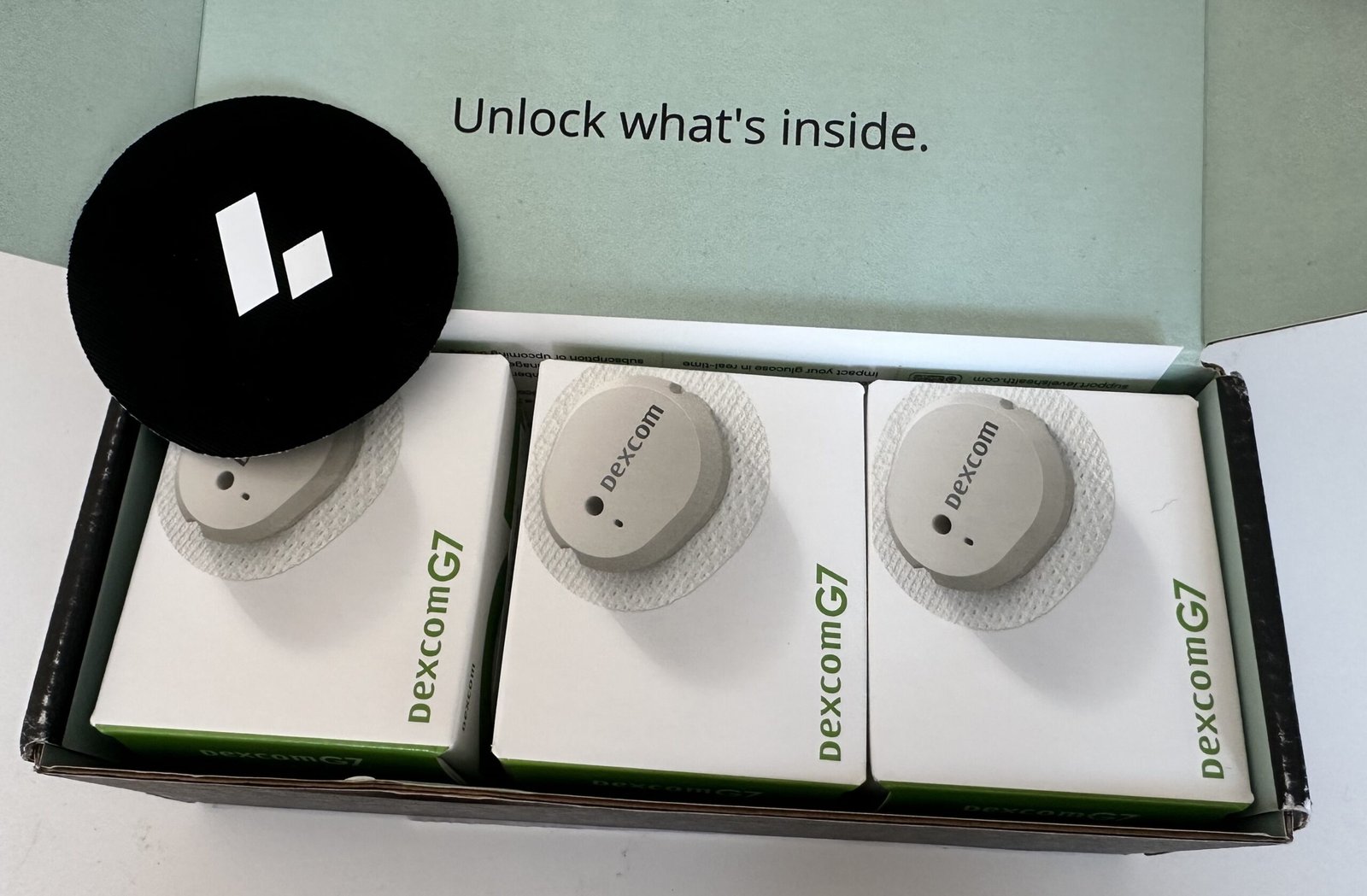
So when I finally slapped the Dexcom G7 CGM (Continuous Glucose Monitor) on my own arm, I’ll admit, I felt a little ridiculous. I’d officially become one of those people. And no, I don’t have diabetes—and (probably) neither do most of them.
Instead, I was testing Levels, a platform redefining how everyday people can improve their metabolic health.
For me, an endurance athlete and someone focused on longevity, I’ve used Levels the last 5 months to understand what’s happening inside my body. The why as to what and when to eat, and how I recover; ultimately body hacking my way to improved performance gains.
Fast forward a few months. I’m still chasing miles, racing time, and trying to balance family, training, and life. But now I have something new: a kind of metabolic feedback routine that alerts (literally) me to my choices and if they’re helping, or hurting.
I’ve been running Levels in parallel with my training, and what follows are three features I believe give it an edge over most tools I’ve tried: labs/biomarkers + macro tracking + dietician + CGM.
Here’s what I’ve learned — the breakthroughs, the frustrations, and how a small patch quietly changed how I train and live.
Here’s What’s Awesome
Three great services for the price of one.
An app that is easy to use, understand and make actionable changes.
The macro tracking AI feature is the best we’ve used.
Here’s What Stinks
Getting started (with the full suite) can be pricey.
If you use the CGM, you’re forced to download a second app.
Tracking macros gets tiresome.
Biomarkers — Understanding Your Health
Once you sign up, the first step is a blood draw at a nearby partner lab. Levels directed me to one based on my location and luckily I snagged an appointment within a few days at a small lab tucked inside a grocery store six miles from home.
Levels followed up immediately with everything I needed to know: show up fasted, bring ID, and be ready for a quick draw. I arrived, checked in, and within minutes was seated in the chair. No payment, no paperwork headaches — everything was covered under the plan I’d selected.
After that, it was the waiting game. I found myself checking the app every day, curious to see how long it would take. On Day 5, an email landed in my inbox: “Your results are ready.” Finally, it was time to see what my blood had to say.
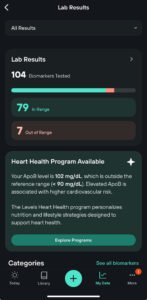
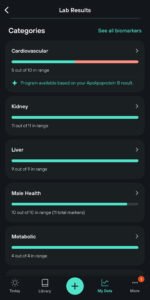
With my detailed lab panel back, my story of male family heart disease deepened.
My ApoB—a key marker for the number of “bad” LDL particles circulating in the blood—was 102 mg/dL, outside the ideal range of < 90.
Elevated ApoB is one of the most reliable predictors of cardiovascular risk; it means more cholesterol particles are “cycling” along my artery walls, slowly contributing to plaque formation.
My LDL cholesterol told a similar story at 136 mg/dL when optimal is < 100. Combined with total cholesterol of 211 mg/dL and a MCHC of 31.4 g/dL (slightly low, indicating less-than-optimal hemoglobin concentration), the trend was clear: endurance training alone wasn’t protecting me from the slow grind of family history.
But the one that caught me off guard was the omega-3 index—my whole-blood EPA + DPA + DHA measured 3.2 % by weight, while optimal cardiovascular protection sits around 5.4 % or higher. Meaning: Low omega-3s can mean higher inflammation, stiffer arteries, and slower recovery.
So how did I even digest all of this information and come up with a plan to combat my heart disease?
Levels offers food coaching and dietitians. Everything I said above was not because I understood any of it, it was all because their experts helped me to understand.
I eat clean, but they pointed out, “not enough fish,” and now the data backed that up.
I’ve since added omega-3 supplements and fish two to three times a week, shifted saturated fats lower, and prioritized fiber and micronutrients over quick carbs. My recovery meals now lean more Mediterranean, thinks olive oil, greens, salmon. And I’ve all but cut out alcohol. Yup. I get it. Fun times.
Many CGM apps are content with simply sending you lab results. Levels is trying something different: anchoring that dynamic daily data to the fixed, slow-moving biomarkers that tell us whether those daily swings matter long term. All with coaching and dietitians ready at your fingertips.
For people who care about longevity, that connection — meal choice, daily graph, lab trend made a huge difference. It wasn’t just results but a path forward.
Macro Tracking — Eat Smarter. Get Stronger
Step 2. I’ll confess, I’ve always just eaten what I wanted. Lean, fit, and always around 170 lbs, it was easy to not track, because why would I.
I looked fine, felt fine, and could hammer through just about any workout.
But as I’ve moved deeper into my forties, “fine” isn’t enough anymore. Strength, recovery, and longevity matter more than calories burned. And I want to get stronger.
Levels’ macro AI capture is less “Diary of What You Ate,” and more “Metabolic Compass” to meeting goals. Snap a picture or your food or a bar code, tag the meal, and the app knits your macros (carbs, fat, protein) together. I was surprised by how accurate their AI was able to piece together my every meal. It wasn’t perfect but with a hit rate of 80 percent, it didn’t leave me frustrated enough to give up on it.
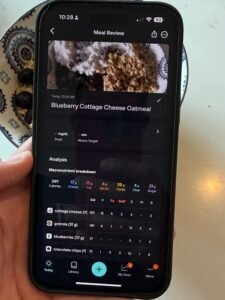
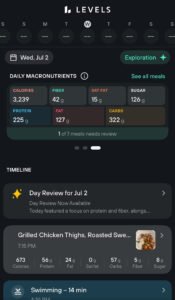
By the end of Day 1, the picture was already clear: I was way under-fueling. My diet was a disaster.
Snacking. Sure, I had that on L-O-C-K! But actually eating what mattered? Nope.
Some days I wasn’t even hitting 100 grams of protein, and my calorie totals were barely scraping 2,500 when I thought I was closer to four thousand. It was eye-opening—and a little humbling—to realize how far off my perception was from reality.
Over the next few weeks, the data became its own kind of coach. I experimented to see which meals fueled me and which ones left me flat. One night I had leftover rice, a sweet potato, lean chicken, and a drizzle of olive oil—it was packed with just what I needed.
The next evening, dinner was rushed and included spaghetti (because kids), canned marinara sauce, and a few meatballs tossed in.
Yup.
Pure trash, high carbs, high sugar, relatively low protein. And I slept like ass knowing my blood sugar was spiking. That single comparison taught me a rule I now live by: buffer carbs with fat or fiber, even on heavy carb nights.
This lesson carried straight into training. Rather than carbs and sodium bombs, I changed when and how I took gels, spacing them out from 30 to every 45 minutes, while pairing them with small sips of electrolyte mix instead of hammering them all at once. The result? Fewer glucose crashes, steadier effort, better recovery the next morning.
I was ignorant to it but after following my macros, I understood what the big deal was. I was dumb to what I was taking in, and even more stupid as to how food actually performed once it was in the system.
Since tracking my macros I’ve gained 5 lbs of muscle from 171 to 176. My body feels healthier and my sustained energy, lasting power, and recovery are vastly different.
But the downside. Remember how I said tracking macros using Levels AI was great. It truly was but after weeks and months of tracking, I definitely got exhausted logging every single thing. That was the downside. As someone who tries to get away from him phone, it was macros that had me staying on it.
CGM — Real time Performance Data
Step 3. Continuous Glucose Monitoring.
This was the feature I was most curious to test. I’m constantly fueling with carbs and sodium to stay sharp and maximize performance—but I’ve always wondered what that was doing to me on the inside. Was I quietly driving myself toward insulin resistance or diabetes? Was I crashing mid-workout or post-session without realizing it? I had to know.
I wore the CGM for the recommended length, 10 days. And during that time, I used it to track the ebs and flows of my diet. Primarily I wanted to understand – 1) how was my diet affecting my everyday glucose levels. 2) What was the latest I could eat at night without having my glucose crash throughout the night to maximize my rest and 3) During long intense rides, how was my fueling. Was I taking in enough to stay level or was I hitting massive spikes during my rides.
Everyday Glucose Levels
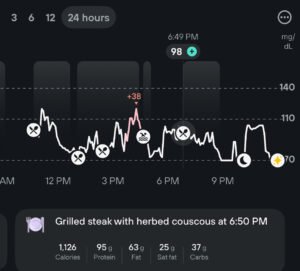
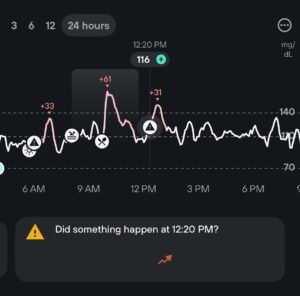
On the left is a complete disaster. You can see how badly I struggled when I first got started, just a roller coaster or dips and crashes.
Then on the right, of course there are still some spikes but thats what I call intelligent eating. I got into a groove, I resisted falling into the hangry moments and instead powered my days with smart eating, all because I was able to track it over time.
Eating Before Bed
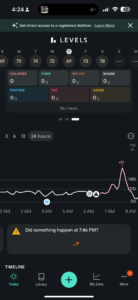
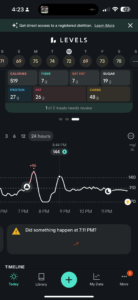
Like my diet, getting a handle on that first week was tough. It was really interesting to see how a grapefruit in bed or sneaking ice cream after the kids went to bed destroyed my glucose levels and had me crashing out throughout the night. But you’ll notice below I really got into a groove and found my sweet spot. Eating something healthy right before 9 p.m. had me leveling out and getting great rest throughout the entire night. I literally could feel the difference when I woke up. Even my WHOOP was celebrating how well I was sleeping and what kind of sleep I was getting.
Fueling Big Workouts
And finally, the thing i really wanted to test, how was my fueling during big workouts?Below, you’ll see I took off at 4:21 a.m. and finished this ride at 8:21 a.m. That’s four hours of cycling, all while taking in 75g of carbs and 1800mg of sodium per hour. I was curious to know. How did I hold up and was my fueling enough, too much, or too little?
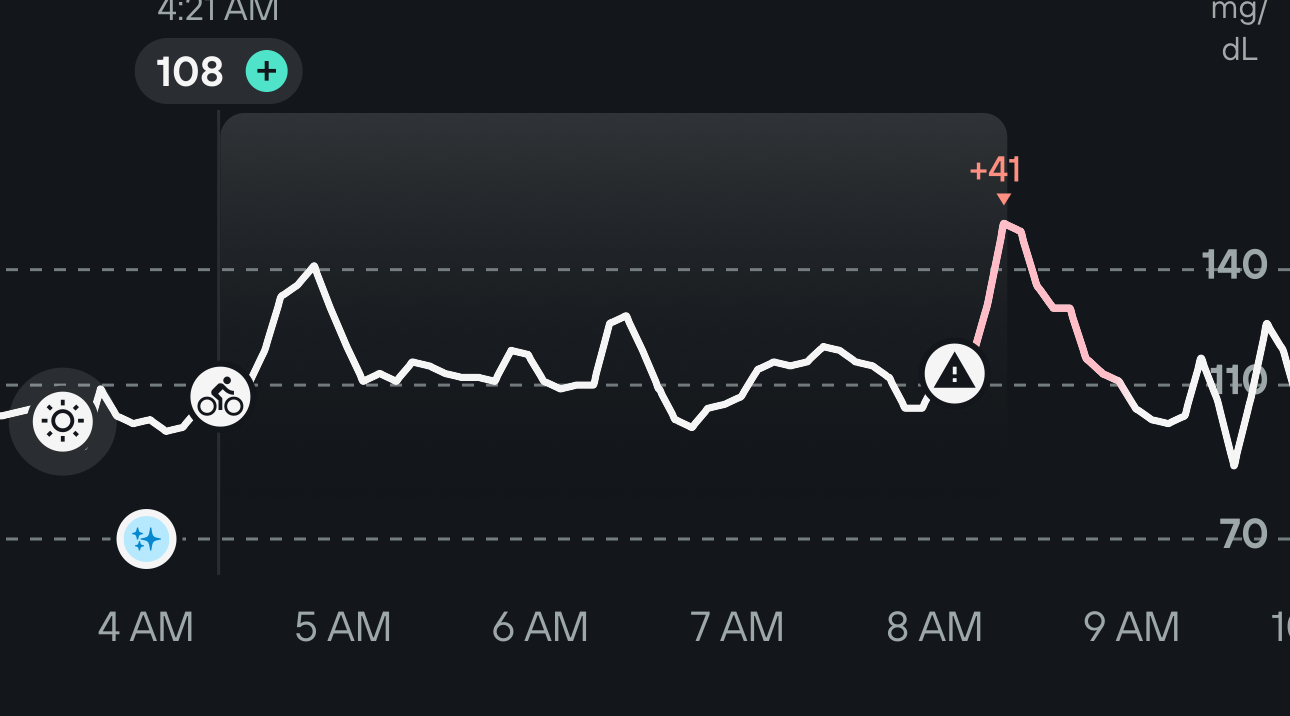
And the result was that I executed this really well. The plan was to stay right in the middle and I was pretty close to it. A few spikes when I took in gels along the way, bookmarked by two massive spikes.
The first being just before 5am when my pre-ride breakfast (overnight oats) hit my blood stream, and the next being around 8:30 a.m. when I finished and crushed 3 eggs, sausage and a baguette for my post-ride meal.
All-in-all, over the course of the 10 day data window, I was able to answer a lot of question marks I had around my daily habits, and training. Ultimately feeling very confident with how to make small pivots that will be massive results moving forward., including how my body reacts to my training and race-day fueling plan.
But CGM isn’t all smooth sailing. It’s easy to overanalyze every bump in your timeline. I had to teach myself not to panic when I saw a sudden drop or a post-meal surge. The app’s alerts are useful, but they can border on nagging—especially when they wake your wife at 3:21 a.m. with a low-glucose alarm that sounds like a fire drill. Great for diabetics. Not so great for marriage. Turn those off, ASAP.
Lastly, the fact that you have to download the Dexcom app in addition to having the Levels app was annoyingly redundant. Just another way for your information and privacy to leak.
Verdict — Is Levels worth it?
Yes. For anyone who wants to get the most from their body or performances, I say dive in.
Combined with the fact that I’m building for longevity, over 40 and still consider myself a competitive athlete threading the needle between performance and health, Levels is the most complete metabolic tool I’ve used.
Biomarker companies are a dime a dozen so when you’re going to spend hundreds (I spent $700+) of dollars, you deserve what’s going to give you value.
Levels doesn’t just clue you into your health— it gives you context (biomarkers), tracking (macros), and feedback (CGM + dietitians). When used intelligently and consistently, it helps you make daily decisions, not just at race time.
If you’re only curious or want a “fun toy,” the cost and effort will feel heavy. But if you commit—to tweaking meals, testing, measuring, forgiving yourself for blips—Levels becomes a daily partner.
After 10 days of wearing the CGM, logging meals, and testing tweaks, I feel sharper and have a completely new and better understanding of what’s happening inside my body.
It’s led me to become more intentional during the day, and with my training. I know better when to push, when to rest, when to and how much to eat. And that kind of feedback is pure gold for anyone reading this.
So, yes: Levels is worth trying — for any athlete who wants to take the guess work out of their training and to live better while doing it.
***
*Note: This review was not paid for by Levels. All thoughts, comments, and writing are my own and real. Because, fuck AI.

Leave a Reply
You must be logged in to post a comment.