

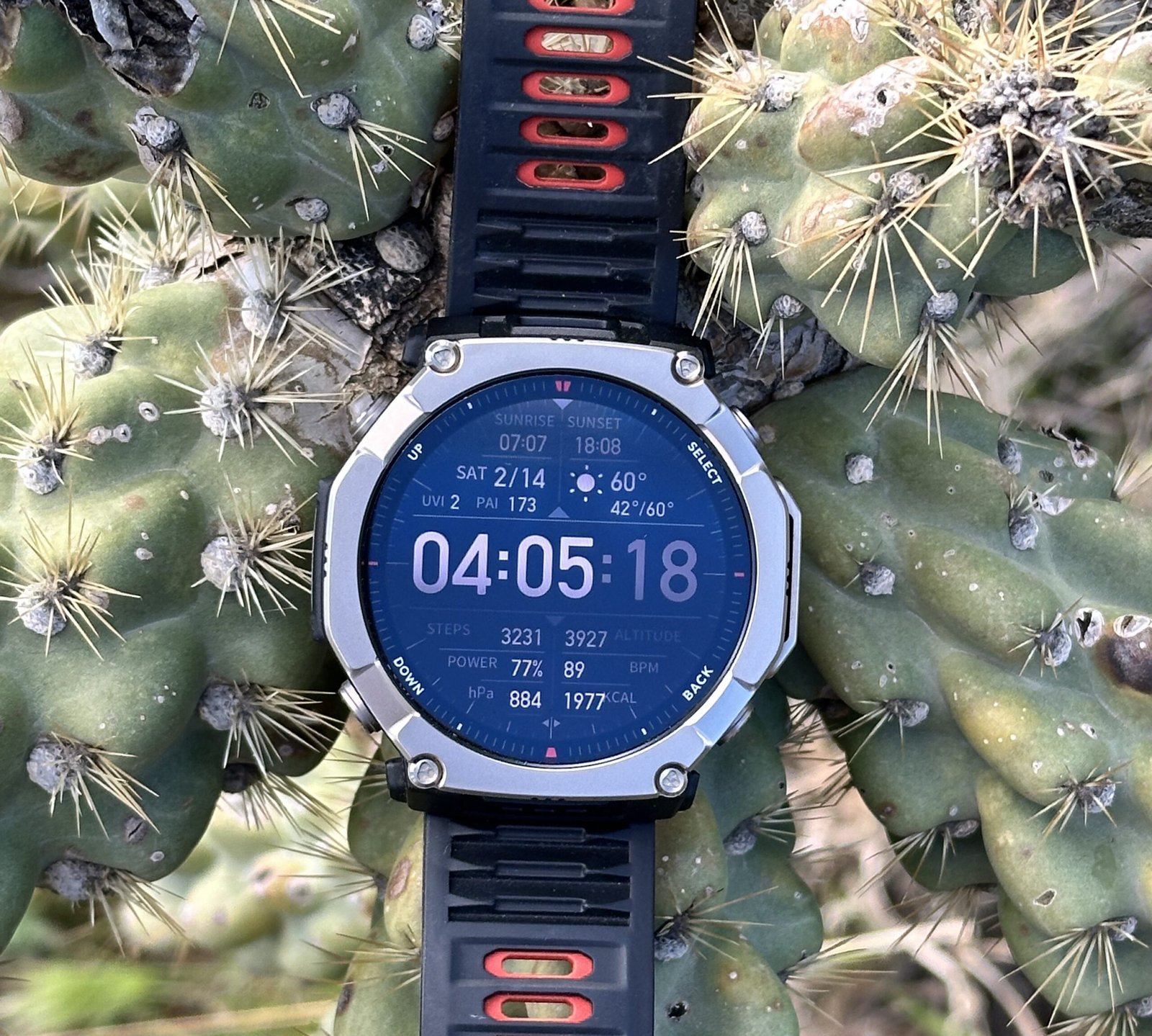
We’re not quick to replace gear and when we do, it’s with the future in mind. If we’re spending $500 or more, it needs to last, not just financially, but experientially. The watch you buy today should still make sense when you decide to line up for something even bigger tomorrow. We may not be running a 100-mile ultra this season, but we never say never.
And during our testing, that’s what stood out about the Ultra 2. You can feel the intent behind it. This device has the build, tech, and battery life that makes you believe it is future proof.
The Amazfit T-Rex Ultra 2 is the brand’s most capable outdoor watch to date and the clearest signal yet that Amazfit is no longer just “good for the price,” but genuinely competitive with the premium watches most endurance athletes default to.
If you’ve lived in the Garmin, COROS, or Wahoo ecosystem for years, the idea of switching can feel risky. But after spending three weeks with Amazfit’s latest, one of which was 4-days in the Arizona desert riding 270 miles over 24-hours, we wanted to see if this watch was as tough, and accurate as the brand said it is.
Of course anyone can get the Ultra 2 but it is not positioned for the casual 5K enthusiast. It’s intention and vision is built for people who day dream about long days outside, navigation-heavy adventures, and multi-day races where battery anxiety kills vibes and focus.
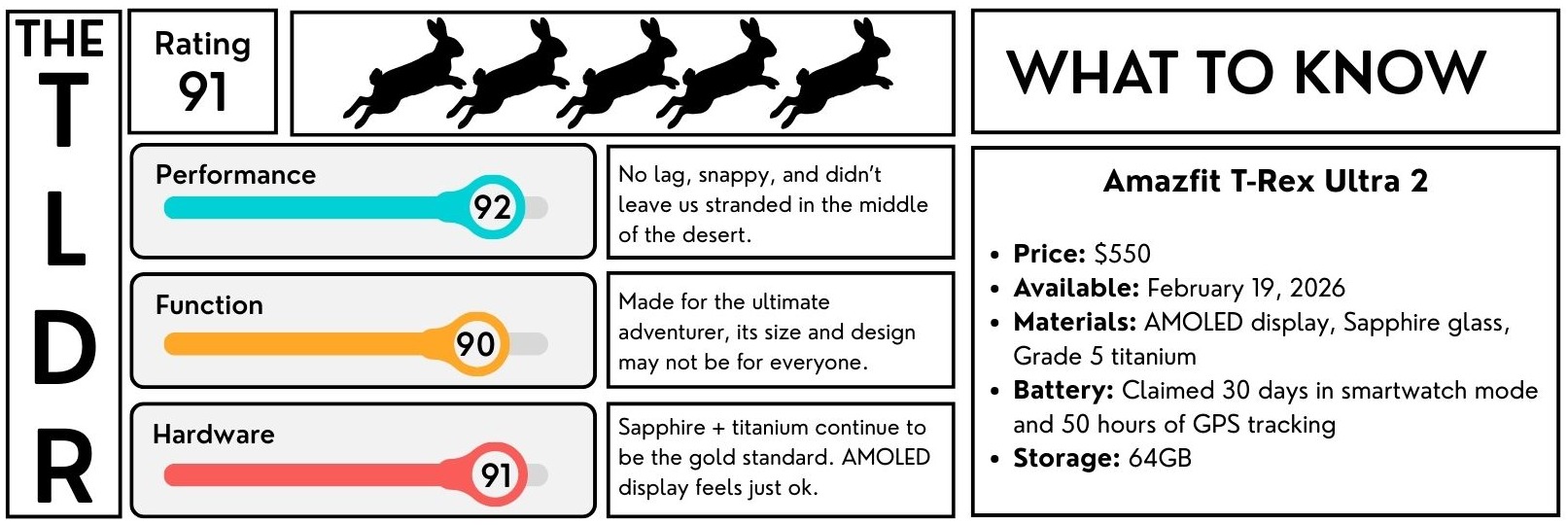
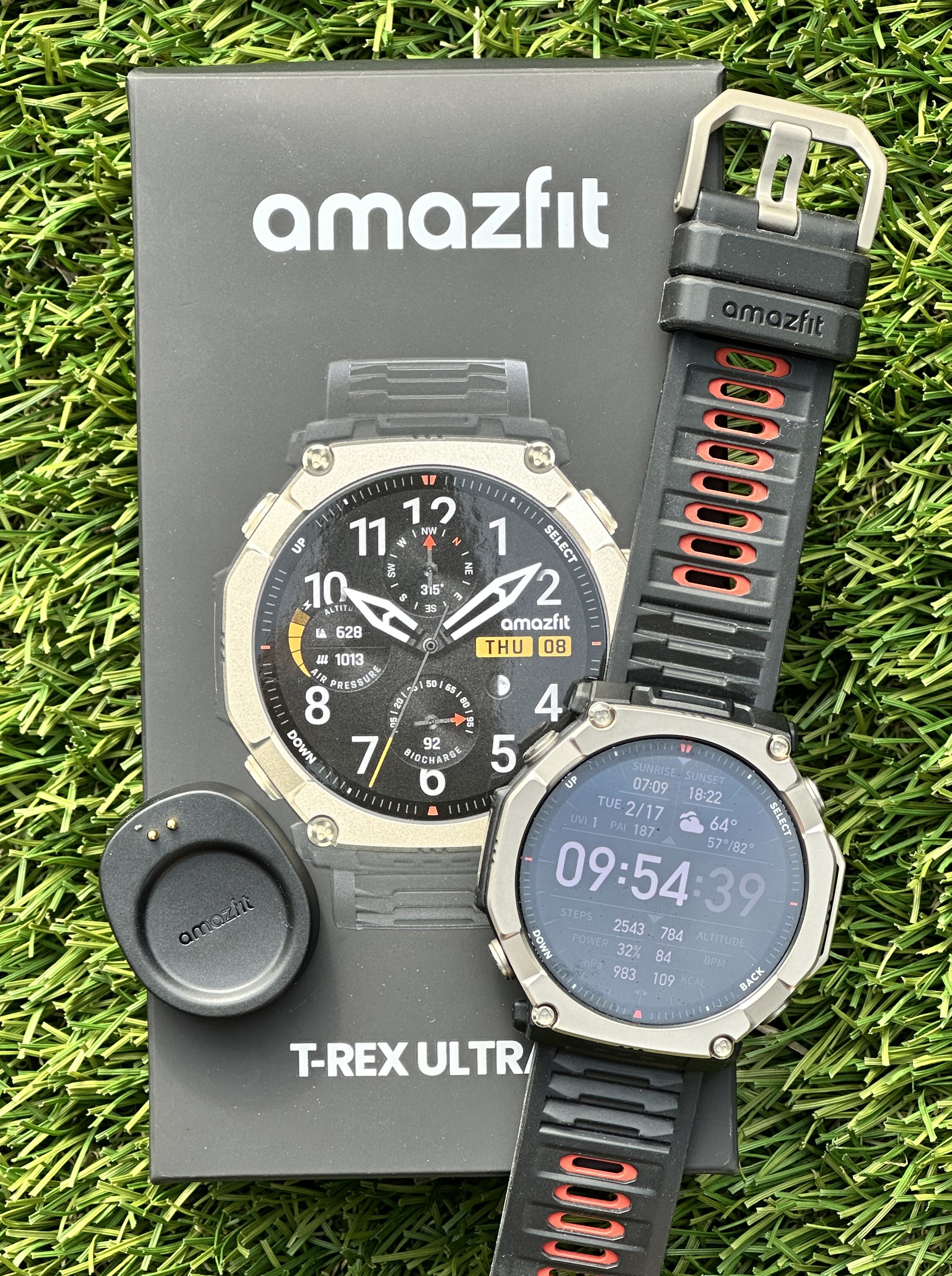
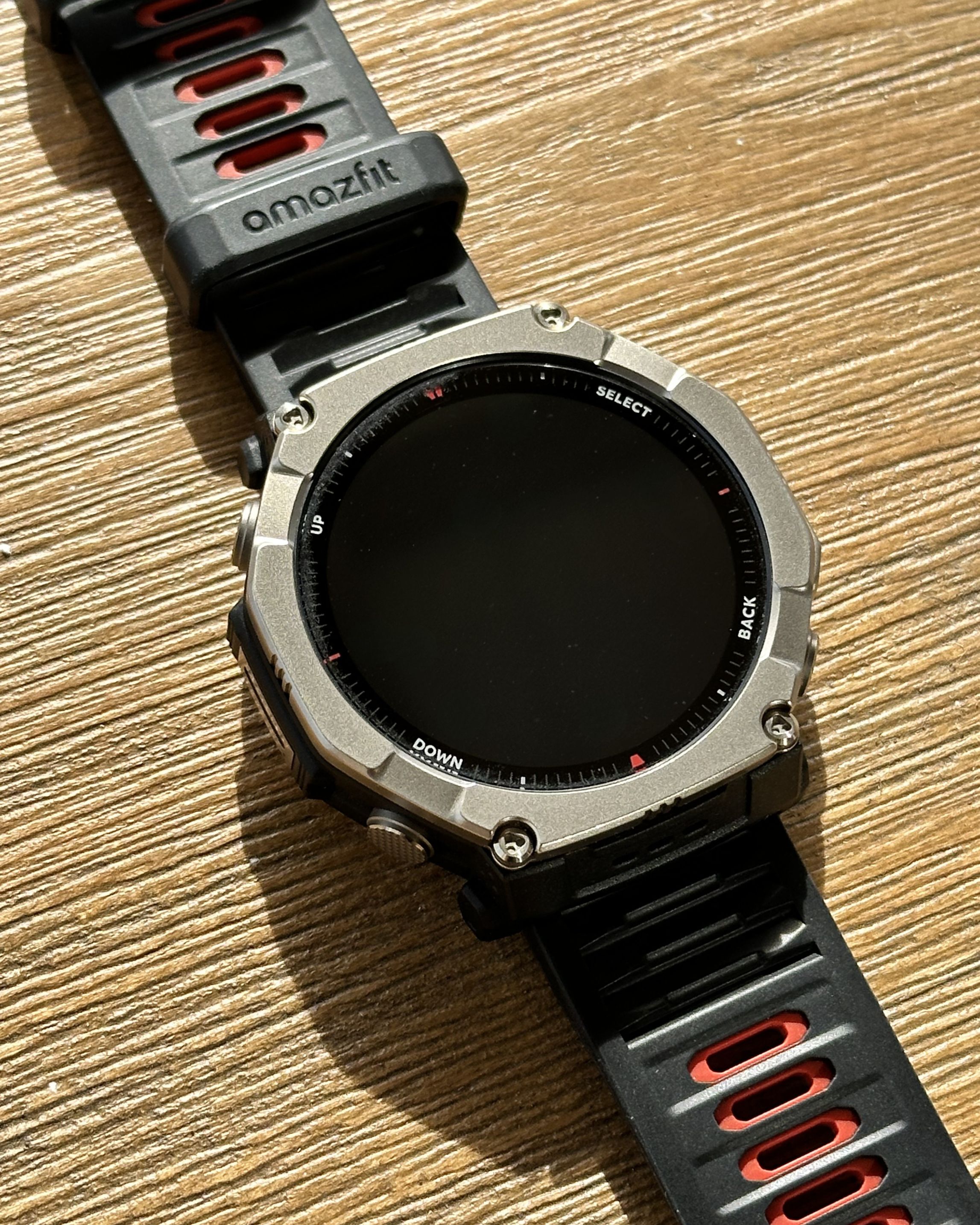
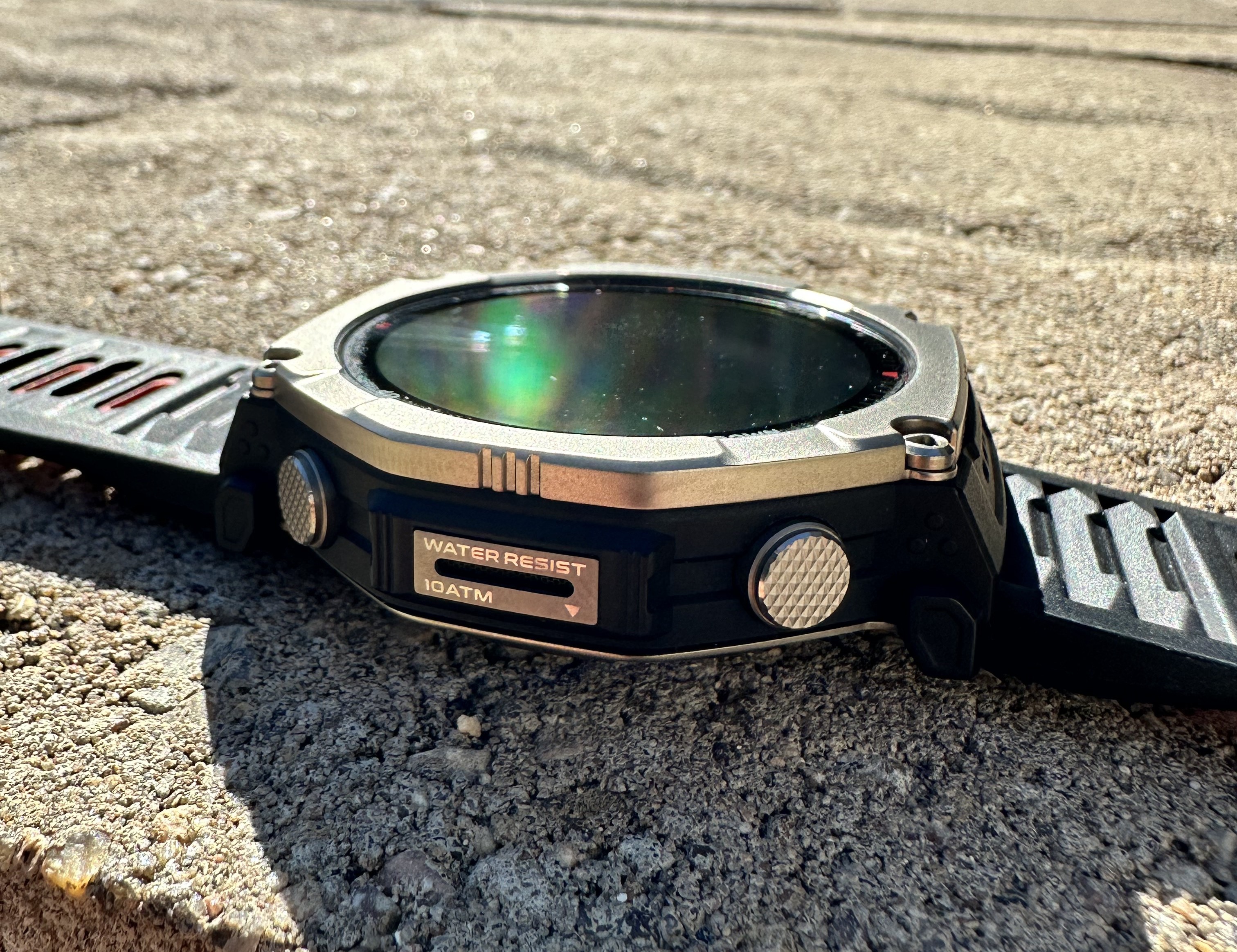
This thing has it all and while I hate lists, outlining the hits are important. The Ultra 2 is 51mm and comes packed with a 1.5-inch AMOLED display, scratch-resistant sapphire glass, Grade 5 titanium bezel and case back, 10 ATM water resistance, dual diving certification, 64GB of storage, and six-satellite GPS support.
And just like that, The Ultra 2 reads like something built for future proofing your gnarliest expedition today and five years from now.
🔥 Here’s What Works
Battery: Great battery life in a smartwatch being advertised as the answer to your solo adventures, really matters. And the Ultra 2 battery is for real. The company says up to 30 days in typical use, and 50+ hours of high-accuracy GPS and we found that too be true. More on the battery later, but it’s truly built for ultra-distance efforts, and long navigation days when charging isn’t an option or is at least the last thing on your mind.
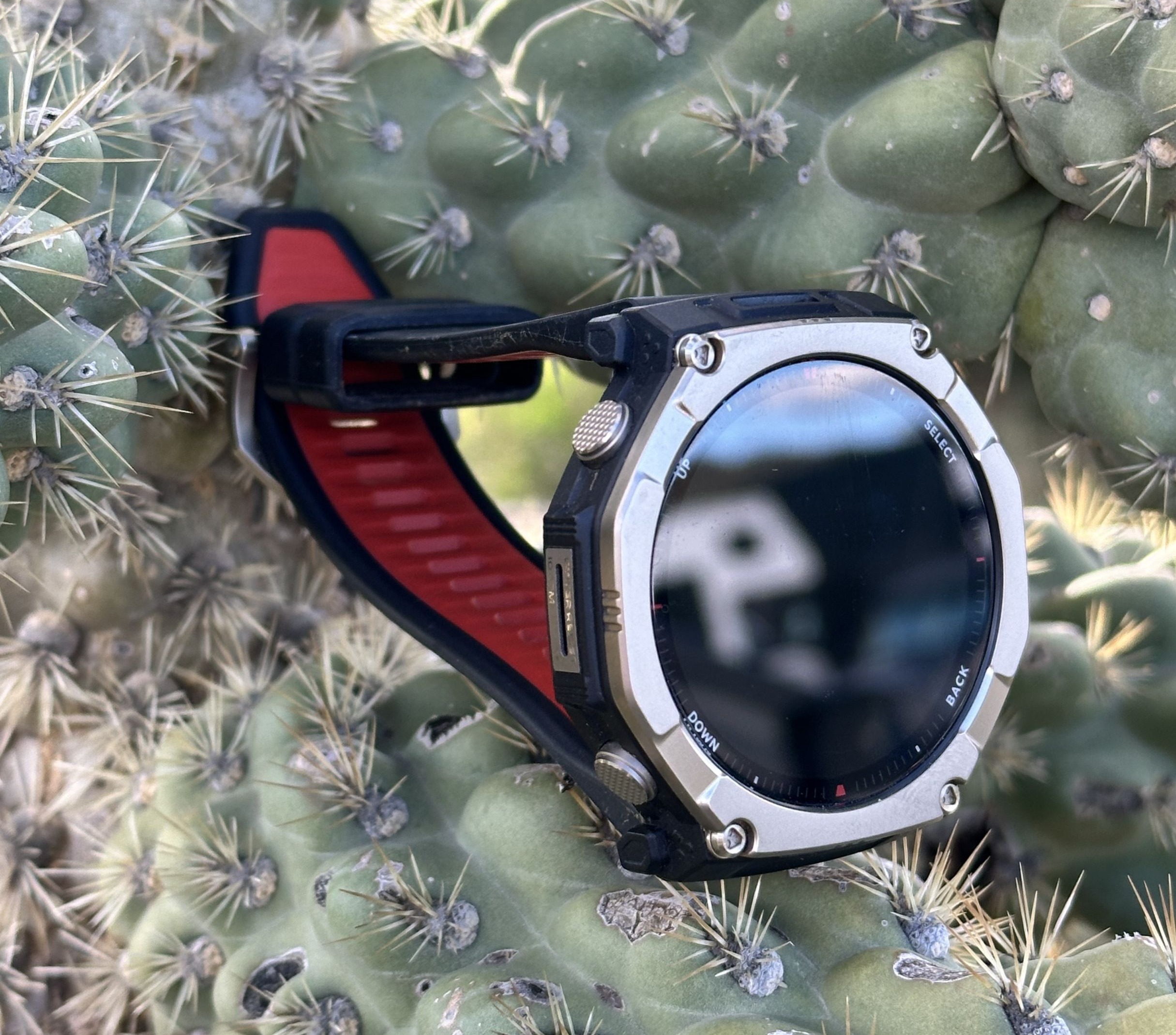
Build: The glass is Sapphire and the case is Titanium. This thing feels bombproof and that’s the first thing we noticed. No, not the weight. But how strong this thing is. It’s the kind of watch you don’t think twice about scraping against rocks, bikes, aid-station tables or while building things in the garage. The materials are legitimately top-tier premium and give the Ultra 2 a feel that justifies its price.
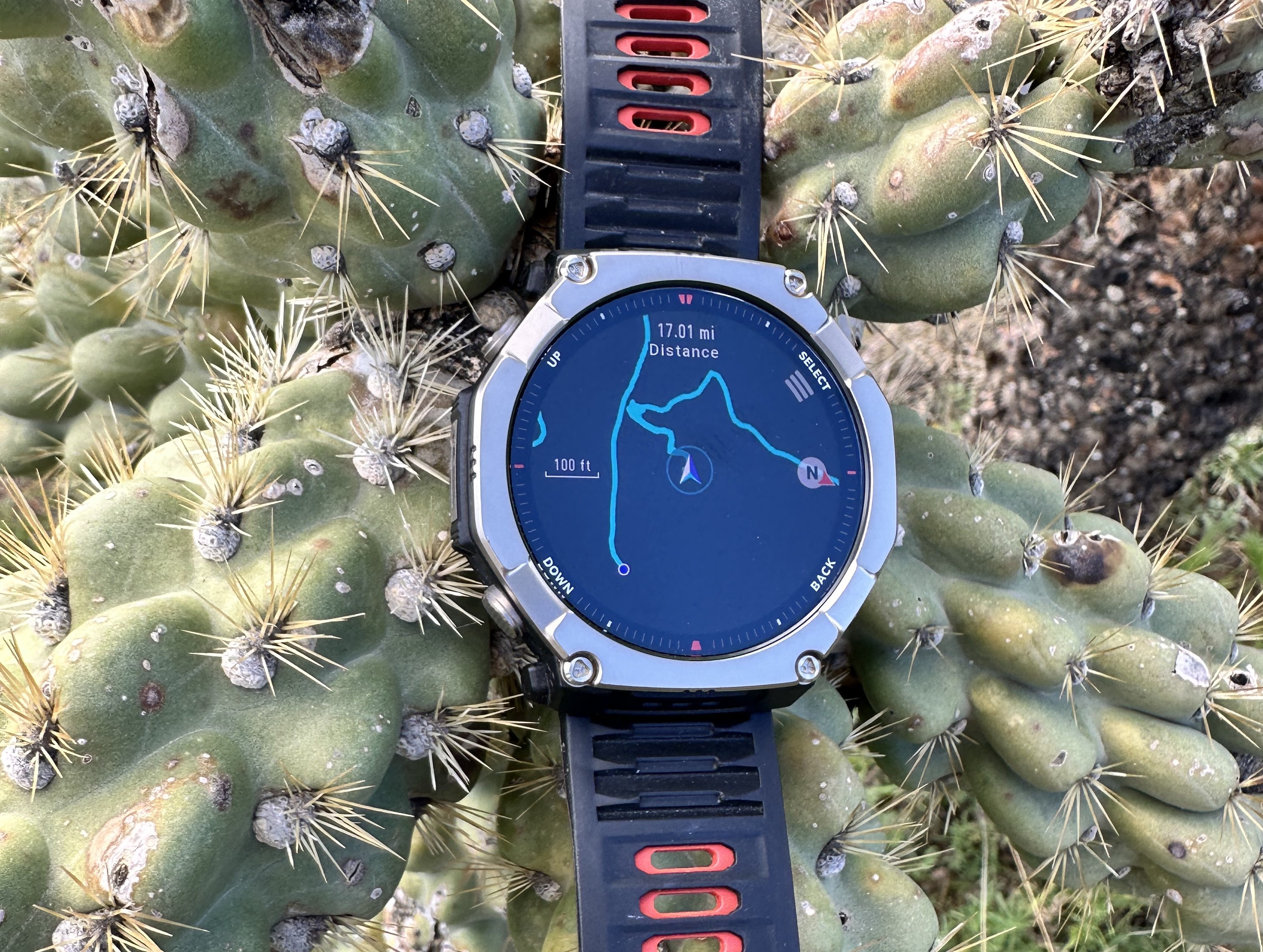
GPS Tracking: Spot on and you can thank the ‘six-satellite GPS support’ here which we kind of laughed at when we first read it. It felt obnoxious and a flex but once we were in the wilderness alone, it showed. The pre-loaded mapping was a breeze to start and follow on the 1.5” display and over the course of our testing, it never felt “laggy” or confused, regardless how far out in the desert we were or under a canopy of trees.
Design: The design is unapologetically rugged (or tactical) yet never feels overkill. Amazfit has really bought into this octagon shape and it might not be for everyone but we didn’t mind it. It’s got big buttons, a thick bezel, and a look that says “I am either in the military or do outdoor stuff.” It won’t win any dainty or minimalist fashion awards but that’s exactly the point.
Health Accuracy: Over three weeks of testing and a monster bike race later, we compared daily health metrics against what we consider the gold standard: WHOOP. The Zepp Health app was never far off from WHOOP. Our heart rate, sleep trends, and recovery metrics were consistently close — close enough that we’d trust the data day to day.
😷 Here’s What Sucks
The Size: This one’s personal to the user, but it likely matters to a lot of people. The T-Rex Ultra 2 is a big boi, 51 mm big, living up to its T-Rex namesake. If you prefer smaller, low-profile watches, this may feel like overkill. If you like substantial, indestructible gear on your wrist, you’ll probably love it.
Design: I know; design was in the above section too. But the Amazfit octagon design isn’t going to be for everyone. Some don’t care, but others are going to want a watch that blends right in with their business life as much as their athlete personality.
The Price: Not because we don’t think the value isn’t there but this watch is expensive in the grand scheme of things, which makes purchasing it a decision you have to weigh. It is still hundreds of dollars cheaper than Garmin and COROS. So weigh the price accordingly.
My Experience: Everyday and at #24HOP
When we were offered the opportunity to review the Amazfit T-Rex Ultra 2, the timing felt almost too perfect.
We were heading into our first team retreat, taking on 24 Hours in the Old Pueblo, a 24-hour mountain bike race in middle of the Arizona desert where our gear (and deodorant) would be tested. The exact kind of environment Amazfit claimed this watch would excel in.
If this watch was going to fail, this was the place it would happen.
In the weeks leading up to the race, I got used to the Amazfit ecosystem and walked away vastly impressed with the Zepp Health app. I walked into it foolishly negative and thought it wouldn’t be very good. I’ve seen a million apps, how could this be any better. But it is.
Fast forward to #24HOP and from the moment the race started and I hit ‘Go’ on the display, the Ultra 2 felt less like a smartwatch and more like a compass and companion.
Unlike road cycling, where you occasionally get moments to glance at your watch, mountain biking demands two hands on the bars nearly all of the time. That’s where the Ultra 2 became a true companion. I pre-programmed it to give verbal updates on my vitals, distance, and average speed every five miles so I never had to risk looking down, or drifting into the botanical garden that was the hundreds of many sharp cacti lining the course. The alerts were clear and easy to hear, letting me know whether I was ahead or falling behind. I loved it, especially in the dead of night.
And that hands off confidence carried into the next big question: battery life.
As I trekked through the day and into the night, battery anxiety never entered the picture. The Ultra 2 started at 90 percent, and 24 hours later the watch still showed 32 percent remaining. Even with continuous GPS tracking, mapping enabled, and voice alerts, it just kept going. This mattered especially on my final lap when my COROS Dura (with solar) bike computer beeped with a low-battery warning. I finished the race, but that Dura beep triggered some PTSD and anxiety seeing the same happened to me during Unbound Gravel XL with more than 60 miles left to ride.
But with the Ultra 2, not once did I find myself dimming screens, shutting off features, and saying a prayer that I wouldn’t be left hanging. It simply worked in the background, which is exactly what you want.
Navigation was another area where the Ultra 2 surprised me. On many smartwatches, mapping feels like a “nice to have” but not something I ever fully trust to use and simply throw caution to the wind. After using it in Austin and during a 24-hour race, that’s no longer how I see it. The preloaded maps launched quickly, directions were smooth, and rerouting was responsive when I drifted off course. More importantly, it worked when my brain didn’t want to. Clear route guidance and climb context removed friction at moments when stopping to double-check directions would have broken momentum or sent me spiraling into hating the watch.
Physically, the watch lives up to its name. The Ultra 2 is thick, substantial, and unapologetically rugged. The weight never bothered me, and the sapphire glass and titanium case didn’t feel precious — even after crashing into a divot four miles into the race. This isn’t plastic. It’s not delicate. But it’s also not for everyone. Some of my team preferred a more traditional round face over the Ultra 2’s bold, octagonal design.
By the time the race wrapped, what stood out most wasn’t a single killer feature but it was how little I thought about the watch at all.
It was a companion throughout that never complained about the exhaustion or pain we felt by the end. It simply supported the experience, quietly and reliably, which is ultimately the highest compliment you can give it.
Garmin on the Cheap?
Sitting with the Front Pack crew at 24HOP, everyone was impressed with the watch. But the recurring comment was “…but I’m so locked into Garmin.”
And that’s the real hurdle. A lot of us aren’t choosing the best watch out there, we’re choosing the ecosystem we’re already invested in. We’re tribal by nature because that’s comfortable and switching feels risky. It’s why a coach will tell you to never try something new on race day.
If you’re coming from Garmin or COROS, the question isn’t “can Amazfit hang?” anymore. If you want absolute ecosystem depth and endless sport profiles, Garmin still wins. If you want clean simplicity and long battery life with minimal noise, COROS continues to do that really well. But if you want an adventure-first watch, a killer app that gives you the big-ticket features without a paywall that is constantly upselling you, the T-Rex Ultra 2 may be it.
At $550, it sits in a very specific lane – premium but not premium without justification.
Comparatively, Garmin’s flagship “money ain’t a thing” Fēnix 8 can climb well past $1,200; and the Enduro line, which is legitimately a battery king hovers around $900.
On the COROS side, the VERTIX 2S is $699, and the APEX 4 sits around $480 depending on size.
But to us, using the Ultra 2 doesn’t feel like, “Garmin on the cheap.” It gives me, a cost conscious athlete on a budget – big value; especially when you consider the premium hardware and completely free app. It can do anything and everything without breaking the bank.
What to Know
Available: February 19, 2026
Materials: AMOLED display, Sapphire glass, Grade 5 titanium bezel and case back
Battery: Claimed 30 days in smartwatch mode and 50 hours of GPS tracking
Storage: 64GB
Price: $550
Availability: Amazfit.com and Amazon
Verdict
When we first started this review, we didn’t know exactly where the Ultra 2 fit.
Amazfit wanted us to believe it was the most adventurous watch out there but it wasn’t until we got out to 24 Hours in the Old Pueblo that we said, “Oh. Now we get it.”
The Amazfit T-Rex Ultra 2 is a serious watch for people who spend long hours outside exploring and don’t want to worry about their watch going through mishaps. I can confidently say, it is the brands most rugged, accurate, and finally refined enough watch to be mentioned in the same breath as the Garmin Enduro 3 and COROS Vertix 2 — without feeling like a knockoff.
Should You Buy?
If you’re like us; budget-conscious athletes who spend long days outside, and value battery life, and navigation that doesn’t suck; the Amazfit T-Rex Ultra 2 is an easy yes.
It’s built for people who live life.
This isn’t a toy watch like the Apple Watch. It’s for current (or future) ultra-distance runners and cyclists, triathletes, HYROX folks, mountain bikers, hikers, divers, and anyone who’d rather worry about the effort ahead than whether their watch will survive it.
And the app? We love a good app, and Zepp Health genuinely surprised us. The data is deep, the layout is clean, and the tracking proved accurate enough that we trusted it day to day.
The size and design won’t be for everyone and if you prefer something slim and discreet, find a different model. But if you’re open to stepping outside the usual Garmin and COROS orbit, having the Ultra 2 as a companion in the desert proved to us that Amazfit is serious about competing at the top end.
Disclaimer: Amazfit sent us the T-Rex Ultra 2 to test. This review was not paid for, all opinions are my own, and the 24-hour mountain bike race was fully funded by us. The feedback is honest. Have questions? Ask in the comments.
Leave a Reply
You must be logged in to post a comment.