

There have always been two choices for monitoring your heart rate during training.
Neither of them is perfect.
Option One: Your watch. Convenient and always there. And for casual runs, cycling, and easy days, it is passable enough. But is passable good enough? Every athlete and coach knows because its happened to all of us, when you need it most, a wrist HRM reads something all kinds of inaccurate.
Whether is is the sweaty wrist, the loose fit, or the constant motion of a running stride; the wrist is a convenient place to wear a watch but has never been the right place to read a heart rate.
Option Two: The chest strap. A primitive tool but one that is accurate and proven. It’s also the thing that doesn’t always want to stay put. Nobody debates its effectiveness but plenty of people debate whether they want to deal with it every morning before a run. The cold band, the positioning, and the inevitable chafe on a long effort. The chest strap earns its reputation on results but is as enjoyable as a vasectomy.
We’ve been big fans of the COROS PACE 4 since we reviewed it. It remains our daily driver and is genuinely one of the best value training watches on the market.
But like any wrist-based device, as a coach and athlete we never fully trust the HR numbers when the effort ramps up.
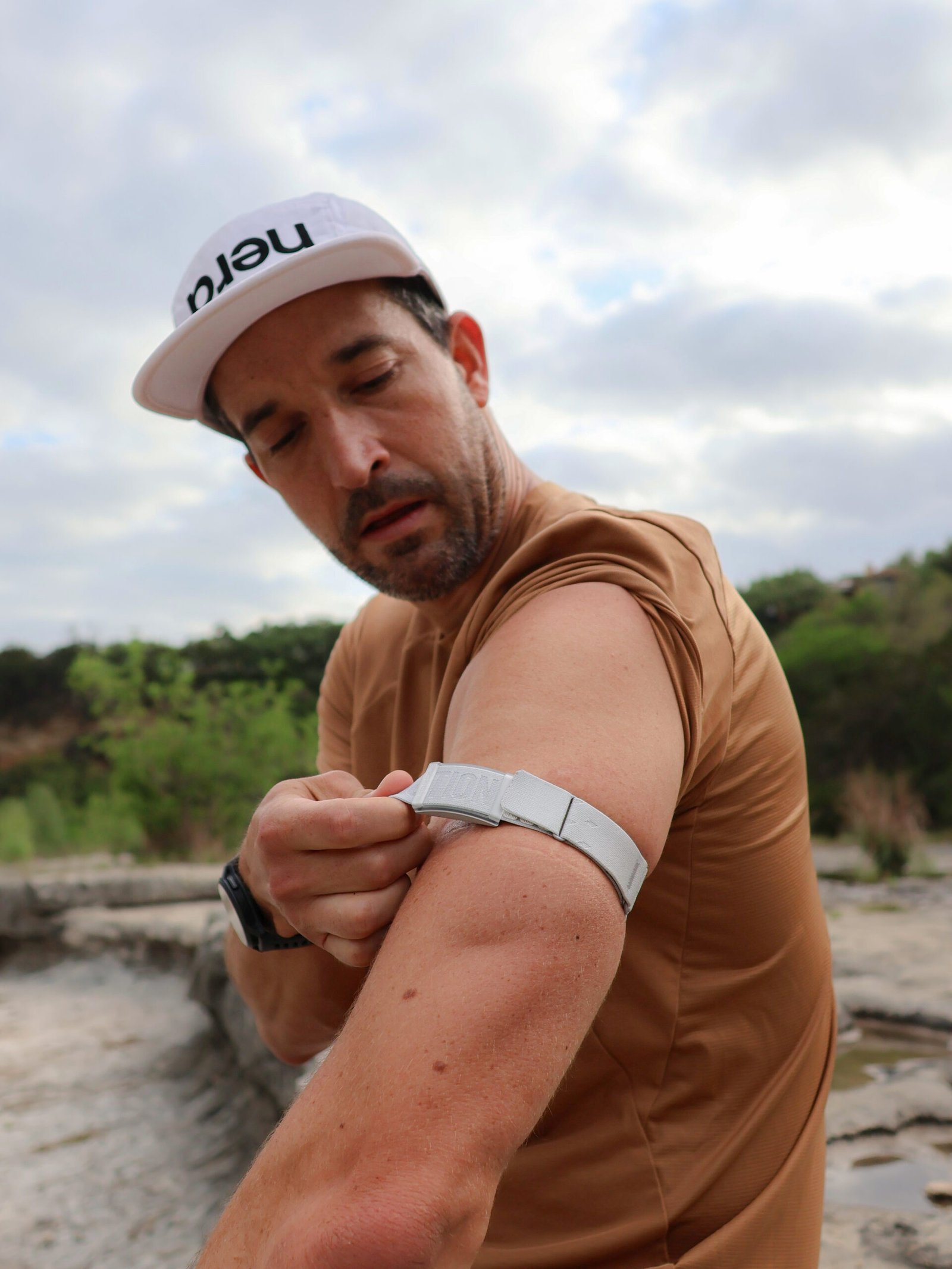
So when we complained to COROS, they offered to send us their uniquely positioned Heart Rate Monitor (HRM), an optical armband that slides onto your upper arm, and stays there.
We thought, why the hell hasn’t anyone else done this?
After a month of pairing it with the PACE 4, we can tell you exactly what it’s like.
It’s like throwing gasoline onto burning coals.
🔥 Here’s What Works
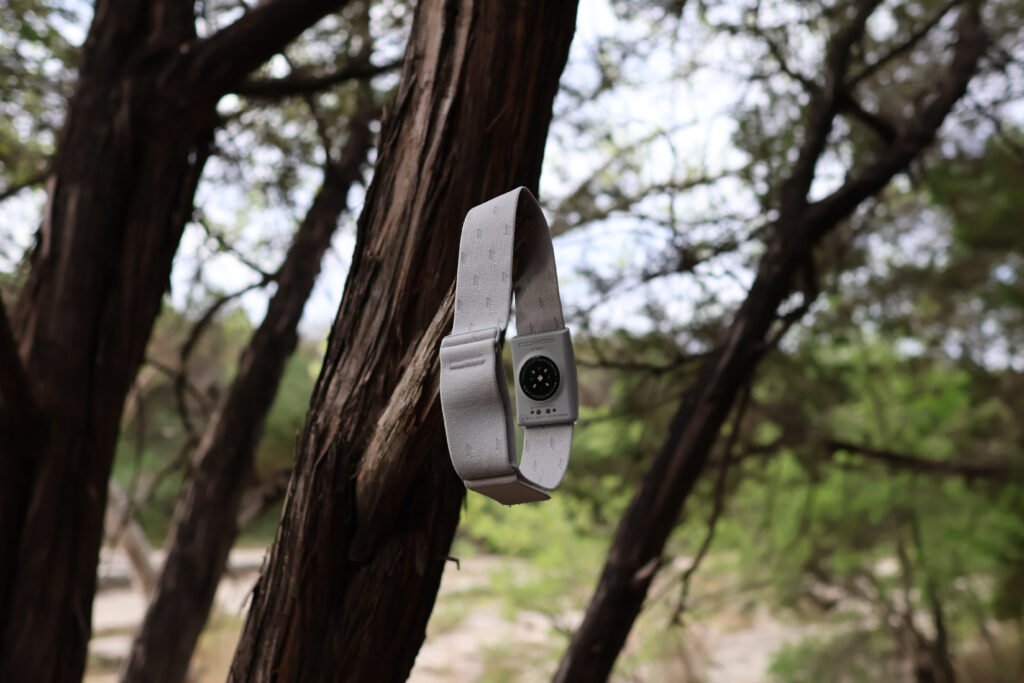
Accuracy: This is what you’re buying it for, so let’s start here The COROS HRM uses a multi-channel optical sensor with 5 LEDs and 4 photodetectors mounted on your upper bicep. The science behind why that matters is this. The wrist has limited blood flow and constant motion from your arm swing. The upper arm has significantly more blood flow, stays more stable during a run, and sits tighter against the skin.
The sensor has more to work with and fewer things working against it.
Since pairing it with the PACE 4, the difference was immediate and impossible to ignore. The numbers that used to spike oddly at the start of an interval or lag on a sustained effort have stabilized. And instead of being a car redlining during threshold work, the reading jump is a lot less ‘spike’ and ramps up and down with what I feel in realtime.
Zone training specifically becomes a completely different experience. When you’re trying to hold Zone 2 or nail a Zone 4 interval, you need data you can trust in real time, not data you’ll rationalize on the back end. The COROS HRM gives you that.
The Setup: It’s embarrassingly easy. There are no buttons on this device. It’s a 3 step process. You pair it with the COROS app once using a QR code included in the manual. After that, you put it on your arm and it turns itself on via automatic wear detection. You start your activity on the PACE 4 or your smartwatch of choice and the HRM is already there. The whole thing is genuinely the most frictionless piece of training tech we’ve added in a long time.
Worth noting: the initial setup does require the app and a QR code so don’t be like everyone ever and throw away the manual before you scan it. After that single activation, you never need the app again.
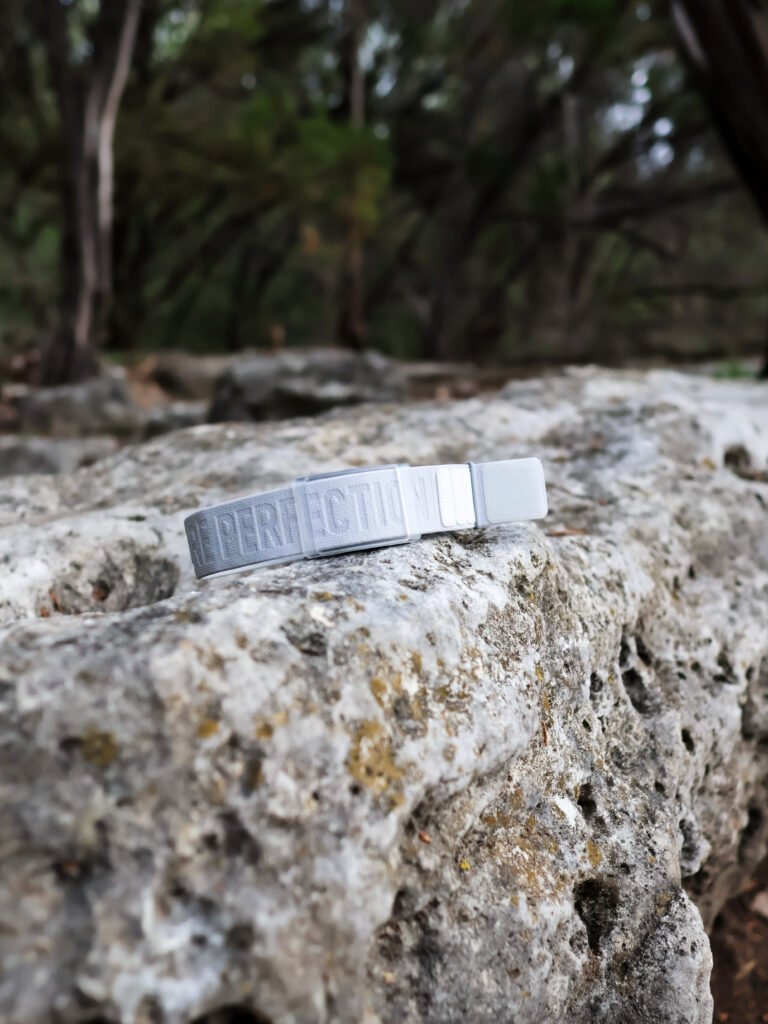
Comfort: At 19 grams, it’s close to weighing nothing. The band is polyester, nylon, and spandex, and the elastic adjusts via a sliding buckle and velcro. Once it’s snug on the bicep, it stays there. No shifting, no distraction, and no awareness that you’re wearing an additional piece of equipment. After multiple runs and bike rides, the routine became: shoes, HRM on the arm, and go! If you really want, you can even wear it all the time but people did ask me what it was. That got annoying.
Sizing note: Adjust the band with your arm bent in a running position, not straight down. When you bend your arm, the bicep expands slightly. Size it straight and it’ll feel too tight mid-stride.
Battery Life: COROS claims 38 hours of active use or 80 days of standby. We can’t back their claims so take them with a grain of salt but after a month of 1-2 hours of daily use, we’ve yet to charge the device. If anything, they’re numbers that mean this thing will charge less often than most devices, and its really nice to have a charging option because our Wahoo HRM chest strap still takes those god awful 2032 batteries. For context, it will outlast a half Ironman, a 100-mile race, and most back-to-back training weekends without needing a cable.
The charger is a proprietary magnetic USB cable (more on that) and takes under two hours to go from zero to full. The only genuine knock: it’s proprietary. The PACE 4 is proprietary too and god damnit, I want fewer cables everywhere, not more. Alas, this is a trend that hasn’t quite reached COROS yet.
Not-COROS Specific: This matters. The COROS HRM connects via Bluetooth to up to three devices simultaneously — your watch, your phone, a gym machine, whatever you need. In addition to the PACE 4, we connected it to our Garmin and Amazfit watches, meaning it’s not a COROS-only investment. If you move ecosystems, the HRM comes with you.
🤢 Here’s What Sucks
No ANT+: If you’re pairing to older Garmin devices, some gym equipment, or anything that requires ANT+ rather than Bluetooth, you’re out of luck. The COROS HRM is Bluetooth-only. This won’t affect most people, but if you have an older ecosystem built around ANT+, it’s worth knowing before you buy.
No Data Storage On-Device: The HRM transmits your heart rate in real time but doesn’t record anything on the device itself. If your watch or phone drops the signal, that data is gone. For most use cases this is a non-issue, but if you’re doing solo long efforts in areas with signal interference, it’s worth being aware of.
The Charger is Yes, Proprietary: One more cable to keep track of and one more magnetic end to lose in our gear bag. This is the second times we’ve complained about this with COROS and we’ll keep saying it. Why can’t we just have universal charging!
Anti-Long Sleeves: Unlike a chest HRM where you can just lift your shirt to put it on, the COROS armband is a little more difficult to initially get on in cold temps. More than a few times I forgot to put put it on before leaving the house and was stuck outside in freezing temps taking off my shirts to slide it on. Not a deal breaker but annoying enough.
My Experience with the COROS HRM
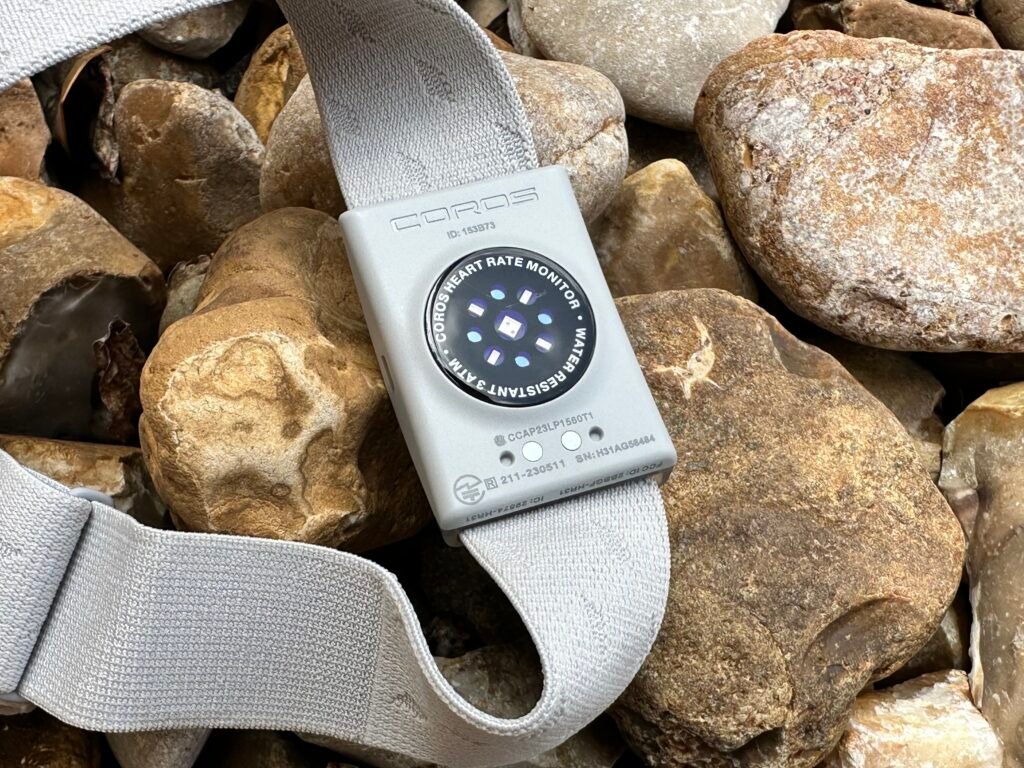
We’ve been using the PACE 4 since our review in November. The watch does a lot of things well. The wrist HR was the one thing we never fully bought in on — it was fine most days but what good is datat if its not entirely accurate.
One month in with the armband changed what we were looking at. The first run felt like a calibration and we even wondered if it was working. By the third, we stopped checking whether the numbers we’re accurate and started just using it and trusting it. And that’s the goal; get accurate data you can trust. From then on, it just kinda blends into the background and not something you think about until after your workout.
Seriously. There isn’t much to say. On interval days, the HR tracked the effort in real time instead of catching up to it and on easy days, we had confirmation that what the body felt like matched what the data was showing. At one point we even wore two different watches attached to two different HRMs to compare numbers.
For heart rate zone training specifically, this changes the quality of the session. Zone 2 is notoriously easy to drift out of and with wrist-only data, you’re estimating and with the HRM, you’re running the numbers as accurately as possible.
The only adjustment is remembering it’s there at all. Twice in four weeks we went to start a run and had to go back inside to grab it from our office.
And that’s the short term tax you pay for adding any piece of equipment to the ritual. Once it’s in the routine, it costs you nothing.

The Real Takeaway
The wrist was never the right place for a HRM sensor and the chest had its own issues with fit and battery life.
The COROS HRM is the answer to a compromise we’ve been living with for years — and it’s a better answer than a chest strap for anyone who wants accuracy without the rub.
Four weeks in and we’re not going back. Arm > Chest.
What to Know
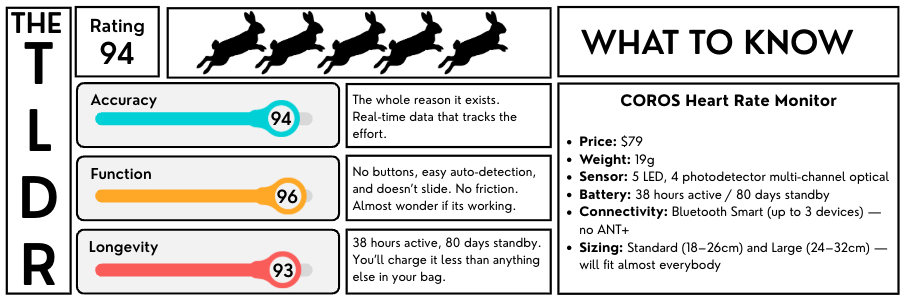
Price: $79
Weight: 19g
Sensor: 5 LED, 4 photodetector multi-channel optical
Battery: 38 hours active / 80 days standby
Connectivity: Bluetooth Smart (up to 3 devices) — no ANT+
Water Resistance: 3 ATM
Sizing: Standard (18–26cm) and Large (24–32cm) — fits most
| Fit tip: size the band with your arm bent at a running angle, not straight. Your bicep expands when bent. Get this right once and you’ll never adjust it again. |
Verdict
The COROS Heart Rate Monitor is a simple product solving a problem that every training athlete has rationalized away for years. The wrist reading is good enough until it isn’t. The chest strap is accurate but comes with enough friction that too many athletes skip it all together.
The armband is the NEW third option. At 19 grams, you get a simple solution with no buttons, that slides on, and connects automatically. It pairs with the PACE 4 (and other devices) like it was always part of the ecosystem — because it was designed to be.
Ultimately, its about accuracy and it does the whole job.
Should You Buy?
If you train with any COROS watch, this is a no-brainer. The pairing is seamless and the accuracy jump is real. If you’ve been relying on wrist HR for zone training, you’ll notice the difference immediately.
If you train with Garmin and are tired of chest strap friction, this works.
If you need ANT+, it doesn’t. If you need something that stores data independently of your watch, look elsewhere.
For the rest of us: At $79, this is an easy, yes.
Leave a Reply
You must be logged in to post a comment.