

Sleep, and we fully believe it too, has become the most talked-about recovery tool in the last decade.
Not cold plunges or sauna’s but yes, that age old sleep.
And yet, for something so foundational, we’re still trying to figure out how to measure it properly.
For decades, the “8-hour rule” dominated the conversation. But science has moved on.
Recent research suggests that regular bedtimes and wake times are actually stronger predictors of lower mortality risk and better overall health than sleep duration alone. Meanwhile, the gap between your weekday and weekend sleep schedules, something most of us are guilty of has been linked to higher BMI, elevated blood pressure, and broader metabolic disruption.
Duration still matters. But regularity and quality may matter more.
And that’s exactly where Sleep Cycle is trying to shift the conversation.
The Research: Moving Beyond a Single Number
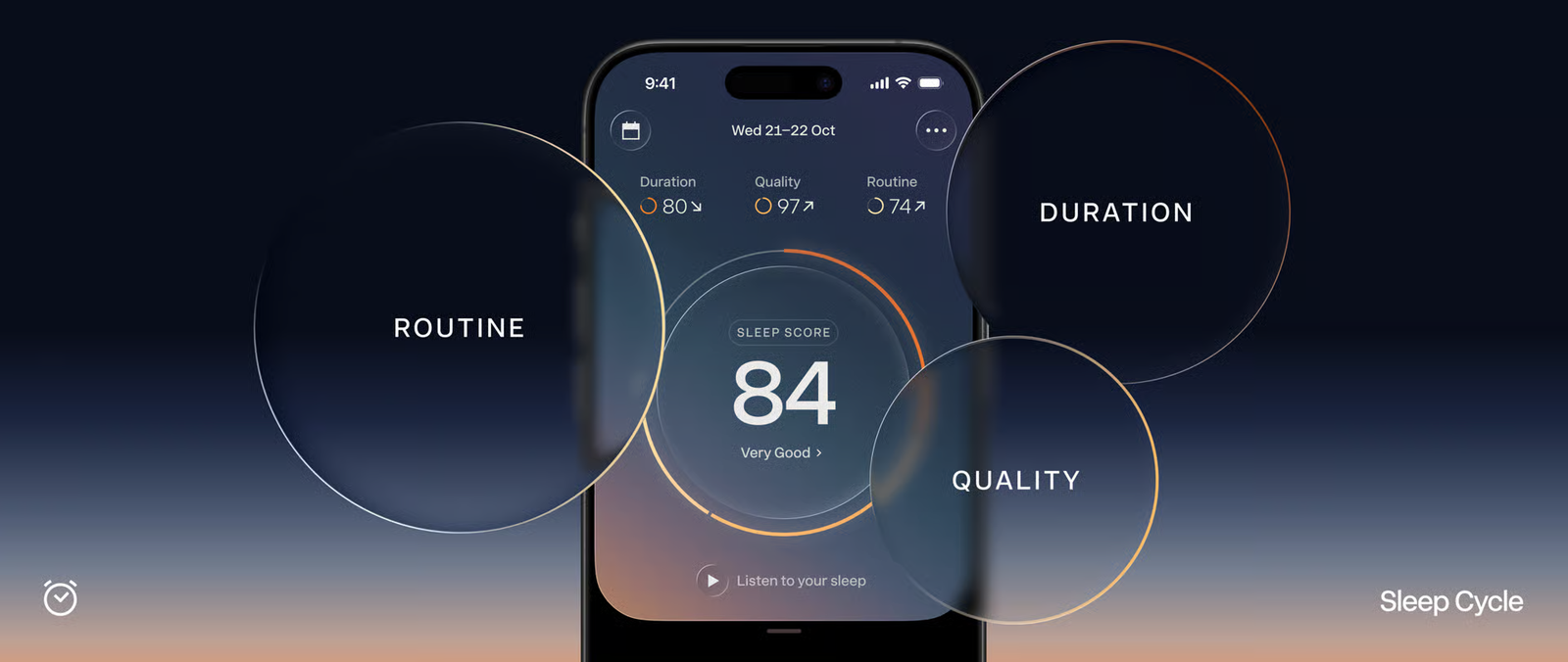
Sleep Cycle’s latest research focuses on evolving the idea of a “sleep score,” the number many of us wake up to and either feel validated by … or quietly hating.
The company’s new model is built around what it calls three pillars of sleep: Duration, Quality, and Routine.
The key shift? Routine.
Rather than treating sleep as a nightly event, this approach emphasizes consistency and circadian alignment, arguably the most important, and most overlooked, components of long-term health.
By weighting routine as the primary dimension, the Sleep Score moves beyond passive tracking and toward something more behavioral. The goal isn’t just to tell you how you slept but it’s to nudge you toward sleeping better, more consistently, and in alignment with your natural rhythm.
In theory, it’s a more modern interpretation of sleep science. One that reflects where research is actually heading, not where it’s been.
The Bigger Question: Who Is This For?
But here’s where things get more nuanced.
Sleep Cycle is a for-profit company. And like every company in the wearable and health tracking space, its goal is to build a better, more valuable product for its users.
Which raises a fair question. Is this research designed to move the broader understanding of sleep forward—or to strengthen Sleep Cycle’s own ecosystem?
Because sleep scores today are fragmented across many for-profit companies.
- WHOOP has one version
- Garmin has another
- Oura has its own model
- And now Sleep Cycle is refining theirs
Each is built on slightly different assumptions. Each is backed by its own data. And none of them are standardized.
We’re not saying Sleep Cycle isn’t better than the rest but the nuances are real, and confusing.
Sleep Cycle’s new model being grounded in clinically relevant markers like regularity and circadian alignment does strengthen the scientific positioning of its platform. That matters, especially as the company expands into partnerships, technology licensing, and potential medical applications.
Through its “Powered by Sleep Cycle” strategy and Sleep SDK, this new scoring system isn’t just a feature, it’s infrastructure. A modular framework that could be integrated into partner apps, corporate wellness platforms, and future healthcare use cases.
Which again raises the question: Is this a universal shift in how we should think about sleep… or a smarter way to scale a product?
Our Thoughts
Sleep Cycle is trying to redefine what a sleep score means and importantly, what actually matters when it comes to sleep.
That shift, the thinking from duration to routine and quality is backed by emerging research and feels directionally right.
But it’s still one company’s interpretation, built within its own ecosystem, for its own users.
The real opportunity isn’t just a better score, it’s a shared, standardized understanding of sleep that goes beyond any single app or platform.
Until then, the best metric is still the simplest one: How do you feel when you wake up?
Leave a Reply
You must be logged in to post a comment.