

This October, we’re running Rim to Rim to Rim at the Grand Canyon.
That is the South Rim to North Rim and back — roughly 42 miles, over 12,000 feet of combined elevation change, through one of the most singular pieces of terrain on the planet.
We’re doing it with a small group, a few of whom have been there before. It’s the kind of run that lives in the back of your mind for years before you finally commit. And by commit, we finally booked lodging and our flight.
But it almost didn’t happen. Earlier this year, the Dragon Bravo Fire tore through the area, shutting down trails and leaving the canyon’s access status uncertain for weeks and supposedly years. Like a lot of people who had been planning this, I found myself checking updates obsessively — wondering whether the trails would be open, whether conditions would be safe, and whether the whole thing would need to be scrapped. Up until recently, the answer was no, then boom, it reopened.
That experience was a reminder of just how delicate our outdoor spaces really are. A single lightning strike sparked a fire that threatened to close one of the most visited and beloved natural landmarks in the United States for years. No policy debate, no budget negotiation. Just nature being nature and showcasing how quickly it can take something away.
The Grand Canyon has existed for six million years and the trail access that makes it reachable to humans is far more fragile than the canyon itself.
What does America the Beautiful actually mean without its outdoor spaces? Without the trail systems that thread through national forests, canyon lands, mountain ranges, and coastlines. All the places people build their lives and identities around?
The honest answer is that it looks like something much smaller. It becomes a country that traded a defining inheritance for a line item on a budget spreadsheet.
The trails are not scenery. They are who this country is.
Which is why what’s happening right now matters — not just to elite athletes, but to every single person who has ever laced up on dirt and gone for trail run or hike.
On March 31, 2026, the Trump administration announced what it called a “reorganization” of the U.S. Forest Service. The word doesn’t do justice to what’s actually happening. The agency’s headquarters is being relocated from Washington D.C. to Salt Lake City. According to the release, its because the west is where the most Forest Services are. All ten regional offices — the operational backbone of the largest federal land management agency in the country — are being shuttered. More than 50 research stations across 31 states are being consolidated into a single facility in Fort Collins. And a proposed budget for fiscal year 2027 would cut trail maintenance funding by 64%. In 2025, the Forest Service lost 5,800 workers nationally.
That is one hundred and ninety-three million acres of national forest; an area larger than Texas being managed by a reduced force.
Some national forests have shed roughly a quarter of their non-firefighting staff in just over a year. The agency’s own internal Trail Program Status Report didn’t mince words: understaffing is already leading to unpassable trails, unsafe bridges, and negative environmental impacts.
The same report warned that without intervention, public access and recreation-based economic contributions will continue to decline in 2026 and beyond.
In an exclusive interview, we headed straight to AllTrails to best understand what they’re seeing from the ground. Pitt Grewe, Head of Social and Environmental Impact at AllTrails, has been watching this unfold in real time — and he isn’t minimizing it. “More people are getting outside than ever,” he told us. “AllTrails members spent 75 percent more time on trail in 2025 than the year before. At the same time, we aren’t seeing resourcing for public land agencies growing at pace. The USFS budget grew by only 2% last fiscal year, and shrank in the two prior consecutive years. Public land managers deserve the resources to support growing demand for outdoor recreation.”
AllTrails has taken a public position in response.
Earlier this year, AllTails joined Patagonia, onX, Peak Design, and more than 74 other outdoor businesses and organizations in signing a letter alongside the Outdoor Alliance urging Congress to fully fund both the Bureau of Land Management and the U.S. Forest Service for fiscal year 2027, specifically calling for $100 million for BLM recreation and $140 million for the Forest Service. It also calls for an end to the federally mandated hiring freeze, which is hampering these agencies’ ability to implement the 2024 EXPLORE Act, a bipartisan legislation designed to improve outdoor access, streamline permitting, and support gateway communities.
Given everyone is afraid to put a target on their back, it’s a rare and deliberate move for consumer-facing brands and a signal that the outdoor industry is treating this as an existential issue, not a political one.
This is the infrastructure crisis of outdoor recreation.
67,000 People Didn’t Wait for Washington
As federal investment pulls back, someone is filling the void at the ground level.
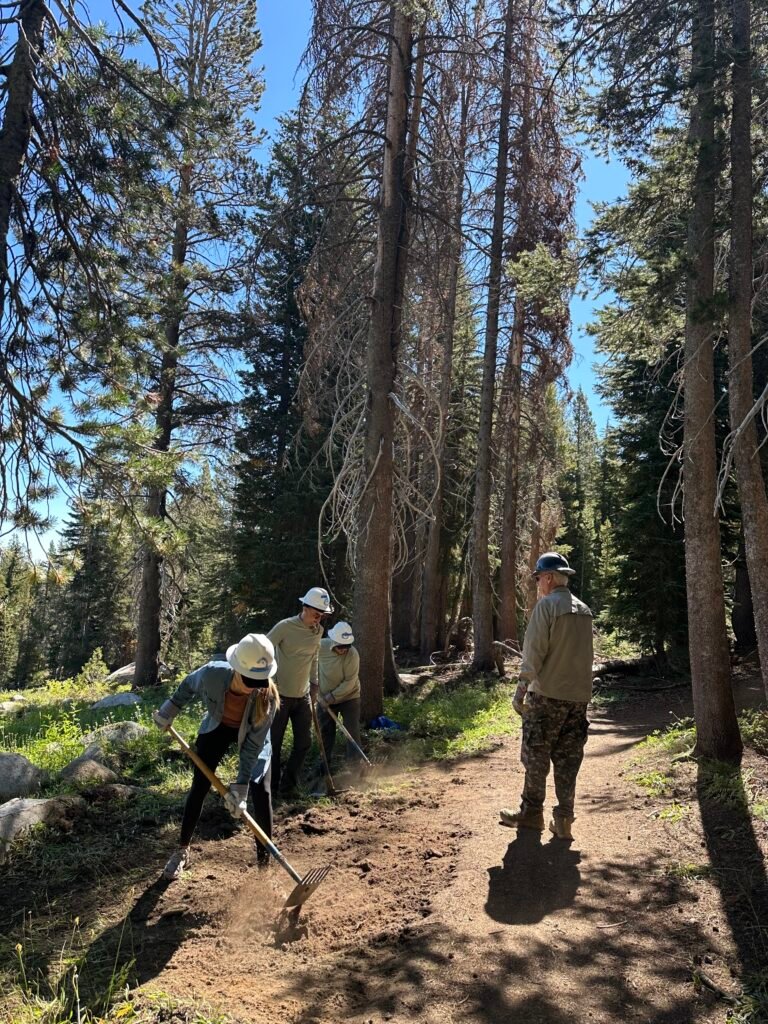
Trail stewardship is the ongoing work of keeping trails functional, safe, and accessible. It’s not glamorous in the least. It’s clearing blowdowns after a storm, or reinforcing eroding switchbacks, and rebuilding water drainage so a trail doesn’t wash out after the next heavy rain. Historically, this work has been the job of the Forest Service and land management agencies. Actual professionals with equipment, training, and budgets but as those resources shrink, a gaps opened. And increasingly, volunteers are the ones being asked to step into it.
In 2025, National Trails Day saw a 56% increase in volunteer participation compared to the year before.
On that single day alone, more than 6,000 dedicated stewardship volunteers improved 758 miles of trail — roughly the driving distance from New York City to Chicago. They cleared, restored, and maintained by simply deciding to show up.
Throughout the year, more than 67,000 individuals showed up across 943 registered events throughout the United States.
Why are people volunteering in record numbers? Partly awareness as the public lands funding crisis has generated more mainstream attention than at any point in recent memory. But there’s something deeper happening too, particularly among athletes. When you train on trails regularly, you develop a relationship with the terrain that goes beyond recreation. It becomes a part of who you are and when you notice a section eroding, you want to give back. That intimacy breeds a sense of responsibility that’s hard to explain to someone who only hikes occasionally — and it’s driving a cultural shift in who shows up and why.
Grewe sees it too — and AllTrails is moving to meet the moment. “This April, we launched the Better Trails Club in partnership with REI across six U.S. cities,” he said. “Every event has been at capacity, with hundreds of volunteers getting outside to pick up trash, remove invasive species, and meet other members of their community.” The demand, he says, is essentially unlimited. The constraint isn’t motivation — it’s organized opportunity.
The AllTrails Stewards Fund, launched in 2025, is another part of that response. It distributed $170,000 to 24 grassroots organizations in its first year, funding projects ranging from bridge construction and erosion repair to invasive species removal and trail reroutes — from the Appalachian Trail Conservancy in Pennsylvania to the Te Araroa Trust in New Zealand. Applications for this year’s fund open in May, with awardees announced in the fall.
These numbers are meaningful in the fact they show a lot of people care. But they’re also humbling when you put them against what’s what’s being lost.
A Big Math Problem
The United States Forest Service manages approximately 158,000 miles of trails, more than any other entity in the world. Maintaining that system at even a basic level of safety and accessibility requires sustained, professional attention.
Water drainage infrastructure, and all the other unsexy, invisible work that keeps a trail from turning into a creek requires ongoing maintenance that volunteers can’t realistically replicate at scale.
Before the current cuts, the Forest Service was already running a deferred maintenance backlog estimated in the billions. The agency’s own research had documented the relationship between trail investment and recreational economy: outdoor recreation contributed $696.7 billion in value added to U.S. GDP in 2024. Trails are not an amenity. They’re infrastructure.
A 64% cut to trail maintenance funding doesn’t reduce the trail network by 64%. It accelerates the deterioration of what already exists. Think of it like your house. If you do nothing over X years, you’re bound to run into issues that compound.
Trails don’t stay at their current condition and wait — they degrade. Erosion expands and closures accumulate. What gets deferred this year becomes a major restoration project in three years, and a permanent closure in ten. It’s just how our government always works.
The endurance athlete community knows this firsthand. Race directors are already navigating a landscape where permits are harder to obtain, trail conditions are less predictable, and the institutional knowledge needed to maintain historic routes is quietly walking out the door as career Forest Service employees retire or resign rather than relocate their families on short notice.
Grewe is candid about the gap. “Volunteers are a crucial part of stewardship,” he said, “but companies and public entities also play a vital role in supporting thriving trails.”
The volunteer model, however energized, isn’t a structural replacement for federal investment — and AllTrails isn’t pretending otherwise.
What AllTrails Is Actually Doing About It
It would be easy to write a piece that frames the volunteer surge as the solution.
It isn’t.
But it’s also not nothing and AllTrails is making a considered bet on both sides of the equation.
On the funding side: in 2025, AllTrails donated nearly $1 million to 75 organizations through its 1% for the Planet commitment. The Stewards Fund represents the company’s first direct grant program specifically for grassroots trail organizations, and Grewe made clear it’s designed to grow. “Direct funding paired with better data and insights — that’s how we think about our role going forward, and we’re committed to growing both,” he said.
On the data side: AllTrails’ Public Lands Program gives more than 800 land management partners free access to visitor insights and real-time tools that help them make smarter decisions about where resources are needed most. Organizations like Friends of the Bridger-Teton are using those tools to organize volunteers, audit trail routes, and ensure visitors have accurate conditions information — even when staff capacity is stretched thin.
“That kind of community-driven stewardship makes me optimistic about what’s ahead,” Grewe said. “AllTrails’ role is to make sure those efforts reach as many people as possible, and to keep putting our resources behind the organizations doing the work on the ground.”
What grassroots stewardship cannot do, however, is replace the scientific infrastructure that allows land managers to make informed decisions about forest health, wildfire risk, and watershed management. It cannot staff the ranger districts that process permits, respond to emergencies, and coordinate search and rescue. It cannot rebuild the institutional knowledge that takes decades to develop and weeks to lose.
This is the honest tension at the center of the trail volunteer surge. The athletes showing up are doing something genuinely valuable and they’re doing it in a context where what’s genuinely valuable is also genuinely insufficient.
The Athlete is a Stakeholder
There’s a version of the endurance sports community that treats trails as a given. An amenity that exists, that you use, and that you trust someone else to maintain. That version is running out of fuel.
The athletes who are most embedded in this moment tend to think about it differently. Their trails are not a backdrop for their training. They’re an ecosystem they belong to. And belonging to something means taking some responsibility for it.
For our readers; anyone who is a runner, cyclist, or endurance and perfromance athlete — the practical question isn’t abstract: what happens to your routes when federal maintenance disappears and volunteer capacity isn’t growing fast enough to compensate?
Some of that answer is already visible. They close. Just go to AllTrails and look up what’s already closed or been rerouted.
This isn’t coming. It’s here.
What You Can Actually Do
The gap between what’s needed and what volunteerism can provide is real. But the gap between what the endurance community currently contributes to trail stewardship and what it’s capable of contributing is also real — and that’s the more actionable number.
We asked Grewe directly: for athletes planning big objectives on public land in 2026 and beyond, what’s your honest advice?
“Go informed and be prepared,” he said. “Our Public Lands Program partners are sharing real-time alerts and conditions directly on AllTrails, so the information you’re seeing comes straight from the people and community on the ground. Check conditions close to your trip, plan accordingly, and stay flexible with your route. Being as prepared as possible removes strain on park staff and land managers who are already doing more with less. And when you’re out there, pay attention and pack out what you bring in. Leave No Trace principles apply to every single trailgoer, whether you’re a first-timer or a seasoned athlete.”
That’s practical advice that applies whether you’re running a local singletrack loop or attempting something like the Rim to Rim to Rim. Show up prepared. Take nothing. Leave the trail better — or at minimum, no worse than you found it.
Beyond the trailhead, here’s where to direct your energy:
Find your trails’ maintainer.
Most trails on national forest land have a managing organization or a volunteer steward group. Trailforks, AllTrails, and local trail coalitions are good starting points. If your training ground doesn’t have an active steward group, that’s information worth acting on.
National Trails Day is June 7, 2026. The American Hiking Society registers events across the country.
Last year’s 56% surge didn’t happen by accident — it happened because organizations promoted it, athletes showed up, and 758 miles got better in a single day. Find an event or organize one.
The AllTrails Stewards Fund opens applications in May 2026.
If you’re affiliated with or aware of a grassroots trail organization doing meaningful restoration work, this is a direct funding pathway worth exploring.
Follow the policy, not just the trail. Organizations like Protect Our Winters and the American Hiking Society are doing active advocacy work on public lands funding. That kind of engagement isn’t separate from being an endurance athlete. It is part of being an endurance athlete.
We All Should Care … A Lot
The 56% volunteer surge is real, and it matters. But it’s not the headline. The headline is that the infrastructure that made American trail running, mountain biking, and that backcountry lifestyle what it is today is under pressure that volunteerism alone cannot absorb.
I’ll be thinking about all of this when we drop into the Grand Canyon this fall — grateful for every maintained switchback, every intact bridge, every route that someone fought to keep open.
And we’ll document it all along the way.
Those things don’t happen automatically and they’re constantly in flux of closing. They happen because communities organize around them, because companies put money behind the work, and because athletes decide that the trails they love are worth showing up for.
Pitt Grewe put it simply when we asked what he’d say to someone who assumes the trails they train on will just always be there: “The trails people love are the result of ongoing, collective investment, and record numbers of people outside mean record potential for stewardship. The trails exist because communities organize around them, because nonprofits fight for them, and because land managers show up day after day with real dedication. I’d invite anyone who trains on the trails to find ways to take care of them.”
And with that, consider this your invitation to show up.
For this feature story, Front Pack Media spoke with Pitt Grewe, Head of Social and Environmental Impact at AllTrails, for this story. The volunteer participation data, Stewards Fund figures, and public lands partnership statistics referenced throughout this story were drawn from the AllTrails 2025 Impact Report. Additional sources were pulled from the U.S. Forest Service Trail Program Status Report; Outdoor Industry Association; American Hiking Society; Outdoor Alliance; CNBC and a few other Google searches.
Leave a Reply
You must be logged in to post a comment.