

Growing up in New Jersey, I knew exactly what creatine was. It was what the guys at the gym were pounding before they headed to the Jersey Shore.
Big tubs and big scoops made big muscles. Add in the gallon of water jug in one hand and an Escalade and you were MTV.
That was the whole identity of the supplement. If you were taking creatine, you were trying to get jacked, and it was probably just in time for summer too.
That image followed creatine around for a long time. And it did the supplement no favors.
Because while the meatheads were busy slamming it in gyms, the researchers were busy quietly building one of the most consistent bodies of evidence in all of sports science.
The conclusion they kept arriving at wasn’t “creatine makes you big.” It was something more interesting than that.
Creatine is one of the most important supplements you can take — full stop. Not just for strength. Not just for size. For performance, for your brain, and for the long game of staying athletic deep into your life.
The meatheads weren’t wrong. They were just early. And they were only seeing part of the picture.
What’s Actually Changed
The conversation around creatine has shifted hard in the last fifteen years.
It’s moved out of the weight room and into everything from endurance, to cognitive performance, women’s health and hormonal cycles, and aging and longevity.
A 2025 paper in Frontiers in Nutrition, co-authored by researchers at Texas A&M, Mayo Clinic, and the University of Wisconsin, made the case plainly: creatine supplementation is safe, beneficial across the entire lifespan, and should not be restricted to any population group.
That’s a big statement. And it’s backed by decades of data.
The supplement that got tangled up in the steroid era of baseball, when disgraced players used creatine as cover for actual PED use has now been cleared, re-examined, and validated by some of the most rigorous research in nutrition science.
So if you’re still on the fence because of something you heard in 2003, it’s time to update the file.
Creatine 101
Creatine is not a foreign compound. Your body makes it from three amino acids in your liver, kidneys, and pancreas. About 95% of it lives in your skeletal muscle as phosphocreatine.
You also get it from food. Red meat. Seafood. But even a solid omnivore diet only delivers about 1–2 grams per day. Your muscles are running at roughly 60–80% of their creatine capacity at baseline.
Supplementation closes that gap and research shows it raises stored creatine levels by 20–40%.
It’s real and meaningful. We can’t all crush macros all day so the downstream effects of that extra buffer touch more systems in your body than most people realize.
The Engine
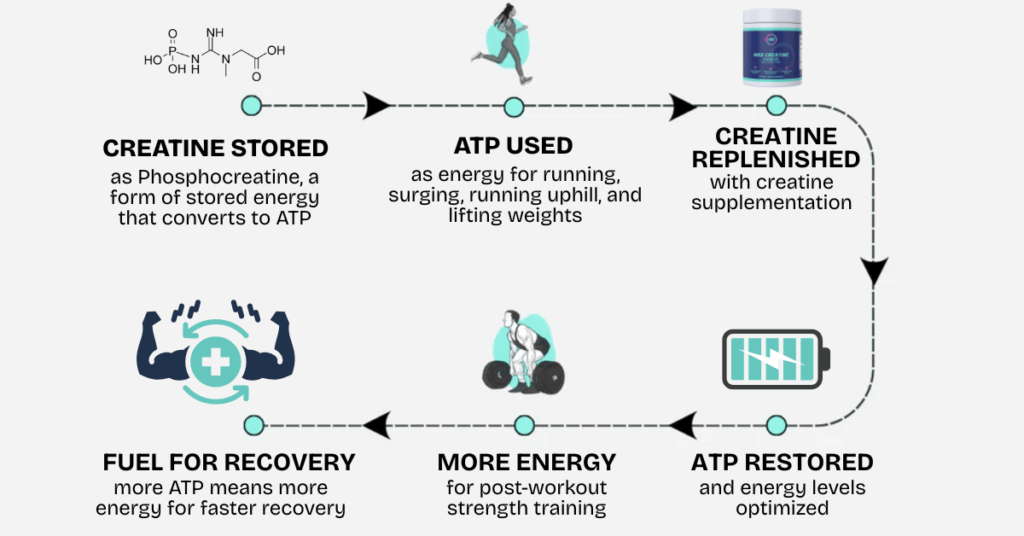
When you go hard at the gym or during that long run or cycling interval, your body burns through ATP (adenosine triphosphate, your body’s primary energy currency) almost instantly and the fastest path to rebuild it runs through phosphocreatine.
Stick with me. The more creatine stored means more phosphocreatine on deck, which means ATP gets rebuilt faster, which means you hold intensity longer before the wheels start to come off.
For endurance athletes especially, creatine use plays out in the efforts that actually decide races or how our race day is going to go.
Creatine doesn’t make you aerobically fitter.
What it does is extend how long you can sustain high-intensity output before your energy systems buckle.
I’m not going to dive into a bunch of examples but you know what I’m talking about. Creatine comes through when your legs are already cooked and you’re asking them for more.
Creatine also accelerates phosphocreatine resynthesis between efforts, meaning your recovery between hard bouts is faster, so you can go again sooner and harder (that’s what she said).
It’s not some rounding error but over the course of a marathon, Ultra, or Ironman block, that is a huge boost.
A 2025 meta-analysis published in PeerJ confirmed what smart coaches have been saying for years. “Creatine supplementation significantly elevates intramuscular creatine content and meaningfully improves strength and exercise performance. Not in a marginal way. Meaningfully.”
Let’s Talk Gains
Strength and recovery. Combined with resistance training, creatine consistently outperforms training alone for strength gains and muscle size. It also supports glycogen storage in muscle, which accelerates recovery between hard efforts. This matters for anyone (all of us) doing back-to-back training days.
Your brain. Here’s the one that should get more attention. The brain is one of the most energy hungry organs you have and it runs on the same phosphocreatine system as your muscles. A 2024 systematic review in Frontiers in Nutrition had 16 randomized controlled trials with participants ages 20 to 76. It found creatine supplementation produced meaningful improvements in memory, attention speed, and information processing. A separate 2024 study in Scientific Reports found that a single high dose improved cognitive performance during sleep deprivation.
Aging. Sarcopenia or age-related muscle loss is one of the most under appreciated threats to long-term performance and independence. The same Frontiers in Nutrition study argued that you should start taking creatine before sarcopenia starts, in the same way you build bone density early to guard against osteoporosis. Creatine is a don’t wait until the problem exists later, but get ahead of it now.
Women are the Biggest Benefactors of Creatine

Not to bury the lead here but this part of the story doesn’t get told enough.
Most of the early creatine research used male subjects (because of course it did), the marketing followed and excluded a huge portion of the athletes who stand to benefit most.
Women.
And here’s what we know now: women have endogenous creatine stores that are roughly 70–80% lower than men’s.
Not shocking, they also consume less dietary creatine because overall caloric and protein intake tends to be lower. And that gap shows up in performance, recovery, long-term health, on and on.
And that gap grows even wider as women age.
A 2025 review in the Journal of the International Society of Sports Nutrition found that during the luteal phase when hormonal changes reduce carbohydrate availability and increase protein breakdown, adding creatine supplementation is an effective intervention to maintain cellular integrity and performance output.
For post-menopausal women, the case gets even more direct.
As estrogen declines, so does its protective effect on muscle and bone. Research confirms that post-menopausal women who supplement with creatine alongside resistance training gain significantly more strength and muscle mass than those training without it.
For people like my wife, she still believes its just for meatheads and I gotta get her to change that mindset. Creatine is not a men’s supplement with a women’s footnote. For a lot of women, the data suggests it matters more.
How Much to Take
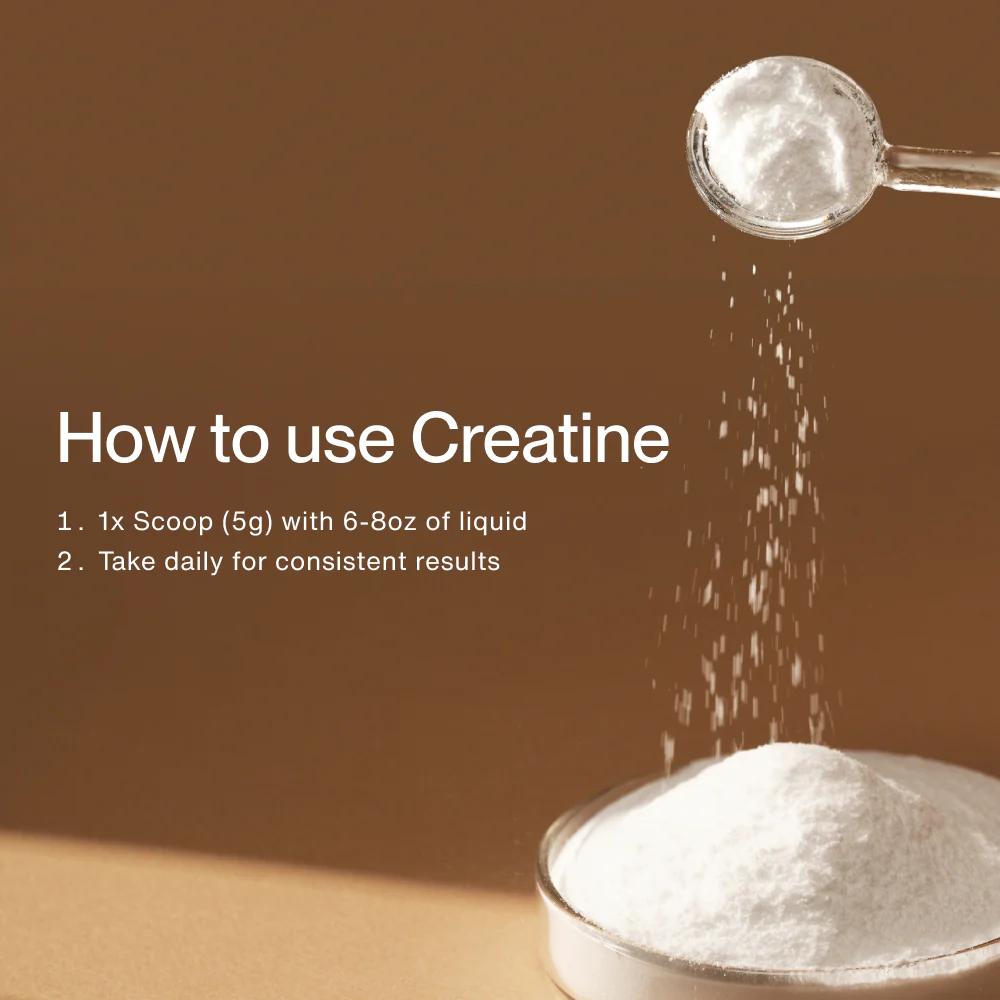
That’s always the question and answer is to keep it simple. The standard dose is around 3–5 grams of creatine monohydrate per day.
Just an FYI. That scooper that comes with your creatine. It is usually 5 grams. They kinda want you using more so you buy more.
But that’s it. That’s the range across the majority of clinical trials. Harvard Health lands here. Mayo Clinic lands here.
For a 180 lb male athlete: 5 grams per day. Some larger athletes should go up to 8 grams, but 5 covers the vast majority of people well. If you’re in a loading phase, you might do 20 grams per day for 5–7 days to saturate your muscles faster but overall, it offers no long-term advantage over steady daily dosing. But you might just get GI discomfort, which is always fun!
For a 135 lb female athlete: 3–6 grams per day. Skip the loading phase. Take it every day like a multivitamin and let it build over 3–4 weeks.
As always, buy from a reputable company, not Amazon. And you want Creatine monohydrate. Not creatine HCl. Look for a Creapure certification or NSF Certified for Sport labeling so you don’t get caught up in any weird gray areas.
The Honest Drawbacks
Water retention, early on but it’s not something we notice.
In our 20’s when we were trying to get big, sure, but not so much now when the main goal isn’t muscle growth. But when you start, your muscles pull in water. The scale may tick up 1–3 lbs in the first week. This is your muscles hydrating — it’s actually a sign it’s working. It resolves.
GI discomfort at high doses. So just follow what we said above. Nobody wants you having bubble guts and farting all around the joint. Take it with food and avoid loading if your gut is sensitive.
The kidney myth — put it to rest. Creatine use raises creatinine levels in blood tests. Creatinine is a marker used to assess kidney function, which is where the confusion started decades ago. But elevated creatinine in a creatine user reflects normal metabolic turnover and not kidney damage. Research consistently shows no adverse renal effects in healthy people at standard doses. If you have pre-existing kidney disease, talk to your doctor. That’s a real conversation to have. Otherwise, this is not the reason to skip it.
Non-responders are real. Roughly 25–30% of people don’t see significant benefit. This is more common in people who already eat a lot of red meat and have naturally higher baseline creatine stores. If you’ve been consistent for 4–6 weeks and noticed nothing, you may be in this group.
Why This Supplement Keeps Getting Slept On
The steroid era did real damage to creatine’s reputation but it’s coming back. A lot of people talk about it openly and they should. Creatine got lumped in with the PED generation and it had nothing to do with.
It is not an anabolic steroid. It doesn’t manipulate your hormones. It doesn’t have the same chemical structure or mechanism. It’s permitted by the International Olympic Committee and the NCAA.
Our Bottom Line
Yes, I’m just a guy who used to watch the Jersey Shore bros chug their pre-workout and get their GTL on.
And it took years of actually reading the science and growing up to realize I had the whole thing backwards.
Creatine is not a bodybuilding supplement that endurance and performance athletes happen to use.
It’s a foundational performance and health tool that bodybuilders got to first. The evidence for it — across strength, cognitive function, aging, and women’s health is about as clean as sports science gets.
So this is the move. Get some. Take 5 grams of creatine monohydrate daily, and enjoy the benefits.
Because after all this time, the meatheads we’re right.
Leave a Reply
You must be logged in to post a comment.