

Be honest with yourself for a second.
You’ve got a training plan. It’s got your long bike ride on Saturday, your threshold run on Wednesday, your easy miles on Friday. It’s structured. It makes sense. And somewhere in there, is a strength day.
Maybe you skip it or put in a half assed effort.
Not because you’re lazy. None of us are lazy. But because it feels optional or you don’t want to get hurt or “big”. Strength has always just felt like a garnish.
And here’s the thing. That strength session isn’t optional anymore. The research has been landing on this conclusion for years and it keeps getting clearer: endurance athletes who lift get faster, stay healthier, and hold form deeper into races than those who don’t.

Not because lifting makes you a different kind of athlete. It makes you a better version of the athlete you already are.
And the data and coaching shows, you should be lifting not one day, but two days a week.
Let’s get into what that actually looks like.
Improve Your “Economy.” Improve Your Performance
Before we talk sets and reps, you need to understand what strength training is actually changing because it’s not a VO2 max thing and it’s not your muscle size. It’s your running or cycling economy.
Economy is the energy cost of moving at a given speed or watts. At any given pace, an athlete with better economy is burning less fuel to hold that effort. That means they either go faster for the same energy output, or they last longer at the same pace.
Elite endurance athletes are elite partly because of massive aerobic engines they’ve built over years, but they’re also running at a cost 10–15% lower than recreational athletes at the same speed.
Strength training improves economy by stiffening the tendons, improving neuromuscular firing patterns, and increasing force production per stride.
The Norwegians know and it’s why they’re so elite at endurance sports. A review by Rønnestad and Mujika published in the Scandinavian Journal of Medicine & Science in Sports found that running economy is improved by combining endurance training with either heavy or explosive strength training, and that heavy strength training is specifically recommended for improving cycling economy.
This is one of the most cited bodies of work in concurrent training science, and the findings have been replicated consistently since.
More recently, a 2025 umbrella review synthesizing multiple meta-analyses confirmed that strength training enhances key endurance determinants including economy, lactate threshold, and maximal aerobic speed. Importantly, those benefits are not limited to elite athletes — recreational runners also demonstrate meaningful performance improvements across different strength qualities and intensities.
The History of Strength and “Interference”
The reason most endurance athletes avoid the weight room comes down to one study and one fear. It’s old science that people still quote.
In 1980, American physiologist Hickson found that doing endurance and strength training at the same time led to smaller strength gains than doing strength training alone. He called it the interference effect.
Coaches heard “interference” and applied it backwards: if strength interferes with endurance, maybe endurance athletes shouldn’t bother.
That’s not what the study said. But the damage was done, much like bad creatine reporting set back the wonder drug 10 years.
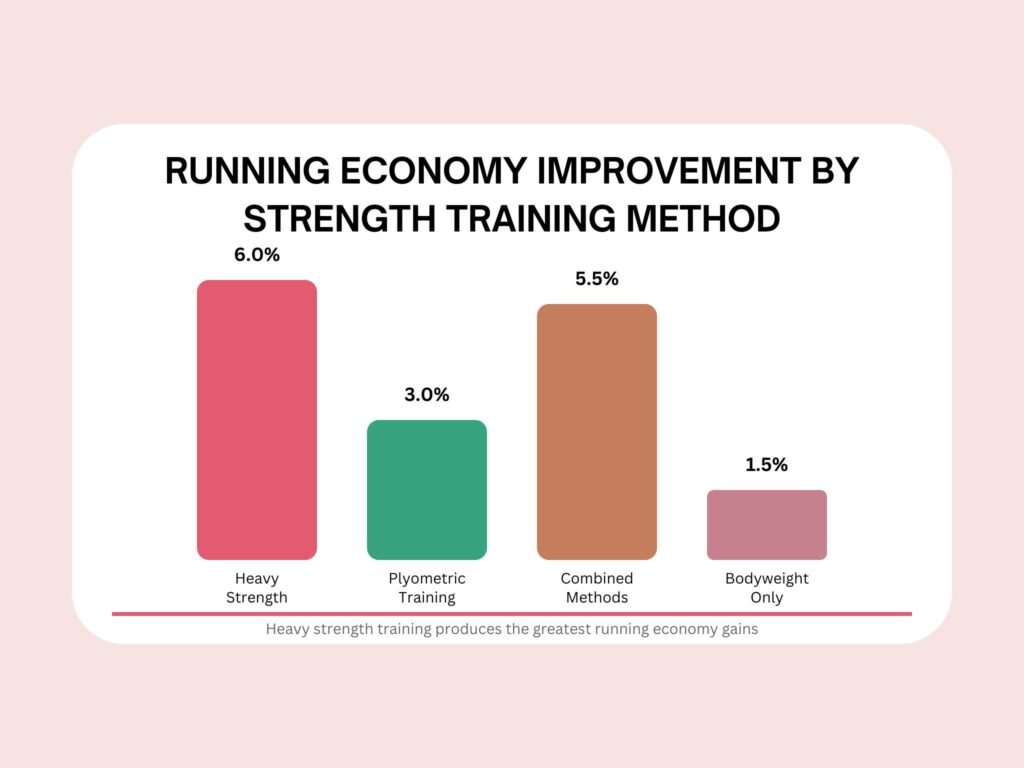
Here’s where the science has landed since: research suggests there is no significant interference effect for untrained subjects, nor is there any interference effect when trained subjects split their endurance and resistance training into separate training sessions.
In plain language, if you don’t do both workouts back-to-back in the same session, you’re largely fine. And even in the same session, a systematic review and meta-analysis covering 43 studies showed that regardless of aerobic training type, concurrent training frequency, training status, age, and training mode, concurrent training with different sequences did not interfere with skeletal muscle hypertrophy or maximum strength.
The practical rule: don’t do a hard strength session and a hard interval workout on the same day. If you have to combine them, lift first, then do easy endurance and give yourself at least 3 hours between sessions if possible. Research confirms that for strength adaptations, performing resistance before endurance is advantageous.
For endurance performance, sequence matters less as both orders showed improvement.
How Much Is Actually Enough
Here’s where the research gives us a very clean answer, which is rare and appreciated.
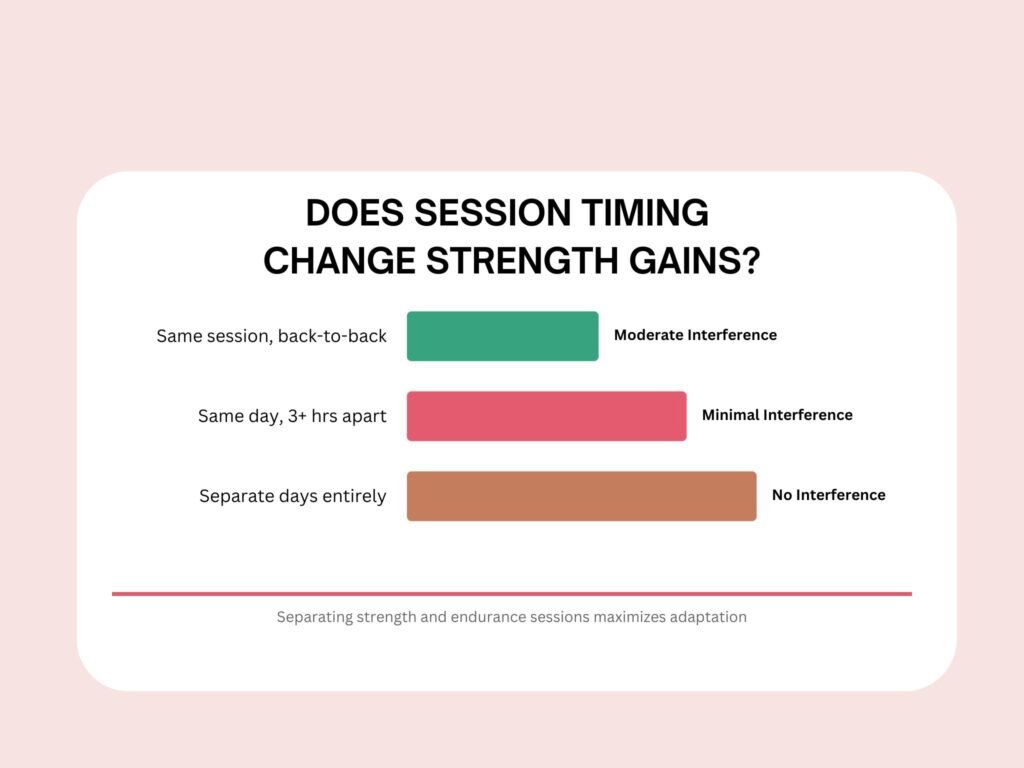
Two sessions per week.
That’s the number that appears consistently across the best concurrent training studies. In the studies reviewed, training frequency for both modalities was usually moderate; two to four sessions per week each.
High volumes of endurance work, especially when combined with frequent lifting, increased the risk of interference.
Norwegian research on female endurance athletes showed that adding just two heavy strength sessions per week for 11 weeks, on top of existing endurance training averaging 5 hours per week, produced significant improvements in maximal strength and running performance.
These weren’t recreational joggers either. They were well-trained endurance athletes who had done zero structured strength work in the preceding 12 months.
Two days. Two well-executed sessions per week, for 8–12 weeks, will produce a measurable change in how efficiently you move. That’s the minimum effective dose and it’s also close to the optimal dose for an athlete whose primary sport is endurance.
We asked Harold Wilson, one of the best Endurance & Strength Coaches, M.Ed. Exercise Science at Brains & Brawn Coaching exactly how he structures it for age-group athletes.
“For AG athletes looking to maximize performance, it’s 2 heavy strength days per week, paired with dedicated mobility work — not mixed together in the same session. I split them out across the week so mobility gets its own day and strength gets their own, each with full focus. And yes, one day is still impactful. But the key is to lift heavy for fewer reps. High rep muscular endurance is not ideal for endurance athletes.”
That last line is worth writing down. High-rep, low-weight sets.
The thing most endurance athletes default to because it feels safer and more familiar is not the stimulus your nervous system needs. You’re not training muscular endurance in the gym. You already do that every time you run, ride, or swim. What you’re training is force production and that requires load.
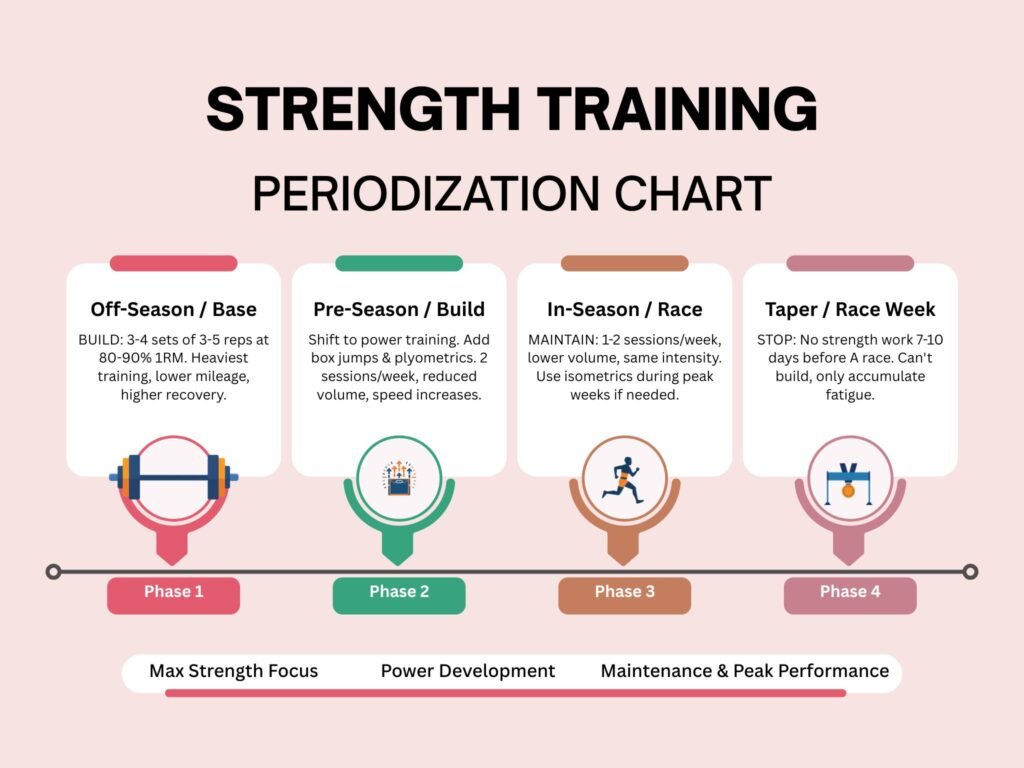
One important note on timing in the training year: the goal of strength training during peak racing season is maintenance, not building.
Reduce both volume and load during high-volume or intensity training weeks. You’re not trying to PR your squat in July. You’re trying to keep what you built in January; staying healthy, strong, and injury free.
What to Actually Do in the Gym
I’m not going to sit here and tell you squats, and sumo dead lifts. 3 sets of 8 reps. What we will say is this. Where most strength plans for endurance athletes fall apart are that they either get too complicated or too vague.
You should build out a specific program yourself or hire someone like Harold.
Please don’t use Chat-GPT.
The research is clear on what moves the needle: compound, multi-joint, heavy lifts. Multi-joint exercises like squats and deadlifts develop core strength and stability while mimicking everyday movement patterns. They’re more time efficient than isolated exercises; one multi-joint movement effectively trains multiple muscle groups simultaneously.
For endurance athletes, the goal is not hypertrophy. You’re not trying to add 15 lbs of muscle or a 36 inch bicep.
You’re training neuromuscular (NeuroM) efficiency, teaching your legs to produce more force per contraction so each stride or pedal stroke costs less. That means heavier loads, lower reps, and full recovery between sets. This is not circuit training and it is not a cardio substitute.
What Lifting Looks Like in Your Training Year
This is where most athletes either overdo it (heavy squats two weeks before their A race) or underdo it (skipping strength every time the mileage ticks up in February).
The research supports a simple periodization model that aligns strength load with endurance load, not against it.
To Recap
Two days a week. Forty-five minutes to 1 hour each. Do Heavy compound movements and it takes more than 6 weeks to feel it, more than 10 to really really feel it.
That’s the whole prescription. And the research backing it isn’t emerging or preliminary — it’s been stacking up since the early 2000s out of Norwegian sports science labs, replicated in runners, cyclists, triathletes, and masters athletes across the last two decades.
The athletes at the front of the pack are built different but they’re stronger because they took the “optional” strength session seriously before anyone told them they had to.
Get in the gym and lift something heavy.
Go home and repeat that twice a week until your race gets here. Your performance will thank you.
Leave a Reply
You must be logged in to post a comment.