


Nobody had ever finished Badwater 135 in under 21 hours.
Then on July 28, 2026, Max Jolliffe did it in 20:53:41, breaking the course record by 39 minutes and 20 seconds. A record that stood since 2019.
It was Max’s first Badwater finish, but let’s take a second to also congratulate Carmen Maria Perez who also broke the women’s record. One record is hard enough to shatter but the fact that two records were broken during the same race makes it damn cooler.
And look, we don’t do hype for hype’s sake because I feel like there is a bit of desensitization happening with just how hard these feats are.
So instead of just telling you it was fast, we pulled the COROS and Strava data from Max’s run and broke down what actually happened out there, mile-by-mile.
The Heat was Brutal
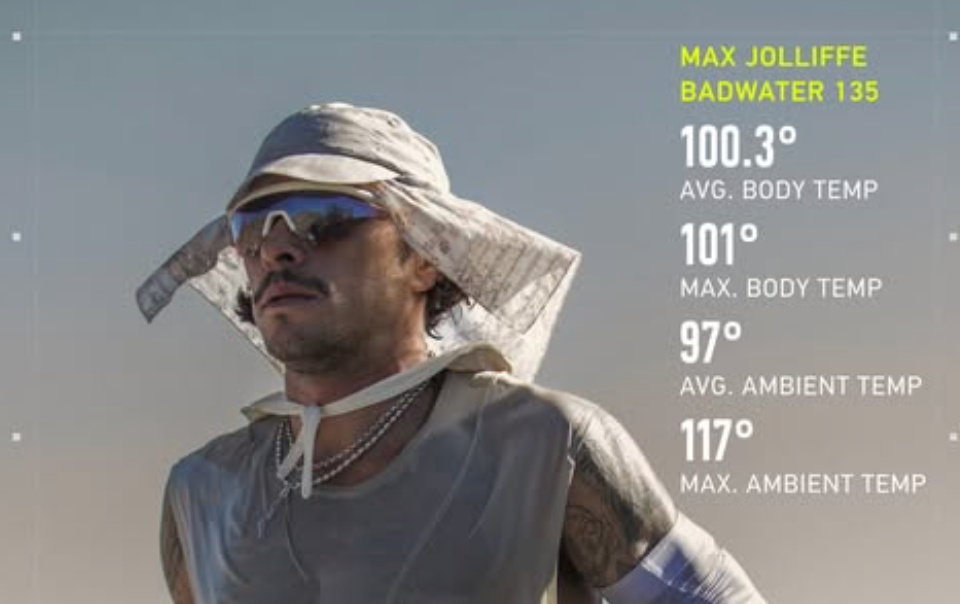
Badwater starts at Badwater Basin which is 282 feet below sea level, the lowest point in North America, with race-day temps well above 100°F and no real relief overnight. For the entire race, Jolliffe’s own body temp readings were as if he was running with a fever. According to COROS, they ran:
- Average body temp: 100.3°F
- Max body temp: 101°F
- Average ambient temp: 97°F
- Max ambient temp: 117°F
His Pacing was Steady
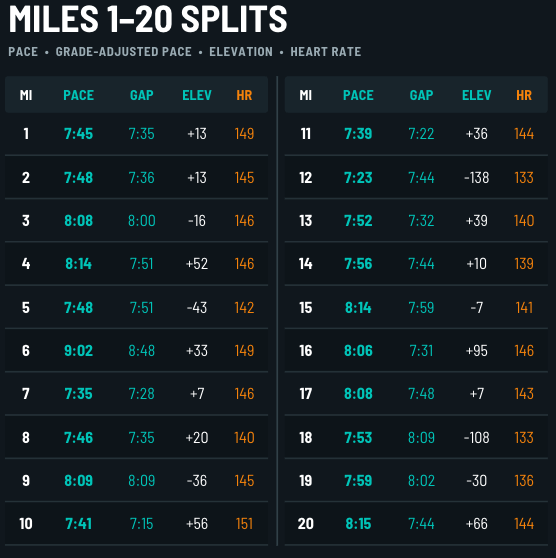
You’d naturally think he’d start off super fast but look at the above, nope.
Average pace for the full 135 miles: 9:18/mi.
Moving time may be even more impressive. Of the 20:53 total time, Max only stopped moving for a total of 8 minutes (20:45:18).
His fastest single mile was 7:16/mi, at mile 67 which was a descent off Townes Pass.
Overall, here’s a breakdown of what each 20-mile stretch looked like.
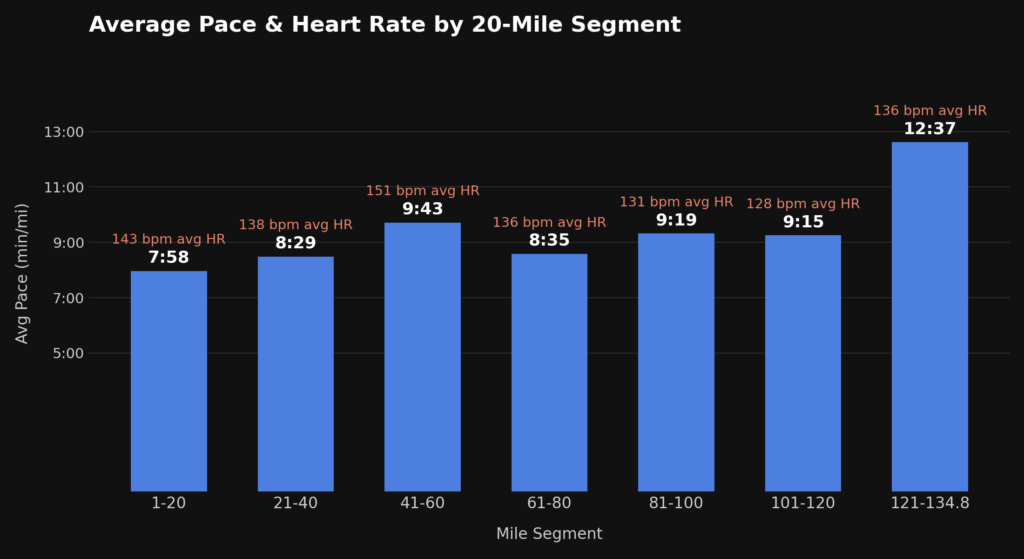
The above is a great breakdown and the thing we most took away from his performance was that he ran 99% of the race with a zone 1 pace. Can you imagine running 135 miles or nearly 21 hours in zone 1. Just banana land. For me, that would be torture enough, but add in the heat, etc. and that’s so impressive of a feat.
Heart Rate
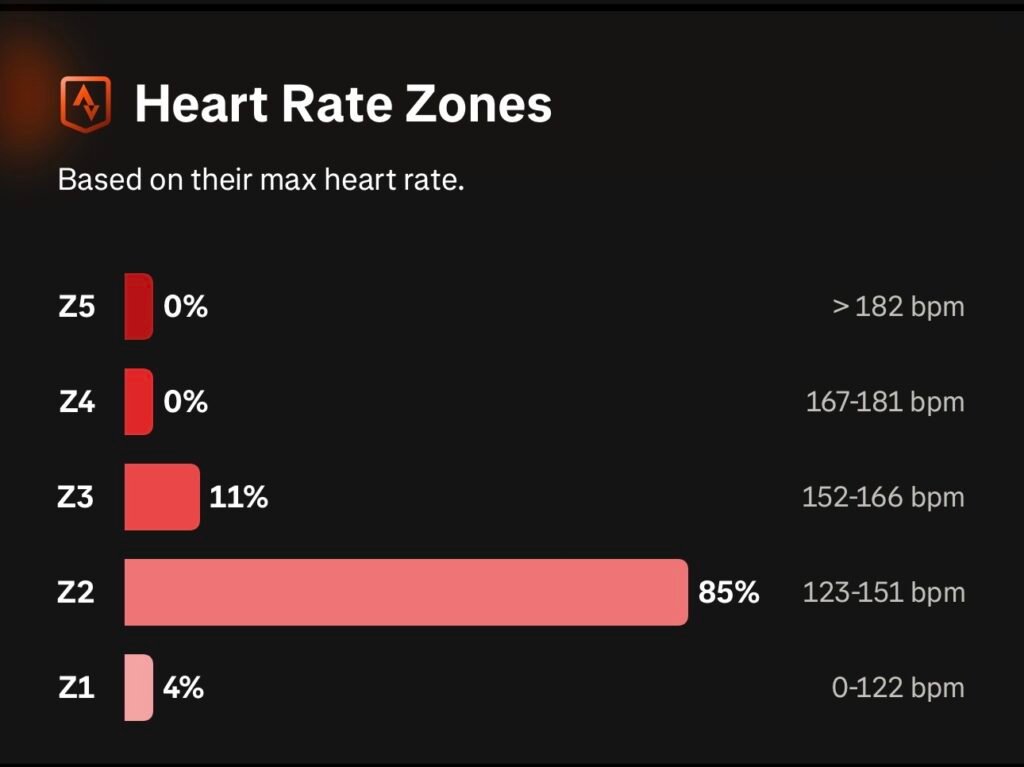
- Average HR: 138 bpm
- Max HR: 165 bpm
- 85% of the race spent in Zone 2 (123-151 bpm)
- 11% in Zone 3, 4% in Zone 1
Nearly 21 hours with a zone 2 heart rate. The temps probably explain why it wasn’t zone 1 but with an average heart rate of 138 and only 11% of the race above Zone 2 you’d probably be shocked that he won the race. Just purely controlled from start to finish with only two real spikes, one around mile 50-55 climbing toward Townes Pass, and then a second one around mile 75-80 on the second big climb.
Cadence
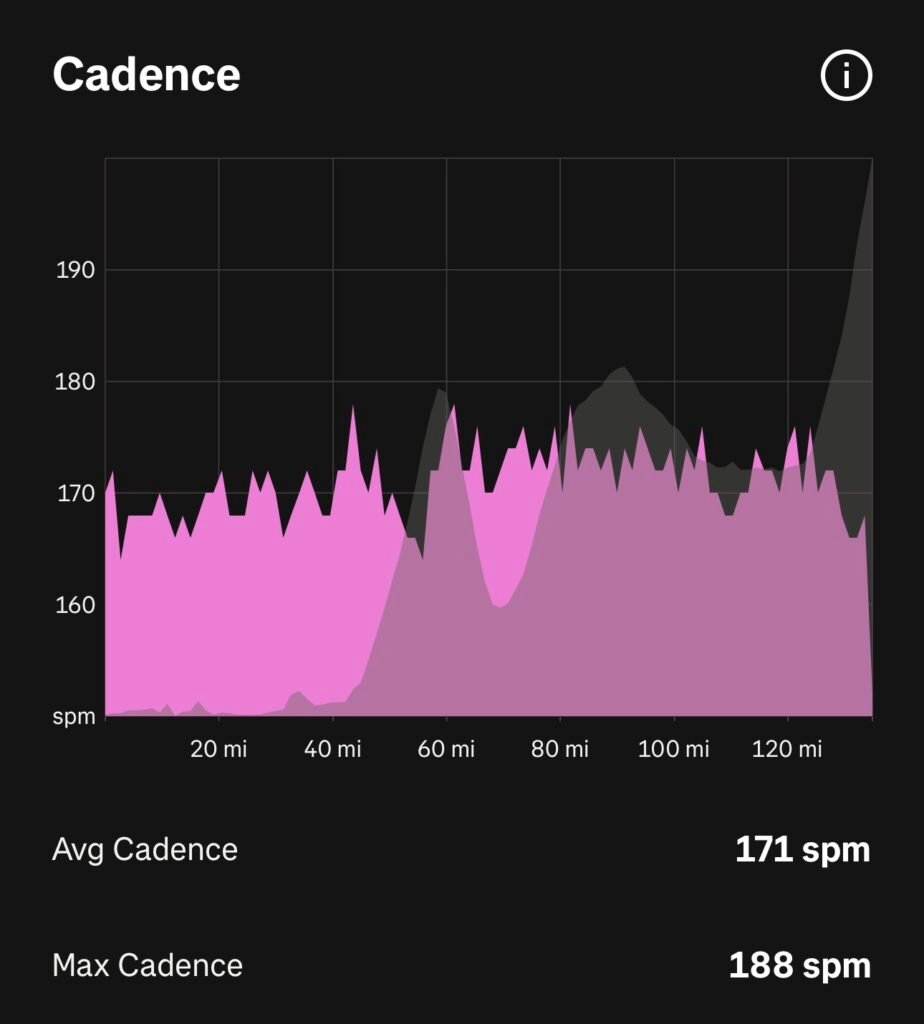
His average cadence was 171 spm highlighting he was doing it absolutely right. Nice short strides that were energy efficient, with the max being 188 spm. Most notably is that the number itself never really varried, as if he was just on a treadmill for 130+ miles. Most often you’ll see cadence dips when a runner’s form begins to fall apart late in an ultra or their body is saying no more. but his barely moves until the final Whitney Portal climb, when the incline itself forces the drop, not so much the fatigue in his stride.
Elevation Profile
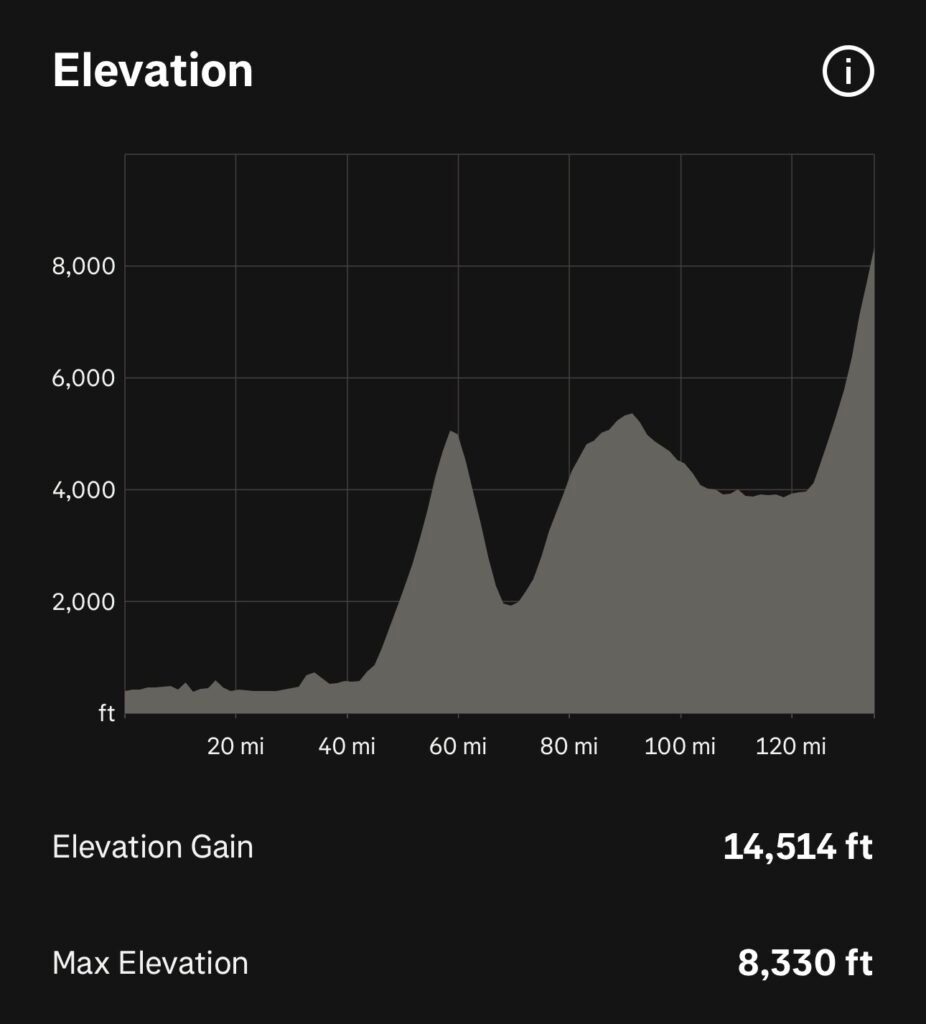
- Total elevation gain: 14,514 ft
- Max elevation: 8,330 ft (the Whitney Portal finish)
The course runs almost flat for the first 40+ miles and then throws three real climbs at athletes. You get Townes Pass around mile 55-60 which goes up to roughly 5,000 ft, then a second climb into the 80s and 90s topping out over 5,300 ft, and then the final climb from around 4,000 ft to 8,330 ft in the last 13-14 miles. Back to pacing, that is exactly where his splits go from a 9-minute pace to a 15-minute pace.
Data is Fun
For all these upper elite finishes, we just love dissecting the numbers and seeing how crazy of a feat this stuff is. Yes, to see a total time, or total moving time paints a picture but when you break down the paces and compare them to what your or I can do; that’s when it becomes most impressive.
And we’re not Jolliffe Stans, or slurping over him. We’re just truly impressed with the feat. He ran for nearly 21 hours in the blazing hot sun, with a body temperature two degrees hotter than normal, with a controlled heart rate, held form, pace, and cadence for 130+ miles.
We just wonder if he remembers most of it.
Leave a Reply
You must be logged in to post a comment.