


ASICS says it wants to be “The Essential Partner to Move Body and Mind.”
I say that’s a big job title for a company many think of as a shoe brand.
Here’s the short version of what ASICS announced as Vision 2035.
The company has been guided since 1949 by the motto “Anima Sana In Corpore Sano,” a healthy mind in a healthy body, and it says the new vision builds on that.
ASICS says its own research found people already spend 86% of their waking hours inactive, and that as technology and automation take over more of daily life, choosing to move will matter even more by 2035.
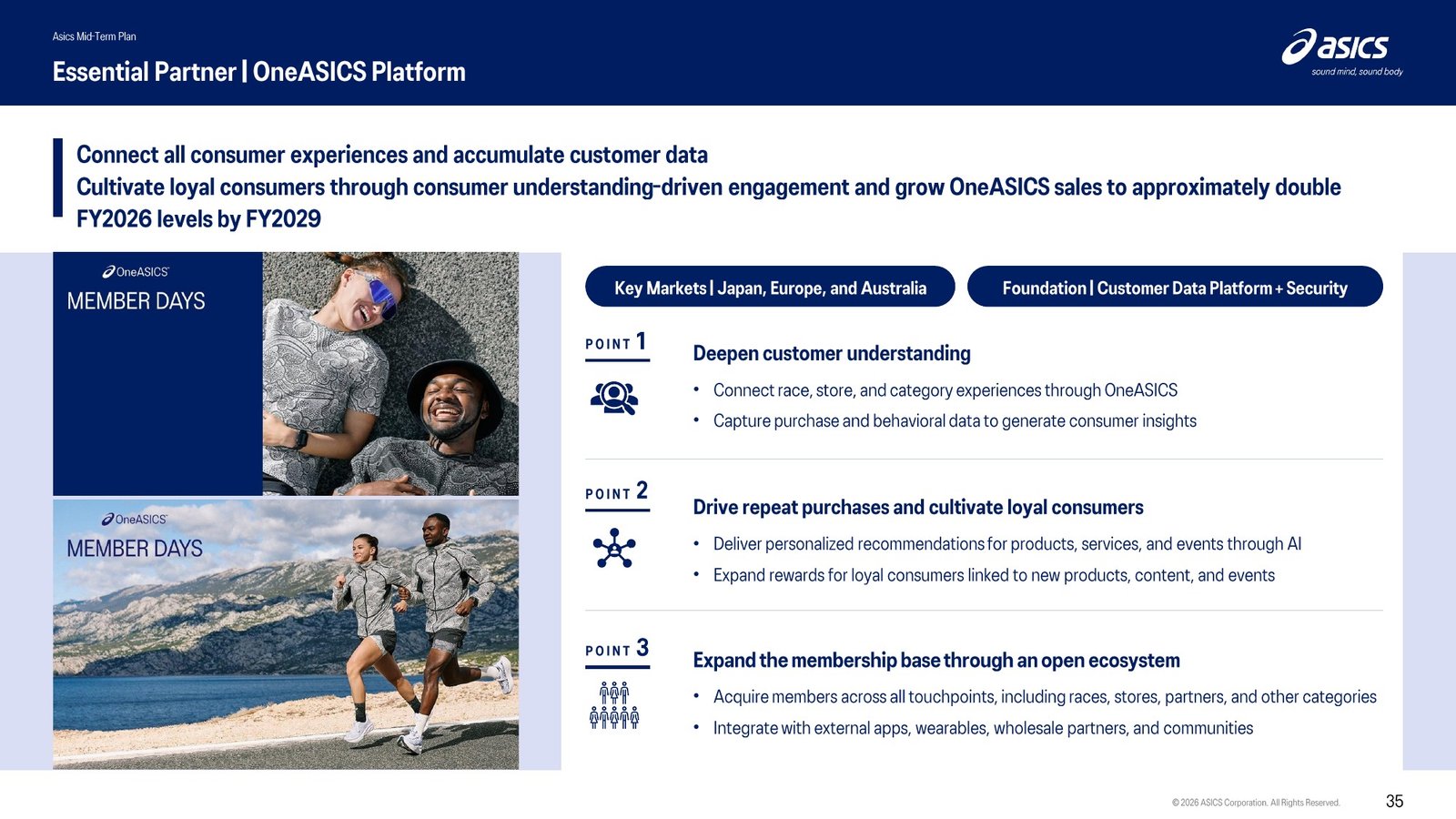
At the center is something called the OneASICS Platform, which ASICS says will understand your goals, interests and lifestyle and connect you with personalized recommendations, training programs, events and communities.
That’s the whole announcement and I’m still a bit confused. I read it twice looking for a launch date, a product name, a price, a user count or a financial target for the platform. There isn’t one. Not a single number about the thing at the center of the vision.
So I went digging even more.
About that 86%

I like that ASICS is making a case for movement. I’m not going to argue with “move more.”
But the number is worth a closer look.
The 86% comes from ASICS’s own State of Mind survey of 34,000 people in 31 countries, and it’s self-reported, assuming a 16-hour waking day. Roughly 14 of those 16 hours, people say they’re not moving. It’s a conversation starter, not a lab measurement.
The Platform Already Half Exists?
Here’s the part the press release doesn’t get into. ASICS has been building this for a decade. It bought Runkeeper’s parent company back in 2016, when the app had more than 33 million registered users. It bought the race registration company Race Roster in 2019. And if you’ve ever created a free Runkeeper account, you became a OneASICS member automatically. That’s the membership program with offers, free shipping and 90-day returns on ASICS products, and a trial of Runkeeper’s paid training plans.
So is the OneASICS Platform new?
Mostly it’s the existing membership program plus a customer data system, with AI recommendations promised on top. ASICS itself says OneASICS “will evolve” into an intelligent, connected platform. That’s an upgrade plan, not a launch.
The numbers are in a separate document. ASICS calls its new Mid-Term Plan 2029 “the first step” toward Vision 2035, and that plan runs close to 70 pages. What’s in there is more interesting than the press release:
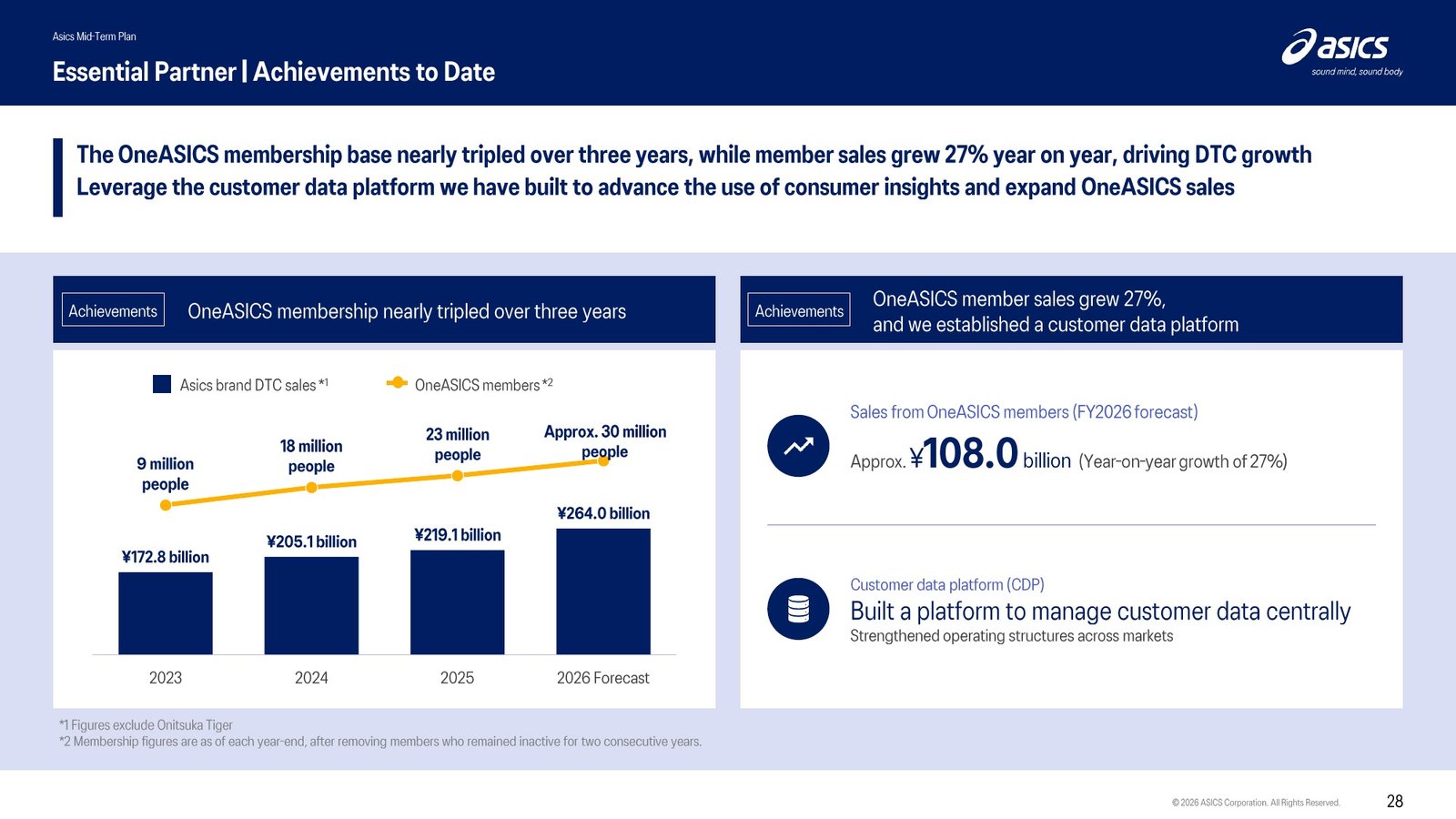
- OneASICS membership grew from about 9 million people to a forecast of roughly 30 million by the end of this year, and ASICS says it counts only members who haven’t been inactive for two straight years.
- Members are expected to spend about $680 million with ASICS this year, up 27%. The plan’s goal is to grow those OneASICS sales to roughly double that by 2029.
- ASICS says it runs the world’s largest race registration platform, with 15 million race entries last year across its four registration businesses.
- At one big European marathon this spring, ASICS says more than 39,000 OneASICS members opted in, about 12,000 new members signed up through race entries, and race-related sales hit US$1.18 million.
That last one is the whole play.
You register for a race, ASICS gets you in the system, and then it follows you through the expo, the merch table and the finish line. ASICS even lists a running app, an “AI race concierge” and race photography as part of that package.
What a Runner Would Get
ASICS’s Vision 2035 site shows some examples of where it wants to go, and they’re fun. In one, a serious runner gets a flat race course and a training plan built around a sub-three-hour marathon. Two weeks out, the system notices a steady heart rate and tired hamstrings and suggests stretching. After the finish it says, and I’m quoting, “please stop by the ASICS booth for some special recovery care!”
That booth line is the most honest thing in the whole vision. It tells me what this is built for.
The plan’s own targets back it up. ASICS wants sales to climb from about $6.6 billion to about $9.4 billion by 2029, roughly 40% more. It wants OneASICS sales to roughly double. For profit, the plan promises “industry-leading profitability” instead of a number. And I couldn’t find a single target about how runners actually do, like more people finishing races, fewer injuries or faster PRs.
The goal is sales, and the platform is how ASICS plans to get there.
That’s not evil. A shoe company’s job is to sell shoes. But “essential partner to move body and mind” and doubling member sales are not the same sentence, and I’d rather you notice that than find out later.
The stock tells a similar story. ASICS shares fell about 14% the day the company posted earnings and released the plan. Reports tied it mostly to earnings landing short of what analysts expected, with investors also picking at the new plan. I’m not a stock picker, but it tells me the market wants proof more than poetry.
Can it take on Strava, Garmin and Runna?
Not yet, and the gap is bigger than the slogan.
Strava says it has more than 195 million athletes, and it owns Runna, the training-plan app. Garmin already owns the watch on a lot of runners’ wrists and the training data coming off it. ASICS has Runkeeper and a membership base of around 30 million, which is real, but it’s a fraction of Strava’s reach. The plan also talks about integrating with “external apps, wearables” rather than owning them, which, in my read, means ASICS expects to borrow my data, not generate it. And when I searched the plan for Runkeeper by name, I didn’t find it, so I can’t tell you what ASICS wants its own app to become.
The same day Nike told investors about its Full Stride Ahead plan, which I broke down here, ASICS told me about this. Nike’s plan is about where it points its energy. ASICS’s is about who owns the relationship with the runner after the shoe leaves the box. Every shoe brand wants to be a platform now, and I get why. Shoes last a few hundred miles. A relationship can last years.
Where ASICS Gets It
I don’t want to be only the guy who rolls his eyes, because ASICS has something real. Most brands would love to own the moment a runner registers for a race. ASICS actually owns that moment, at scale, and it has already shown it can turn it into members and sales at big marathons. ASICS’s own investor numbers show the membership base grew a lot. That’s a better starting position than a slogan.
The Growth Isn’t Coming From Running
Vision 2035 is all about movement and I looked at the shoes; stores have already ordered for next spring and summer.
Those wholesale orders are up in the mid-teens across its biggest markets. Performance running is flat. The jump is in SportStyle, the lifestyle sneakers, and in the U.S. those orders are up by more than half. Wholesale is about 60% of what ASICS sells. These are early numbers, and they can still change.
I don’t mind a running brand selling fashion shoes. I mind a vision about movement that leaves out the part of the business that’s actually growing.
My Thoughts
I’d call Vision 2035 a good strategy wearing a mindfulness costume. The strategy is simple: own the race signup, own the data, recommend the next shoe, repeat. The costume is the “body and mind” language. The order book just makes that harder to miss: the vision is about movement, and the growth is in lifestyle shoes.
If ASICS pulls it off, here’s what I’d want as a runner. A plan that adapts to me without a paid upgrade. Race recommendations that aren’t just ASICS-sponsored events. Honest shoe advice, including “you’ve still got 200 miles left in those, keep them.” The day the app tells me not to buy something, I’ll call ASICS an essential partner.
Until then, I’m watching for the stuff the press release left out: dates, features and what it costs. When there’s a product, great, let’s test it out. Until then, I’ll keep tracking my runs on the usual platforms.
Leave a Reply
You must be logged in to post a comment.