

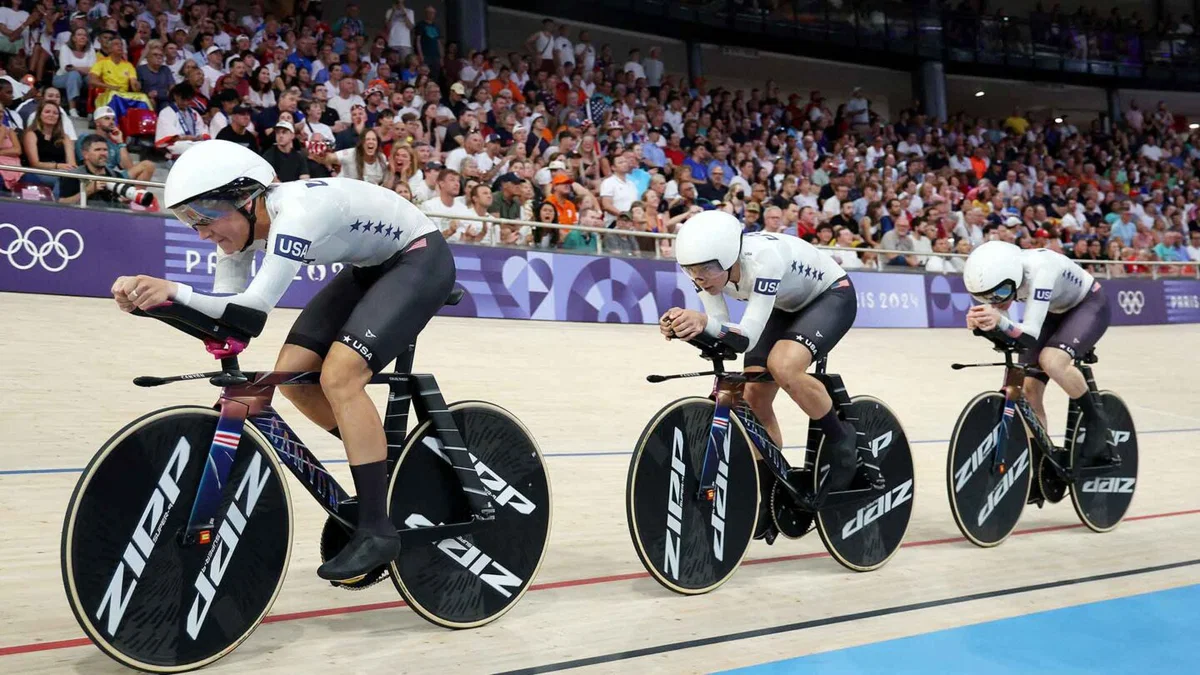
Let’s start with a single number: 0.6 seconds.
That’s how far ahead the U.S. women’s team pursuit squad finished in Paris, taking the country’s first-ever gold in the event. It included four riders, 4,000 meters, 16 laps, and a margin so thin you could lose it by blinking at the wrong time at the start line.
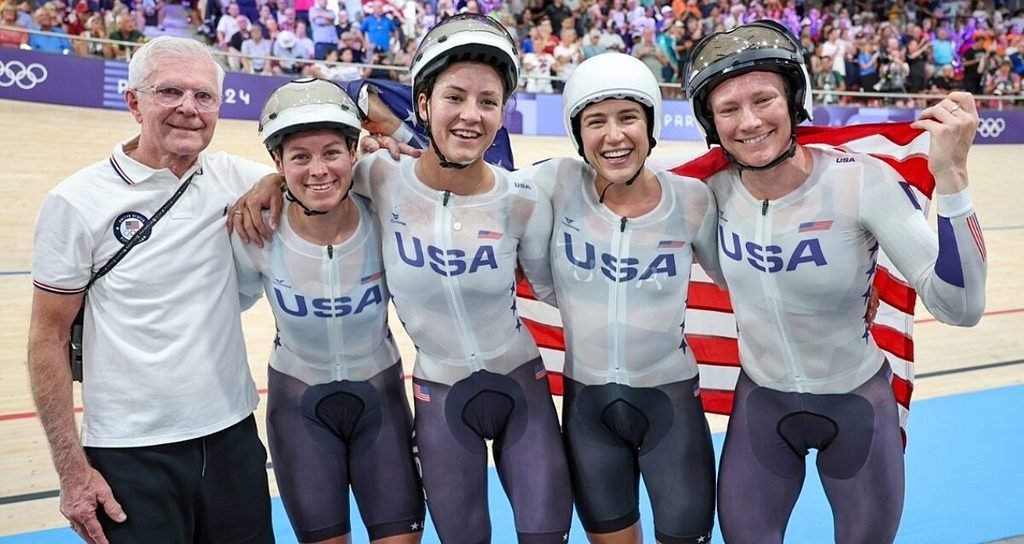
Here’s the part that gets lost in the highlight reel. That gold wasn’t an accident, and it wasn’t just legs. It was the result of a two-year effort called Project 4:05, where USA Cycling tore the event apart piece by piece to figure out how to get four riders around the track in under four minutes and five seconds. Who pulls at the front, for how many laps, in what order, at what power. Every variable got put under the microscope.
And now the plot twist: USA Cycling CEO Brendan Quirk admits that effort ran on volunteer and heavily discounted data science help, with no single system tying it all together.
His words on that setup were blunt: they absolutely cannot do that again.
Which brings us to today’s news. USA Cycling has a new partner built to fix exactly that.
So, What Actually Happened?

On November 3, Snowflake announced it is now the Official AI Data Cloud & Collaboration Partner of USA Cycling. The deal supports the run-up to the LA28 Olympic and Paralympic Games and covers every Olympic discipline (road, mountain bike, track, BMX racing and BMX freestyle) plus Paralympic road and track.
Data at an Olympic Level
As athletes, we try to stitch together power files, sleep scores, and recovery metrics from five different apps. Now imagine that at the national team level when all this stuff is the most important thing in the world. For the best of the best, they’re tracking power, heart rate, cadence and speed from every ride. And I’m sure wearables track sleep and recovery. Telemetry showing how a mountain bike’s suspension handles terrain.
Collecting all that is the easy part. According to USA Cycling, that information currently lives across seven or eight separate tools. Alec Pasqualina, the Director of Mountain Bike, described the setup as a messy landscape where somebody has to go check everything everywhere. And when a lean staff gets busy, the deeper stuff like sleep, nutrition and recovery analysis is the first thing to get bumped.
If that sounds familiar, its because every athlete with a full-time job and a training plan get this. But just with Olympic stakes.
The plan is to pull everything into one secure, governed platform, lined up with the U.S. Olympic & Paralympic Committee’s Athlete 360 initiative. Athletes, coaches and performance directors would all work from the same information, and they’d be able to ask questions in plain language instead of needing a data scientist on speed dial.
Quirk’s point is that the people using this are Swiss Army knives, not programmers, so natural language isn’t a luxury. It’s a requirement.
The Cool Stuff
Here’s where it gets fun.
Trackside Race Analysis. In team pursuit and BMX racing, athletes can have only minutes between rides to make changes. The plan is to pair race video with power, speed and timing data so coaches can show a rider exactly what to fix before the next run, whether that’s pacing or equipment, saving valuable time.
LA28 Medal Forecast. USA Cycling’s medal forecasting model debuted for Paris, and it’s expanding to cover Olympic and Paralympic cycling and updating as results roll in. The idea is to show leadership where the team is best positioned to land on the podium so funding, staff and support go where they’ll count most. Quirk has put a big target on the wall: 10 Olympic medals and 12 Paralympic medals on home soil.
Cracking Scorecard. Using Snowflake Cortex AI, the team will connect competition footage to judges’ scores to see which tricks score most reliably and where a run is leaving points on the table. No more guessing, see what the judges are actually rewarding.
Why This Could Be Huge
This is the kind of stuff we love and it will be interesting to see if all the above drives results. But let’s also be realistic about the limits first. A data platform doesn’t turn a pedal. Software won’t sprint for you, and a partnership announcement is a starting line, not a podium guarantee. It always will come down to how the athletes perform on race day.
That said, here’s why we think this one has real legs.
It fixes a real problem, that USA Cycling admits. Project 4:05 proved that when USA Cycling goes all-in on analysis, it can produce a gold medal. The catch was that it depended on goodwill and discounts. Turning a one-off heroic effort into a repeatable system is the difference between winning once and building something that lasts.
The margins are brutal. In cross-country mountain biking, the top five can finish within about a minute of each other after roughly an hour and a half of racing. In team pursuit, six-tenths of a second decided gold. When the gaps are that small, finding even one overlooked training pattern or pacing tweak is the whole game. And every other country is doing the same too.
Pasqualina is especially fired up about looking back at an athlete’s best days and mapping what they did in the weeks leading up.
The athletes are on board. Riley Amos, a Paris Olympian in cross-country mountain biking, said data can be powerful or overwhelming, and he’s excited to use this to see through the clutter.
For everyone involved, the goal isn’t more numbers. It’s fewer, better answers.
All of this to say, it isn’t staying just in cycling. USA Cycling joins USA Bobsled/Skeleton on Snowflake, and Quirk says he wants to share what the team learns with the USOPC and other national governing bodies. If one sport cracks the code on connecting its data, other sports get to skip the trial and error.
LA28 is a once-in-a-generation lever. Pasqualina pointed to the growth American cycling saw after the 1984 Games and believes another home Olympics could be the biggest catalyst for enthusiasm and growth the sport has had. If the data helps cycling win more medals in front of a home crowd, the ripple effect could be like when Lance (maybe a bad example) brought a whole new wave of enthusiasm to American cycling.
Our Thoughts
We hope we hear more about this and it isn’t just some one-of. For now we’ll keep an eye on how quickly USA Cycling gets everything into one place, whether the trackside race analysis shows up in results leading up to the games, and how the medal forecast evolves as LA28 gets closer. From there, it would be dope if all the nerds took what actually worked and then fed it to us normies because the big unlock isn’t more data, it’s making data usable fast, in plain language, so it actually changes what you do tomorrow.
If the national team figures out how to do that well, let’s hope the tools and ideas that come out of it have a way of trickling down to the rest of us.
Leave a Reply
You must be logged in to post a comment.