


World Athletics just published the qualification system for the LA28 Olympic Games, and the marathon standards are brutal.
2:05:00 for men. 2:22:20 for women.
Here’s the part I can’t get past. Both are faster than the current Olympic records. Huh?
Tamirat Tola set the men’s Olympic record of 2:06:26 in Paris. Sifan Hassan set the women’s Olympic record of 2:22:55 a day later. So if you want to line up in Los Angeles in 2028, the automatic time standard asks you to run faster than anyone has ever run at the Games.
No pressure.
What World Athletics Actually Set
These are the official numbers from World Athletics’ press release and the qualification system document:
- Entry Standards. 2:05:00 (men) and 2:22:20 (women)
- Qualification and Ranking Window. November 1, 2026 – April 30, 2028
- Field Size. 70 athletes in the men’s marathon and 70 in the women’s
- Country Limit. A maximum of three athletes per National Olympic Committee
- The Games. July 15 – 30, 2028
For comparison, the Paris 2024 standards were 2:08:10 and 2:26:50.
That makes the men’s bar 3:10 tighter and the women’s 4:30 tighter, base on my own math.
In pace terms, 2:05:00 works out to about 4:46 per mile for 26.2 miles. 2:22:20 is about 5:26 per mile (also my math).
That’s my 5K pace. On a good day. Downhill.
The Ranking Route is Getting Bigger

World Athletics is also changing the mix. Paris used a 50/50 split between entry standards and world rankings. For LA28, World Athletics says “40% of athletes are expected to qualify through entry standards and the remaining 60% are expected to qualify through world rankings.”
So the time is not the only way in. It’s just the fastest way in.
World Athletics says its methodology accounts for the marathon “where trends show that in an Olympic year, times are between 30 to 60 seconds faster than the trends would forecast.”
One catch. Hitting the standard doesn’t guarantee a spot. World Athletics says that if more athletes than the quota run the standard, “achieving the entry standard does not automatically guarantee a quota place. In this case no athletes will be qualified by world rankings.”
The Marathon has its Own Rules

This is where it gets interesting.
There are two deadlines. According to World Athletics, “any athlete ranked higher than the 56th athlete on the filtered Quota Place ‘Road to LA’ list (three per national Olympic committee) on March 19, 2028 will be considered qualified.”
After that, “the remaining 15 athletes” are determined through the same standards-or-rankings pathway, without bumping anyone who qualified by March 19. That’s 55 plus 15, which matches the 70-athlete field (my math).
Top five at a Platinum Label marathon counts as the standard. World Athletics says “the first five finishers at the Platinum Label marathons held during the whole qualification period will also be considered as having achieved the entry standard and will be listed first on the ‘Road to LA.’”
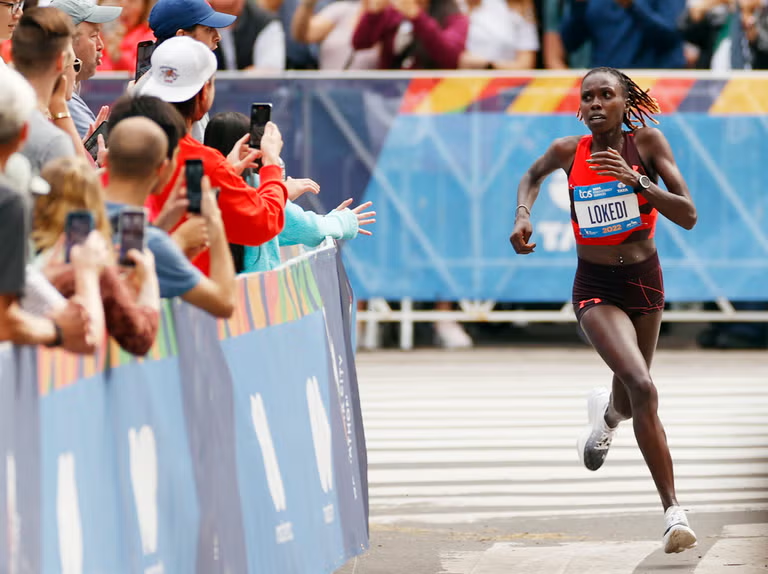
That matters right now. The TCS New York City Marathon, a Platinum Label race, ran on November 1, 2026, the first day of the window.
Andreas Almgren won the men’s race in 2:06:01 on his marathon debut. Sheila Chepkirui won the women’s race in 2:24:36, and Jessica McClain of the USA was second in 2:24:42.
None of those times beat the LA28 standards. But by my reading of the rule, all of the top-five finishers in both New York races are already treated as if they had.
World Athletics hasn’t published the official Road to LA list yet, so I’ll treat that as my interpretation until it does.
Place Beats Pace
Spots go to countries, not runners. For the marathon, the qualification document says quota places are allocated to the National Olympic Committees, not to individual athletes. So the national federation still picks who uses the spot.
There’s a safety valve. A country can give a quota place to an athlete who hasn’t otherwise qualified, as long as that athlete has run at least 2:11:00 (men) or 2:29:00 (women) during the window. In Paris, that floor was 2:11:30 and 2:29:30. So even the backup option got 30 seconds tighter.
Courses must be legit. Qualifying marathons need a course measured by a World Athletics/AIMS Grade “A” or “B” measurer, and for entry-standard purposes the net elevation drop can’t exceed 1m per km.
For context: the clock has moved fast
In April 2026 in London, Sabastian Sawe ran 1:59:30. World Athletics has since ratified it as the men’s world record, and it makes him the first man to break two hours in a record-eligible marathon. Yomif Kejelcha ran 1:59:41 behind him. I covered the shoes from that day in The 2026 Marathon Majors Had One Clear Winner.
On the women’s side, World Athletics lists two world records. Tigst Assefa holds the women-only record at 2:15:41 from that same London race. Ruth Chepngetich’s 2:09:56 from Chicago 2024 remains the mixed-race record. She was later banned for three years after a positive test, and the mark stands because it predates that test, according to Reuters.
The home team has a shot, too. Conner Mantz ran 2:04:43 to break the American record in Chicago in 2025, which is 17 seconds under the new men’s standard. Emily Sisson’s 2:18:29 is listed by World Athletics as the North American women’s record, well under 2:22:20.
And the gear arms race isn’t slowing down either, see: the Nike Alphafly 4 and the Nike Apex, which Nike claims delivers 40% more energy return.
What Happens Next
World Athletics says it will publish Road to LA, its official qualification tracker, in the latter part of 2027. Partial marathon rankings close in March 2028, and the timeline says World Athletics will announce marathon quotas by country on March 22, 2028. The full ranking period ends April 20, 2028.
That’s 18 months of racing so expect a lot of fast spring and fall marathons with a lot of nervous agents.
I like this system more than the headline numbers suggest.
My Thoughts
I’ll never be an Olympian because i’m old and slow but, yes, 2:05:00 and 2:22:20 are absurd. They’re faster than the Olympic records, and I don’t think World Athletics expects many people to qualify on time alone. That’s the point of moving to a 60% rankings split.
The real story is the Platinum Label top-five rule. It rewards racing, not just pacing. A runner who wins a hot, hilly, tactical marathon can earn the same credit as someone who rode a rabbit train to a fast time on a flat course. Considering the LA28 marathon will be a championship race in July, that feels right.
Yet through all of this, I wonder if the rankings route stays transparent. When 60% of the field qualifies through a points table most fans can’t explain, World Athletics needs Road to LA to be easy to follow. It’s promised for late 2027. I’ll hold them to it.
And to every runner who just ran New York and finished top five: congrats. You may have qualified for the Olympics. That would be great news.
Leave a Reply
You must be logged in to post a comment.