


Anything with the word cardiac sounds terrifying but I promise you, this is not that. But it is summer and with heat is in full swing, so I do want to talk about cardiac drift.
Right now, I’m getting about an hour into my long run and the pace feels controlled. Overall, my breathing is steady but I take a look at my watch and the heart rate sits at 158, which is about 14 beats higher than it was at mile one. Yet I’m doing the same pace and same effort but getting a different number.
My first instinct is that something is wrong. Your second instinct is to slow down. Both instincts are understandable but neither one is fully correct.
What you’re looking at is cardiac drift, one of the most misread signals in endurance training and it is not a warning light but instead a data point like so many others you should know and understand.
What is Cardiac Drift?

Cardiac drift is the gradual, progressive upward creep of heart rate during sustained exercise at a constant effort level. You’re not running harder. Your perceived exertion hasn’t changed. But your heart is beating faster, and it’s going to keep doing that until you stop, cool down, or drink something.
In coaching I see this all the time. For example, a recent athlete ran a full 10 miles at an 8:09 pace. As steady as it comes but
The mechanism is straightforward once you understand it. Your heart’s job is to deliver oxygenated blood to working muscles. It does this by controlling two variables: how fast it beats (heart rate) and how much blood it pumps per beat (stroke volume). These two numbers multiplied together equal your cardiac output or the total volume of blood moving through your system per minute.
In an ideal world, your stroke volume stays constant and your heart rate stays constant and everything is efficient and predictable. In the actual world, over the course of a long effort, your stroke volume starts to fall.
Here’s why: as you sweat and your blood plasma volume decreases, there’s literally less fluid in the tank. The heart has less to work with per beat. Stroke volume drops and to maintain the same cardiac output; to keep delivering the same amount of oxygen to the same muscles at the same rate, your heart compensates by beating faster. And that’s the drift part. Your heart is essentially adjusting in real time.
And yes, heat accelerates this dramatically. When your core temperature rises, your body reroutes blood to the skin for cooling, and that’s blood that is temporarily unavailable for muscular work — which means your heart has to beat even faster to get the same effective delivery to your legs.
This is why cardiac drift is worse in summer, worse in humidity, and worse on days when you went to train slightly dehydrated or didn’t eat to begin with.
How to Spot It in Your Own Data
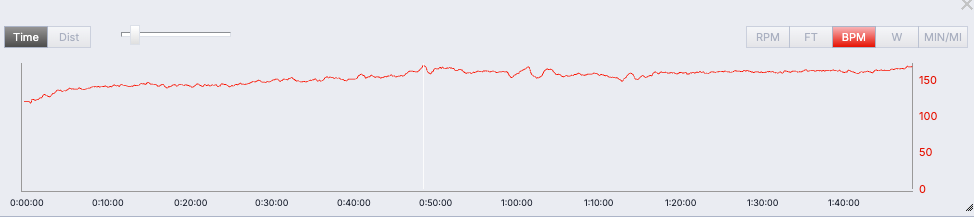
If you’ve never looked for cardiac drift in your training files, go pull your last long run right now. Open the heart rate graph and set it against your pace graph. What you’re looking for is this: pace holds steady (or slows slightly) while heart rate trends upward through the second half of the effort. Not a spike, but a gradual, consistent climb that doesn’t recover even when you’re just running steady.
That’s cardiac drift. And the size of the drift tells you something.
A well-hydrated, heat-acclimatized athlete in good aerobic condition might see 5 to 8 beats of drift over a two-hour run. A dehydrated athlete running in summer heat on a day when they skipped a meal and their pre-run electrolytes might see 20 to 25 beats of drift over the same window. You’ll just get a completely different physiological experience.
Garmin for example calls this “aerobic decoupling” and actually calculates it as a percentage. They look at the ratio of your heart rate increase to your pace change over the back half of a run. A decoupling score below 5% is generally considered efficient. Above 10% and your aerobic system is working significantly harder to maintain what you’re asking of it.
Both Wahoo, Polar, and most others also display some version of this data too. It might be buried but it’s there.
My point is that the number is there and worth understanding. Most athletes scroll past it because they don’t know what they’re looking at but you should versus just saying, “Why is my HR creeping?”
Why This Changes How You Read It on Race Day

Here’s where cardiac drift stops being a training curiosity and starts being a race day problem.
Imagine you’ve locked in a heart rate ceiling for your Ironman bike — let’s say 145 beats per minute as your target zone. You ride the first hour, heart rate sits at 138. You feel strong. You push a little but by hour three, you’re at 144 which is still fine. But then by hour five, you’re at 148 and climbing without changing effort, because six hours of sweating in the sun has eroded your plasma volume enough that your heart is now working harder to do the same job.
If you don’t understand cardiac drift, you slow down. Or worse, you ignore the number entirely, push through, and arrive at T2 already in a physiological hole that the marathon will make you pay for in full.
If you understand cardiac drift, you can adjust by drinking more, adding some more sodium or a snack. By acknowledging that a rising heart rate late in a long effort is partly a fueling and hydration signal, not just a pacing signal, you’re making the correction that keeps the drift from compounding into much bigger issues.
This is why the athletes who study their data tend to perform better than athletes of equal fitness who don’t. Not because the data makes them faster in a vacuum but because it tells them things their perceived exertion can’t allowing them to adjust accordingly.
Some Good News
Cardiac drift gets smaller over time and is one of the clearest markers of improving aerobic fitness.
As your aerobic base develops, your heart gets more efficient at each beat and stroke volume increases. Plasma volume also increases, even at rest, and well-trained/consistent athletes have significantly higher blood plasma volume than sedentary individuals, which is one of the primary mechanisms behind aerobic adaptation. Your ability to thermoregulate improves. All of this means your heart doesn’t have to compensate as aggressively over the course of a long effort.
Compare your decoupling scores from a long run in January to a long run in May, assuming consistent training. If the training is working, the drift gets smaller, saying that the cardiovascular stress will be less. And that folks, is fitness. That’s the aerobic base compressing the drift because your system is getting better at managing sustained effort.
Cardiac drift isn’t just a problem to manage, it’s a diagnostic tool. It tells you when your hydration is off, when the heat is getting to you, and if your aerobic fitness is outpacing where it was six weeks ago. It is one of the most honest signals your body produces.
Your watch has been showing it to you the whole time and now you know what it means.
What to Do About It Right Now
Three things, in order of impact:
- Hydrate before you need to. Cardiac drift accelerates when plasma volume is already low at the start of your session. Pre-loading with 16 to 20 ounces of fluid and sodium 60 to 90 minutes before training blunts the drift curve significantly. You’re starting the run with a fuller tank, which means the heart doesn’t have to compensate as early or as hard.
- Add Electrolytes, not just water. Plain water without sodium during a long effort can dilute plasma further as sweat sodium outpaces fluid intake. Electrolytes during sustained training, especially in heat, help maintain plasma osmolality and keep the drift from compounding.
- Use decoupling as a training quality metric. Rather than just chasing pace and heart rate targets in isolation, track your aerobic decoupling score on long efforts over time. If it’s consistently above 10%, something is off, either the effort is too high, the hydration is wrong, or the heat is more significant than your pacing accounts for.
If it’s trending down over weeks and months, your aerobic base is building exactly the way it should be.
For all the data you get with your watch, the drift doesn’t lie. Learn to read it and it’ll tell you more about your fitness than your pace ever will.
Leave a Reply
You must be logged in to post a comment.