

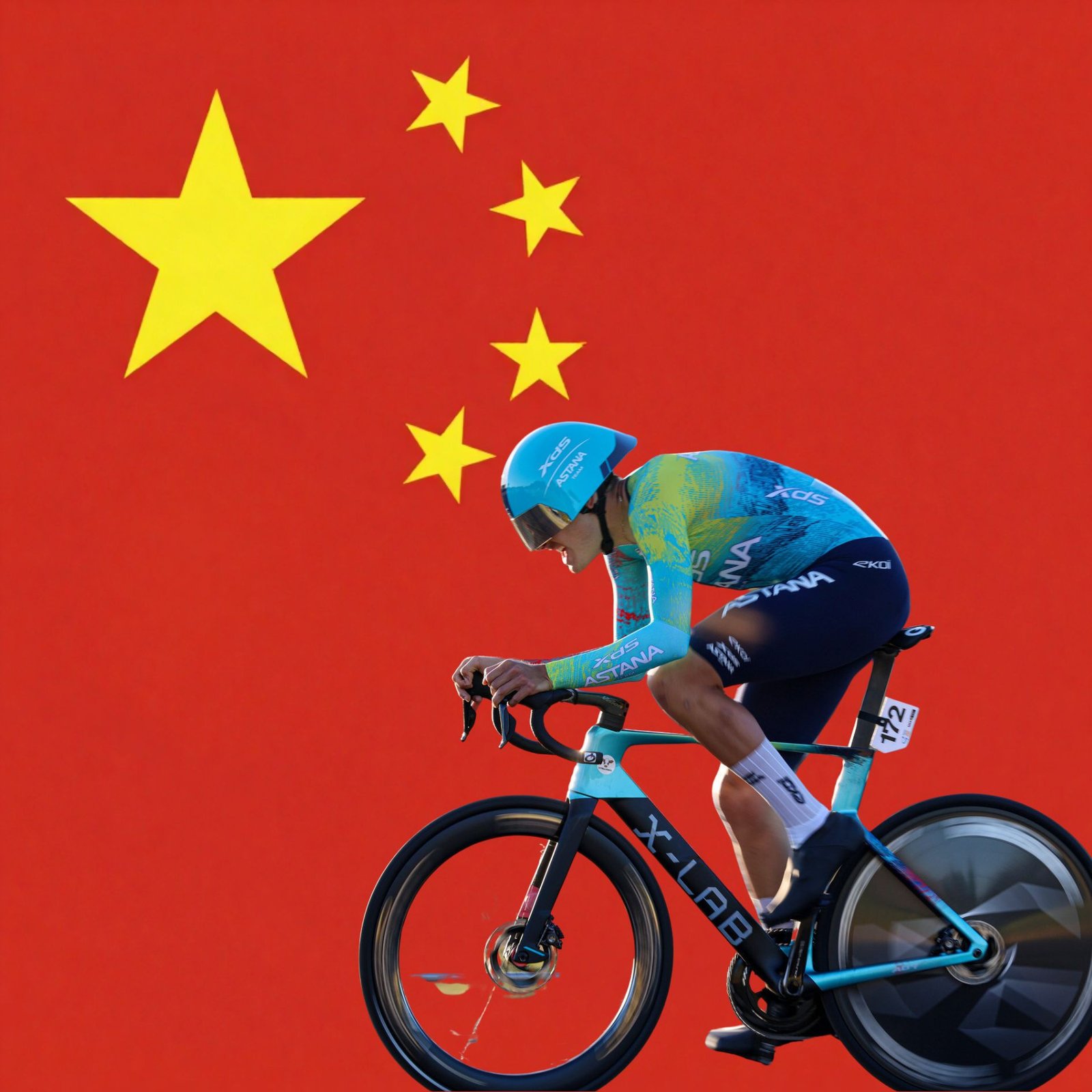
If you don’t follow too closely, for years, nearly every carbon frame you bought from brands like, Specialized, Trek, and Cannondale are made in China or Taiwan. Western companies designed the bikes, marketed them, and charged accordingly.
And then DTC (Direct-to-Concumer) happened. And a massive trade show called China Cycle happened; and the legacy brands suddenly have a lot of competition.
A new wave of Chinese brands have stopped manufacturing other people’s bikes and started building their own.
They’ve got the factories, the engineers, the materials supply chain, and increasingly, their bikes are getting on podiums to showcase their efforts.
In 2025, an 18-year-old won the UCI Junior Road World Championships on a bike most Americans had never heard of. A Chinese-sponsored team is racing the WorldTour and wind tunnel-validated framesets are hitting the market at half the price of comparable Western hardware.
It’s all a bit nutty but happening fast.
Right now, in our eyes, there are six brands that are leading the charge and we’re here to drop some knowledge so the next time you see them on a group ride, it’ll be less confusion and more intrigue.
Western Brands Got Pricey
Before we get into the Chinese brands, here’s a reference point for how much bikes cost these days.
- A Specialized Tarmac SL8 frameset runs $3,500–$4,500+.
- A complete S-Works build pushes past $12,000–$14,000.
- The Cannondale SuperSix EVO Hi-Mod frameset lands around $3,500–$4,750.
- A race-ready Ultegra Di2 complete build clocks in around $6,000–$8,000.
These are the bikes that dominate team sponsorship, bike shops, and group rides. They’re excellent but they’ve also gotten so expensive.
Keep those numbers in mind as we discuss the following:
XDS / X-Lab
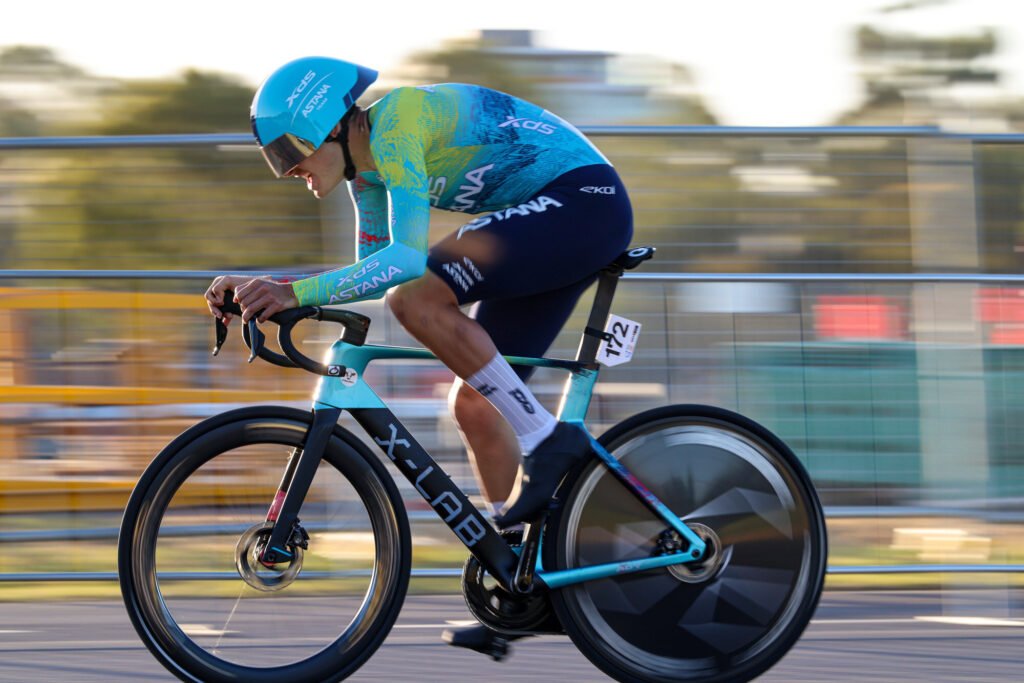
Founded: 1995 | Headquarters: Shenzhen, China | Specialty: Road, & gravel
XDS has been operating for 30 years as one of the largest bicycle manufacturers on earth.
It has supplied many of the most famous brands in the industry and the factory makes about 8 million bikes a year.
For most of its existence, XDS was an OEM ghost; producing frames for brands you know and trust, collecting a manufacturing fee, and staying invisible. But that changed in 2025 and the move sees XDS, a leader in China’s cycling market, step onto the global stage with its high-performance X-LAB brand, positioning the team, and the company for greater success in the WorldTour.
The vehicle for this was a sponsorship deal with what was formerly the Astana Qazaqstan team. For the first time, a mainland Chinese bicycle brand was not just sponsoring a WorldTour team but it was the name of the team. XDS bikes now appear in the peloton at the Tour de France, the Giro d’Italia, and Vuelta a España.
X-LAB is the premium sub-brand (think S-Works) and operate from Shenzhen, about an hour away from Hong Kong.
XDS launched a nine-bike X-LAB global range across road, gravel, urban, and e-bike categories. The flagship is the AD9, a full aero road bike and it gets a Toray T1100 carbon frame and fork, and a Shimano Dura-Ace Di2 build. The weight sits at roughly 15 lbs for a large size. It’s like a Mercedes Benz.
Then there’s the RT9 which XDS claims it’s among the lightest production road bikes ever made, with a frame weight reportedly down to 550g.
Pricing: The X-LAB AD9 frameset is not yet for sale, but a complete bike sits at $7,999, according to their website. The next best model is the AD8 and is an all carbon frame, with 105 Di2 and comes complete for $4,499, costing significantly cheaper than many comparable bike shop and Western models.
The X-Lab officially launched in the U.S. this year, through independent bike dealers — not direct-to-consumer. XDS has 240 distributors, over 14,000 employees, and operates in 50 countries. It’s massive.
Bottom line: This isn’t a startup you’ve never heard of, it’s a manufacturing giant going direct. The WorldTour result was just the start of the credibility stamp that years of OEM production couldn’t provide.
Win Space
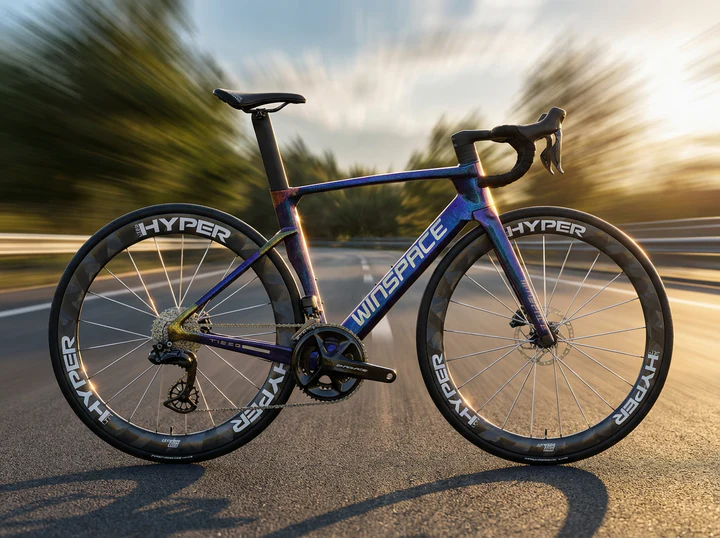
Founded: 2008 | Headquarters: Xiamen, China | Specialty: Road, gravel, triathlon, & wheels
Win Space is probably the most established Chinese brand in the Western performance cycling conversation. It got there without a WorldTour team or a viral race result. They’ve just built consistent and well-reviewed bikes at a price point that forced us to pay attention. On top of that, their direct-to-consumer business model makes it easy to purchase.
Founded in 2008 in Xiamen, China, Winspace began with a simple mission: design and build high-performance carbon fiber bicycles that deliver elite-level performance at a price that more cyclists can afford. The T1500 aero road bike launched in 2017 and a second generation followed in 2024. Winspace produces over 5,000 frames per year from their own factory in Xiamen, which is regarded as the heart of carbon bike manufacturing.
The turning point for the brand came in 2022, when independent engineer Hambini, a bearings engineer, tested the T1500 over 5,000km and declared it “easily better than BMC, Canyon, Cervélo, Giant” on ride feel and handling stability.
Cycling forums exploded and called bullshit, but it drove massive attention to the brand around the world.
More recently, Win Space crossed into professional racing. In 2024, Winspace became the first mainland Chinese bicycle brand to appear at a UCI Women’s Grand Tour, when a team rode Winspace bikes at the Vuelta Femenina.
Winspace also makes wheels under the Lún Hyper brand. A good set of carbon wheels from a Western brand can run anywhere from $1,900–$7,500.
Winspace wheels cost around $1,000 and their latest flagship road bike (the M6) is consistently positioned against the Specialized Tarmac SL8 and Canyon Aeroad.
Pricing: T1550 frameset runs approximately $1,400–$2,000 and complete builds with mid-range components can be assembled for $3,500–$5,000, roughly half what a comparably spec’d Western bike would run.
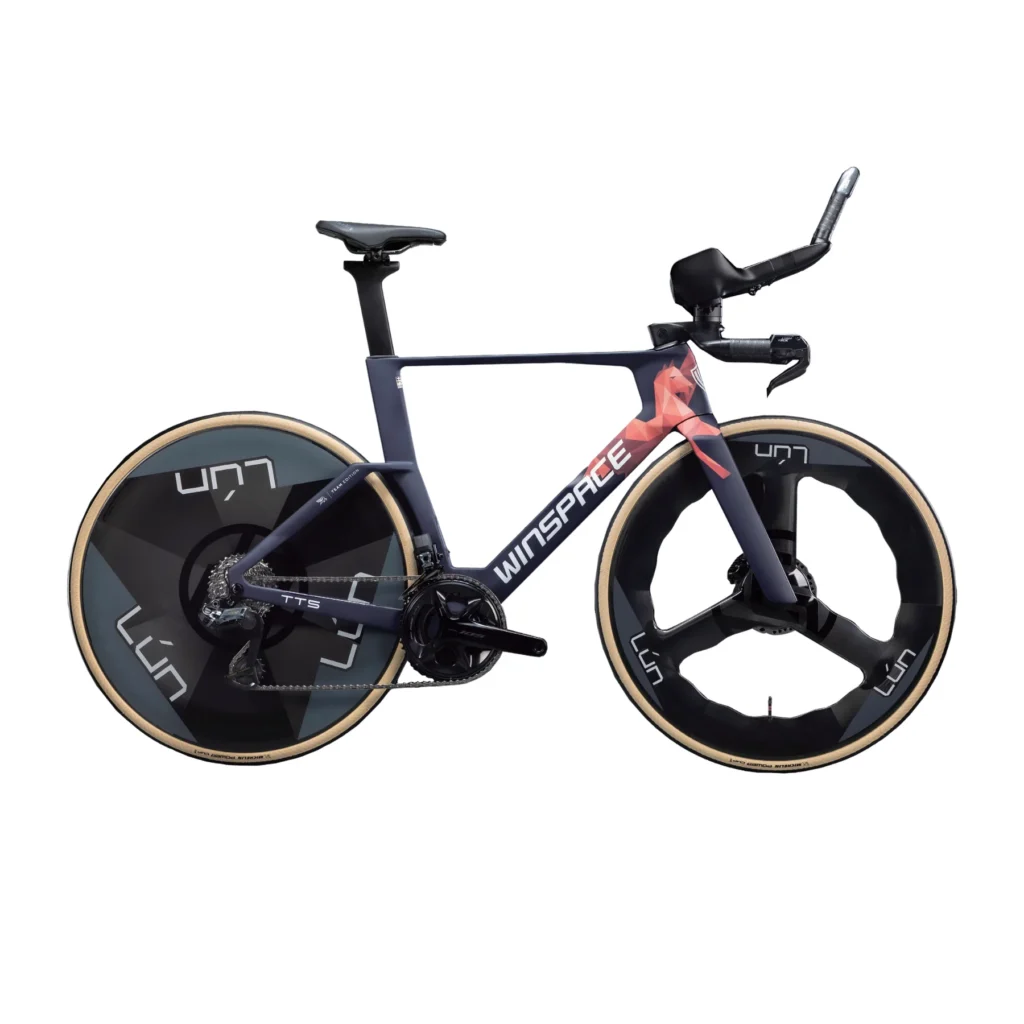
They also have a TT bike which we all know, the most premium can set you back $12,000 – $16,000. The Winspace TT5 goes for $5,200.
Bottom line: Win Space is the brand that started the conversation. It’s been around long enough, and reviewed seriously enough, that it’s no longer a risky buy. The wheels alone are a value story.
Quick Pro
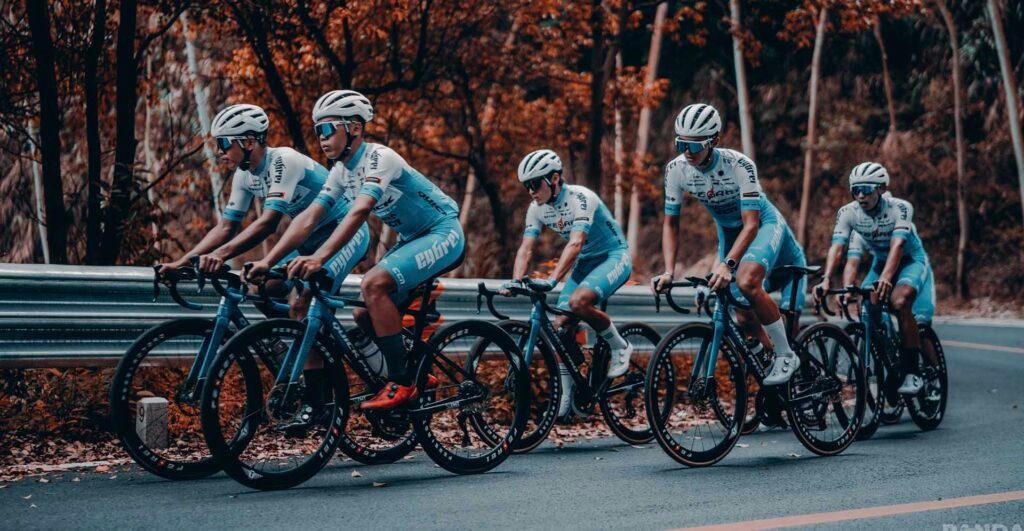
Founded: 2012 | Headquarters: Huizhou, China | Specialty: Road racing
Quick Pro is the newest name on this list with the biggest result and some controversy that they’ve bought their way into any bike conversation with media and influencers.
But they have results. In 2025, 18-year-old Harry Hudson won the UCI Men’s Junior Road World Championships in Rwanda on a Quick Pro AR:ONE. His bike weighed 6.83kg, making it the lightest bike in the junior race compared to other models that were sitting around 8.5kg.
The company was founded in 2012 with a focus on racing and the tagline “anyone can race.” It boasts vertical integration with its own factory and R&D facility.
The AR:ONE is “purpose-built” and produced as a single piece rather than being made up of separate parts bonded together after moulding. It’s geometry is race-aggressive, reaching figures that are comparable to a Trek Madone or Specialized SL8, with the stack sitting roughly 10mm lower across most sizes, up to 20mm lower on the XL. On top of all of this, former WorldTour pro Martin Laas was involved in the development process.
Quick Pro’s growing ambition is clear: grow fast now that they are in the spotlight; how very Chinese of them.
Pricing: The AR:ONE frameset runs approximately $1,900. A complete, high end race build, comes in around $4,000.
Bottom line: One race result doesn’t make a brand, but it makes people look and the Quick pro AR:ONE is a legitimate race machine at a price point that makes you shake your head.
Pardus
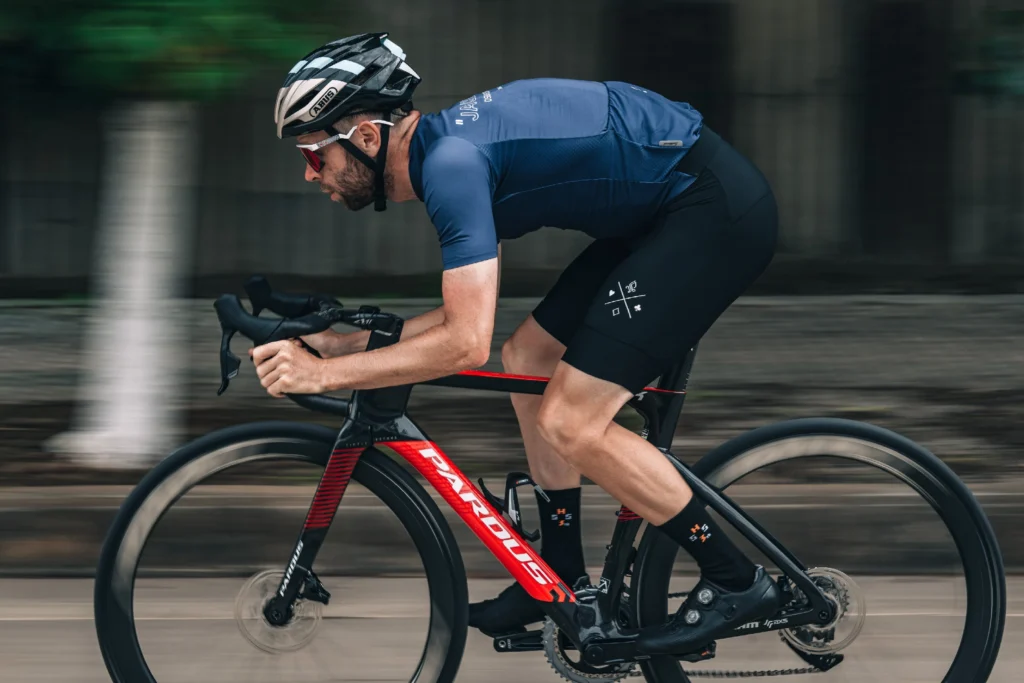
Founded: 2010 | Headquarters: Shandong, China | Specialty: Road, track, & gravel
Pardus has a pedigree that most Western brands can’t match. Pardus is the official bicycle of the Chinese National Cycling Team, and an equipment supplier to numerous national and continental teams. It has supplied equipment for events such as the Olympic Games and UCI World Championships.
Pardus’s journey with the Olympics began at the 2016 Rio Games which was the first time a Chinese domestic brand accompanied the national team, breaking a century-long dominance of foreign brands in cycling events.
The parent company is Taishan Sports Industry Group, a 40-year-old industrial conglomerate that makes equipment for the Olympics across multiple sports. Unlike brands that rely on third-party suppliers for carbon frames, Pardus maintains control over every step of production within its 100,000-square-metre facility, the largest in Northern China. It sources raw Toray carbon fibres and utilises an in-house R&D center to develop proprietary resins and weave its own carbon sheets.
The consumer line launched in 2017 and has expanded steadily.
The current range includes the SPARK EVO (all-around competition road bike), ROBIN EVO (endurance road bike), and URAGANO gravel bike.
In May 2026, Pardus made its most significant Western push: Pardus officially launched in Europe as the only Chinese cycling brand to establish a permanent corporate footprint as a European shareholder. It set up warehousing in Poland, is in 21 countries with 25+ sales agents; selling exclusively through IBD dealers.
Pricing: The Pardus SPK Gen4 aero race bike — carbon frame, integrated handlebars, carbon-spoke MVMT wheels, Shimano Ultegra Di2 — comes in under $5,700 USD at 6.7kg. For context, a Specialized Tarmac SL8 Expert with Ultegra Di2 runs $8,500+ USD.
Bottom line: Pardus has the most institutional credibility of any brand on this list and has been in two Olympics and serves the Chinese National Team. It has its own carbon manufacturing and the European push this year puts even more legitimacy behind it.
INCOLOR
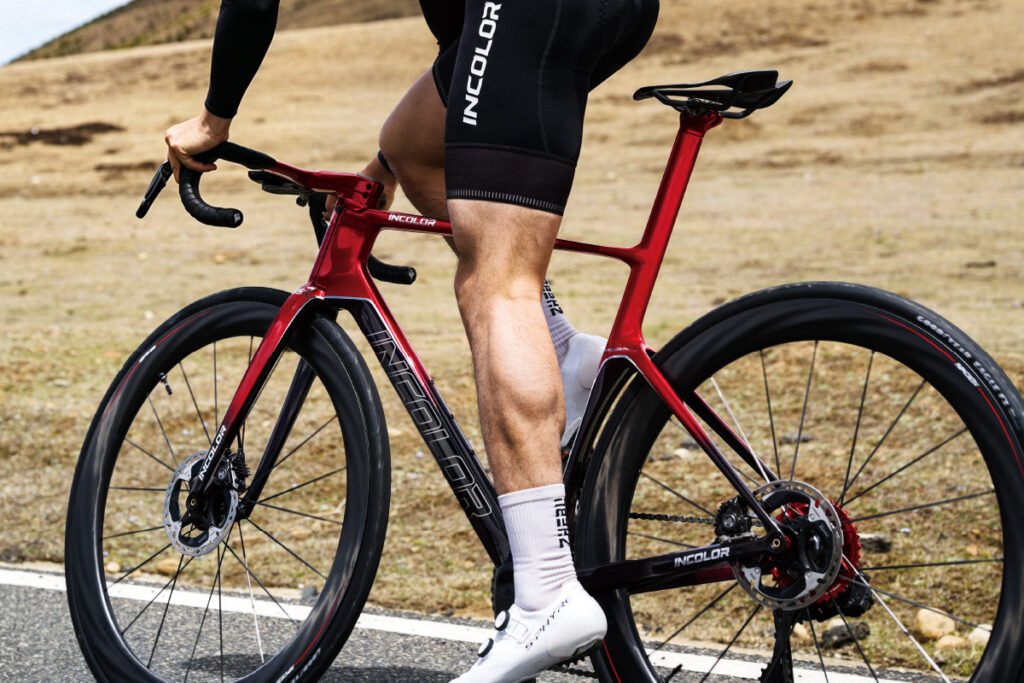
Founded: 2010 (bikes in 2020) | Headquarters: Guangzhou, China | Specialty: Road, gravel, components, & helmets
INCOLOR is the most technically unusual brand on this list and one we know the least about. Their website is fully Chinese and its hard to really find any reviews of their bikes in the States.
The brand started as a design and custom painting shop, moved into carbon fiber repair, began designing bikes for other brands in 2018, and started designing its own bicycles under the Incolor brand in 2020.
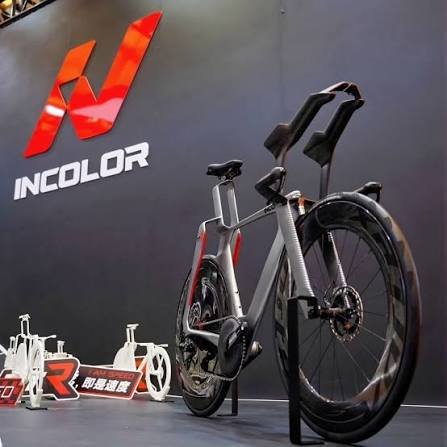
The range is tight and focused: the SSR (aero), SR+ (lightweight aero), SR (all-rounder), and VG (gravel) and they also own and sell aero wheelsets, bar/stem systems, drivetrain components including a carbon crankset and 12-speed anodised cassette, and a range of 3D-printed computer mounts.
The SSR is the headline bike. It’s an aero bike that has tested faster than a Cervélo S5 at the Silverstone wind tunnel and the claimed frame weight including integrated seatpost sits at a claimed, 750g.
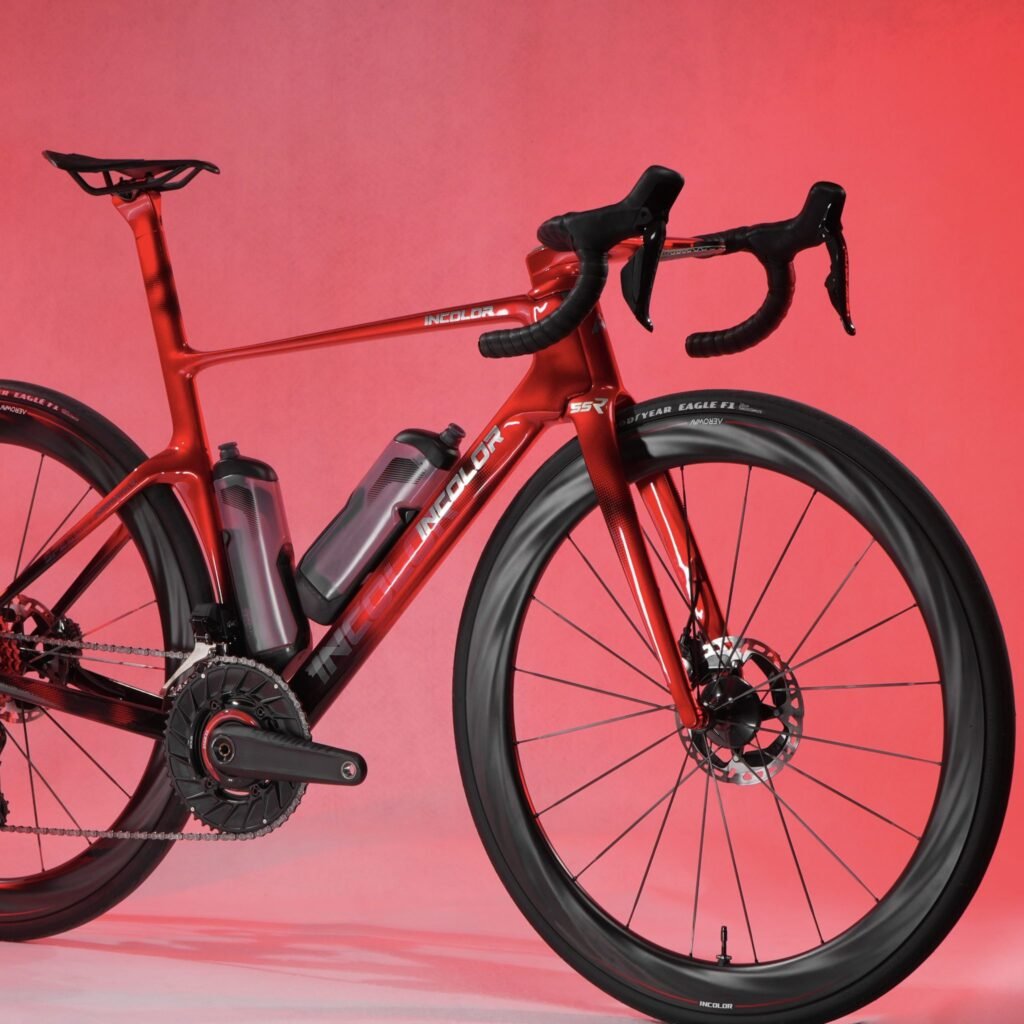
Most recently, Incolor debuted a new TT prototype at China Cycle 2026, featuring a split-seatpost design that minimizes frontal area. Early testing suggests the design could be faster than the recently updated Colnago TT bike.
Pricing: The SR+ frameset runs approximately $1,800–$2,200. The SSR sits higher, in the $2,500–$3,000 range.
Bottom line: INCOLOR is still a mystery and doesn’t have a WorldTour profile yet, but it’s building a full ecosystem faster than almost anyone else on this list. They claim wind tunnel data backed by third-party testing but its all a bit of a mystery right now.
SEKA
Founded: 2020 | Headquarters: Shanghai, China | Specialty: Road & gravel
SEKA is the brand that started showing up at Western events a few years ago, especially in the UK market. And not just at cycling trade shows but actual consumer events, right next to power brands like Pinarello and Cervélo.
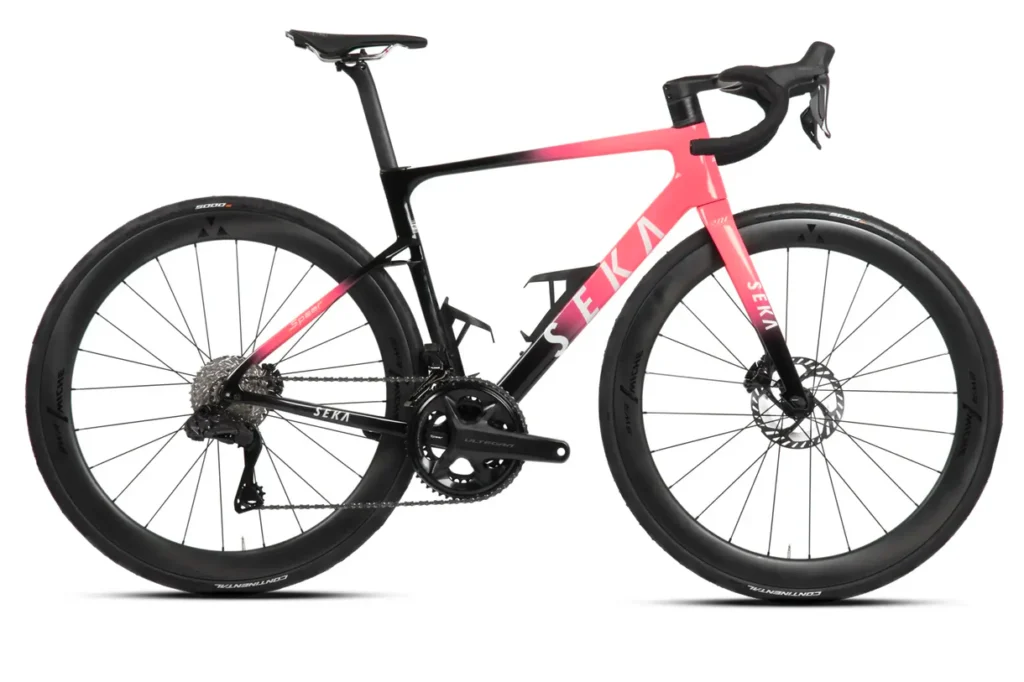
The flagship is the Spear, an aero all-rounder and features its “Wind Eye” innovation: a seat-stay opening that reduces air drag by approximately 6 watts while increasing vertical compliance by 23%. The frame is a true one-piece molded carbon construction and looking at their website, SEKA worked on the Spear frame for over three years, investing in research, development, CFD models, and wind tunnel testing.
Cyclingnews took the Spear to a wind tunnel and it tested as an all-rounder aimed directly at the Specialized Tarmac SL8 — with a frameset price difference of over $2,500 compared to the S-Works tier.
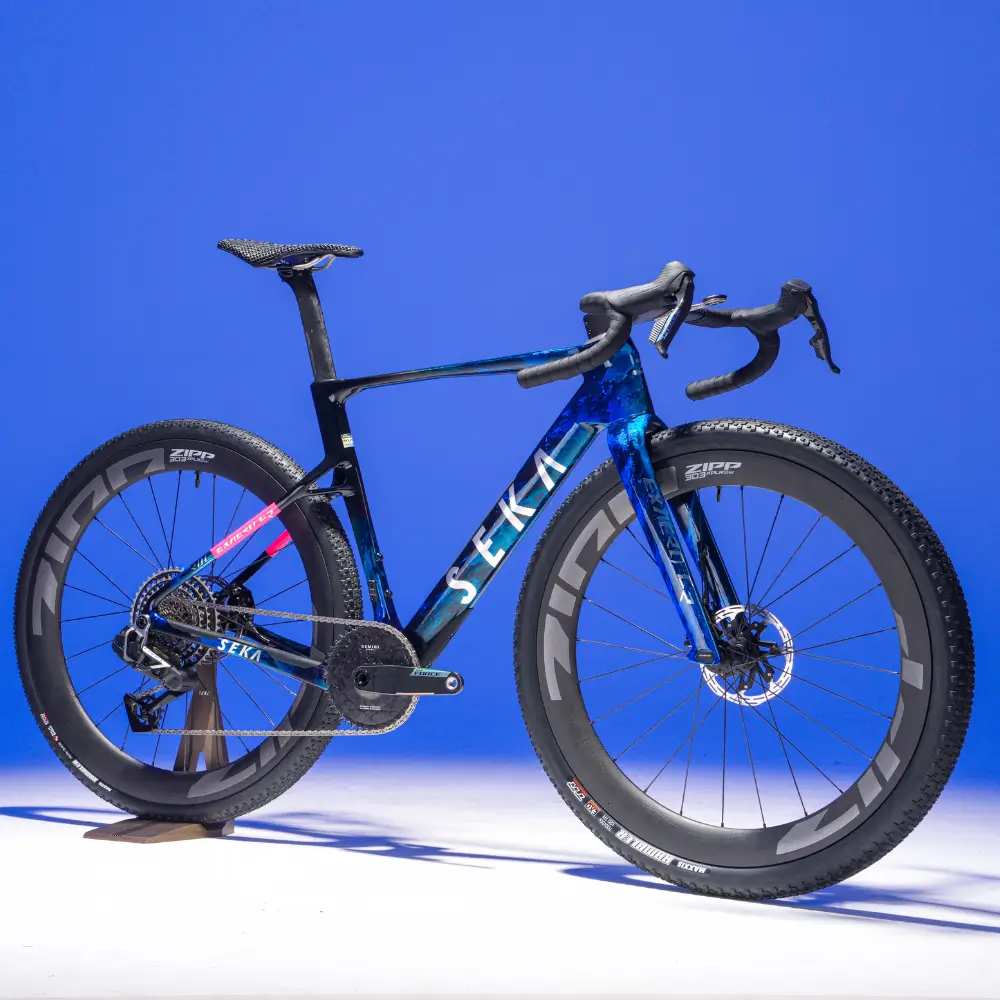
For gravel, SEKA offers the ExAero GR which is gorgeous and something we’d love to test out.
All SEKA framesets undergo advanced fatigue, impact and load testing to simulate thousands of miles of real-world use, conforming to ASTM and EN ISO 4210 standards. SEKA backs its framesets with a lifetime manufacturer warranty on the frame and a 5-year warranty on bars, seatpost and forks.
Pricing: The Spear frameset runs $2,100–$2,700 depending on RDC (reduced drag cable) configuration. The ExAero GR gravel frameset is $3,300 and a complete Spear build with Ultegra Di2 lands somewhere around $5,500–$6,500.
Bottom line: SEKA is the most design-forward Chinese brand right now. It’s investing in R&D infrastructure, showing up in mainstream media, and building with Western cycling culture in mind from day one. The Spear is a genuinely compelling bike and beutiful.
The Pricing Breakdown
| Brand | Flagship Frame | Frame Price | Comparable Western Bike | Frame Price |
|---|---|---|---|---|
| XDS / X-Lab | AD9 Aero | N/A | Specialized Venge / Trek Madone | $4,000–$5,500 |
| Win Space | T1550 Gen 2 | ~$1,400–$2,000 | Canyon Aeroad / Cervélo S-Series | $2,500–$4,500 |
| Quick Pro | AR:ONE | ~$1,900 | Trek Madone / Spec Tarmac SL8 | $4,000–$5,500 |
| Pardus | SPARK EVO | ~$2,500–$3,000 | Cannondale SuperSix EVO Hi-Mod | $3,500–$4,750 |
| INCOLOR | SSR | ~$2,500–$3,000 | Cervélo S5 | $4,000–$5,000 |
| SEKA | Spear RDC | ~$2,714 | Specialized Tarmac SL8 | $3,500–$4,500 |
Frameset prices only.
So, What’s the Catch?
That is a fair question and if you ever consider buying, here are a few real considerations:
Availability and service. XDS and Pardus are actively building dealer networks in the U.S. and Europe. Win Space and Quick Pro sell primarily through curated DTC retailers like Panda Podium. INCOLOR and SEKA are still in earlier stages of Western distribution so if something goes wrong, you’re not going to get the service infrastructure that Cannondale or Specialized has built over decades. So buyer beware at the moment.
Resale value. Wheras you can command three-fourths of the dollar you paid for a high ednd road or triathlon bike, resale for a Chinese brand is completely unknown. There’s no established secondary market for these bikes in the U.S. yet. If you’re planning to flip in two years, factor that in.
Import duties. Depending on country, tariffs can add 10–25% to final cost so while framesets may be cheap, import costs have to be factored in.
Brand cache. This isn’t all that important to us, we love owning a bike that nobody else has.
The Bigger Picture
The Western cycling industry has spent 20 years telling you a story about where the value is but more often than not, the carbon was always made in Asia. The engineers designing those bikes were increasingly based in Asia and the supply chain is Asian.
What you were paying for was the logo, the marketing, the dealer network, and the vibes.
Like Amazon does with its Amazon Basics line, these Chinese brands have spent 20 years acquiring every piece of the cycling puzzle and IP. They excel at this and the factories were already theirs and now they have the design teams, the wind tunnels, the race results, and increasingly, the distribution.
Chinese brands aren’t coming. They’re already here here.
Win Space won a Grand Tour stage. Quick Pro won a World Championship. XDS-Astana is racing the Tour de France.
How will our beloved Western brands respond.
Leave a Reply
You must be logged in to post a comment.