

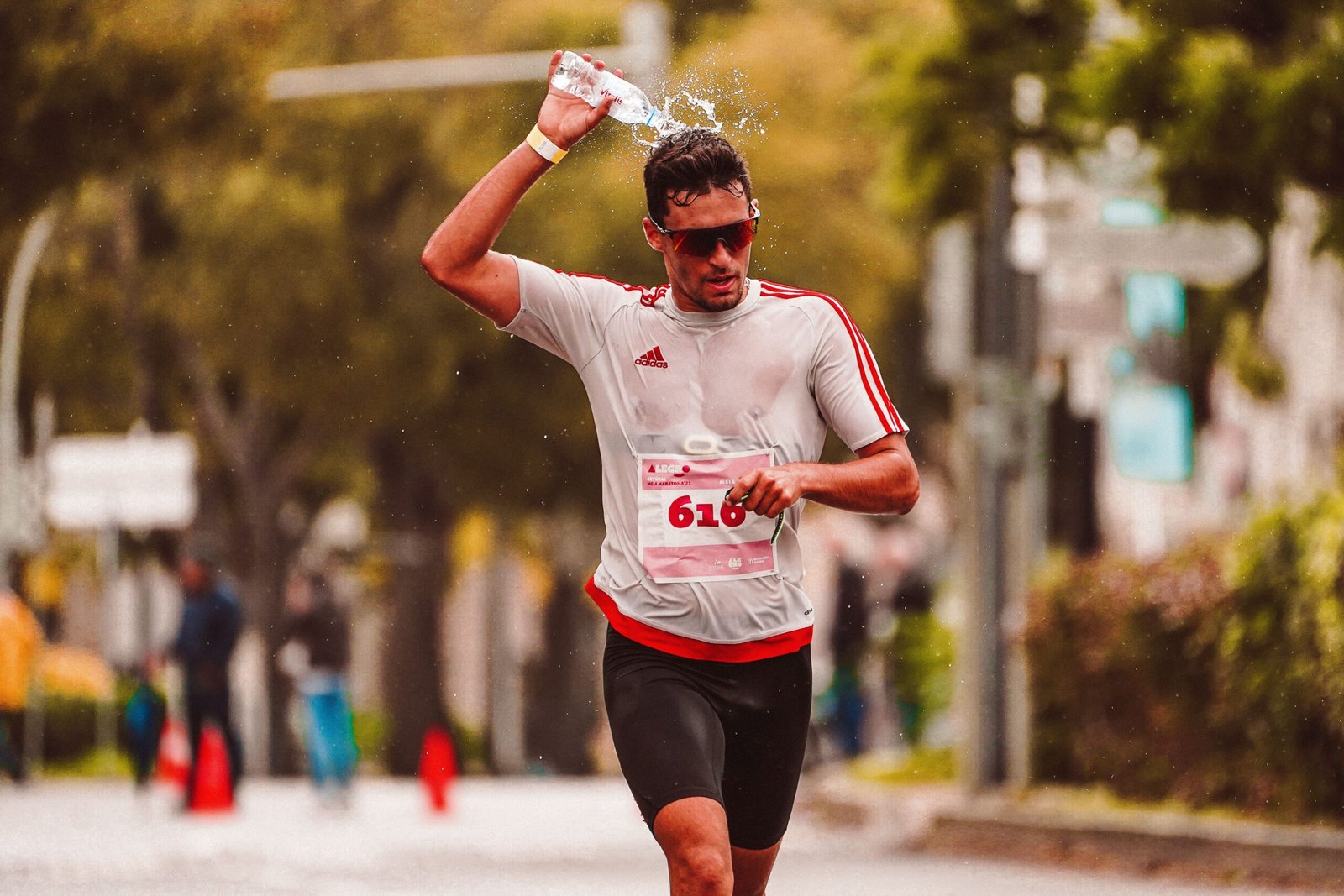
Endurance athletes go by numbers and when numbers are down, they freak out.
Like clockwork, its happening all across the country right now, and it has nothing to do with overtraining, burnout, or losing fitness but has everything to do with the fact that you’re trying to run the same paces, hit the same power numbers, and hold the same heart rate targets you nailed in February, but in July.
The data may look bad, you’re sweating like a pig and your brain is allowing doubt to creep in. “Is something is wrong with me” you begin to ask.
No. Nothing is wrong with you, it’s just summer is in full force.
February You vs. July You
Let’s be direct about something that doesn’t get said enough: your February training and your June training are not the same sport. Yes, you may have the same shoes, and same routes but its a completely different physiological experience. And the sooner you stop comparing the two, the sooner you can actually train well.
When the temperature climbs and humidity piles on, your body is doing an enormous amount of additional work just to keep you from overheating. Blood gets rerouted to the skin for cooling. Your heart rate climbs to compensate. Core temperature rises faster. Sweat rate accelerates.
And all of this happens before mile one is even done, and it all costs energy and capacity that, in cooler conditions, was going toward your pace.
The research on this is pretty sobering. For every 10 degrees Fahrenheit above roughly 55°F, you can expect to see somewhere in the range of 20 to 30 seconds per mile added to your pacing.
I.E. – That tempo run you were doing at a 7:20 pace in March? On an 85 degree day in June with 70% humidity, the same effort and the same perceived exertion, with the same cardiovascular load, might look like 8:00 to 8:20.
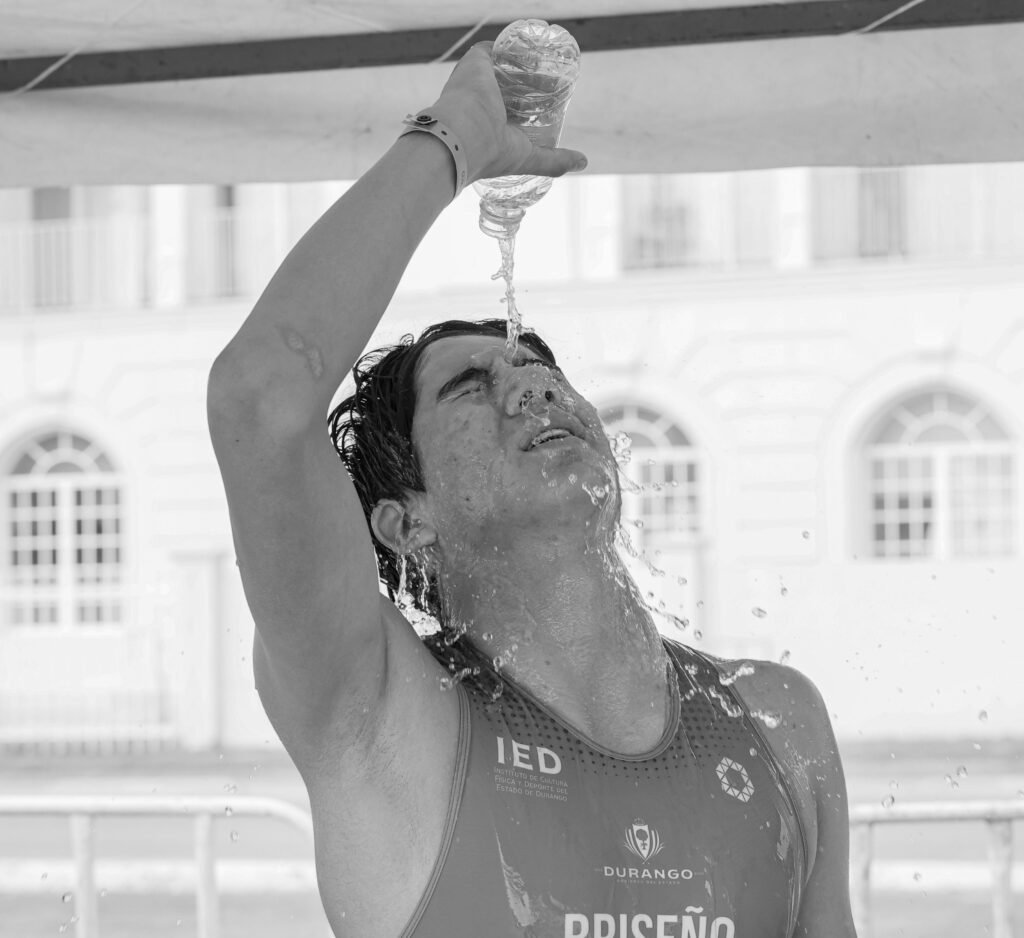
The same principle applies in cycling and triathlon. Power at threshold doesn’t hold the same way. Run splits off the bike get slower not because your legs are dead but because your cooling system is already overwhelmed before you take a stride. Heart rate decouples from effort in ways that make your training zones feel like suggestions rather than targets.
And shift your mindset during these months by not looking at your pacing every quarter mile.
Summer is truly a masterclass in training by feel, and if you let it, summer can be one of the best tools available for building body awareness that carries you forward into understanding yourself more.
Instead, start utilizing Rate of Perceived Exertion (RPE) based workouts — where the target is a targeted level of discomfort or a workout done at a conversational pace. These tend to hold up much better in the heat than pace or power zones.
The pace will come back and it always does, but only if you’re consistent enough in June and July to still be training in August.
This is a no brainer too but think about shifting your key sessions to the earliest hour you can. The difference between a 6am run and a 9am run in midsummer isn’t just a few degrees but can be a difference of UV at zero and UV at face of the sun. The athletes who figure out how to get their hard work done in the morning window tend to have much more productive summers, and recovery versus tackling on mid-day heat like some stupid badge of honor.
And give yourself grace. July training is hard and is supposed to feel hard. The athletes who thrive in summer aren’t the ones who feel great, they’re the ones who stop expecting to see wintery paces and just keep showing up.
Fuel Properly
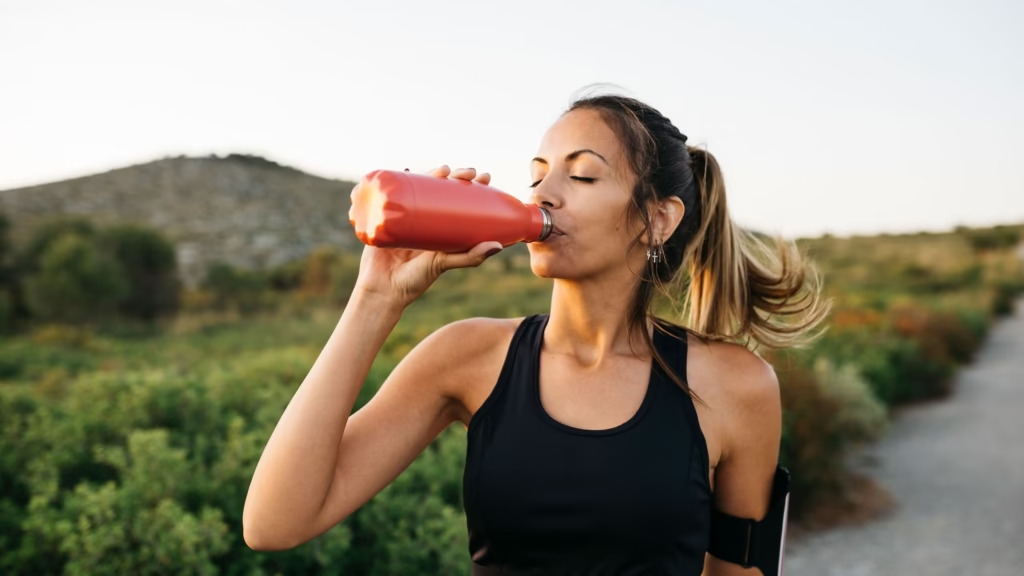
Like pacing, your sweat rate in summer heat is almost certainly higher too. Most athletes dramatically underestimate how much they’re losing per hour, which means they dramatically underestimate how much they need to take in before, during, and after. You might even be derailing your next day or entire week.
Your before and during shouldnt be afterthoughts and is probably the single biggest mistake athletes make in hot weather. They treat hydration as a minimum but they need to be going above and beyond. Front loading fluid and sodium before training, and maintaining that intake during is the only way to stay ahead of the deficit because by the time performance degrades, you’re meaningfully behind and it’s hard to catch up.
Fueling is incredibly personal but at 6’2 and 175 lbs, the general framework I live by but am always playing around with depending on my fitness and the weather is:
- Pre-session: 16 to 20 ounces of fluid with sodium in the 60 to 90 minutes before I head out. Not just water but sodium as it is the mechanism that makes the fluid actually absorb and stay in your system rather than pass through.
- During: 24 ounces per hour should be the bear minimum in heat, with sodium throughout. I’ll start at 1,500 mg of sodium and go from there. On long sessions in high humidity, this floor goes up and you don’t need to convince me. I can do 2,500 mg of sodium and sometimes that isn’t even enough. And yes, don’t be scared or carbs and sugars too.
- Post-session: Drink to 150% of what you lost. Every pound of body weight lost during training is approximately 16 ounces of fluid that needs to come back in, plus the sodium to hold it.
And then of course, carbs enter the picture because they’re not just fuel but a partner in sodium absorption. Sodium and glucose share a transport mechanism in the gut and in summer heat, your body is burning through glycogen faster because thermoregulation is an energy-expensive process.
Any athlete who cuts carbs in summer to “keep things light and tight” tend to be the ones who cramp, bonk, and drag themselves through efforts.
Lean into the carbs, and sugars. Keep your pre-workout fueling honest and keep up with your fueling throughout your entire workout. Heat can suppress your appetite while simultaneously increasing demand on your body. Don’t let it fool you.
Now, about Sweat Tests.
If you’ve been on the fence about getting a proper sweat test done or when to do one, summer is your answer.
Not because it’s a fun luxury then, but because the data you’d get from a February sweat test is the wrong data for June training. Sweat composition and sweat rate change with heat acclimatization and ambient conditions. The athlete you are in August, running in 92°F and full sun, is losing sodium at a rate that might be completely different from what a lab captured during a cool indoor session in winter.
For myself, I get the sweat test when conditions are at their worst so I know the absolute most sodium I need and can do some mental math backwards in the cooler months.
We recommend LEVELEN ($129 – $249) which a few takes weeks but we love and then Nix ($189) is you want something more immediate.
Then of course, some sports dietitians in your area might offer sweat testing too. It’s one of the highest-ROI performance investments you can make and we’re not just saying that. A few years back I was underfueling my workouts by more than 50 percent and my sodium loss on the run is vastly different than on the bike. My exact test below.
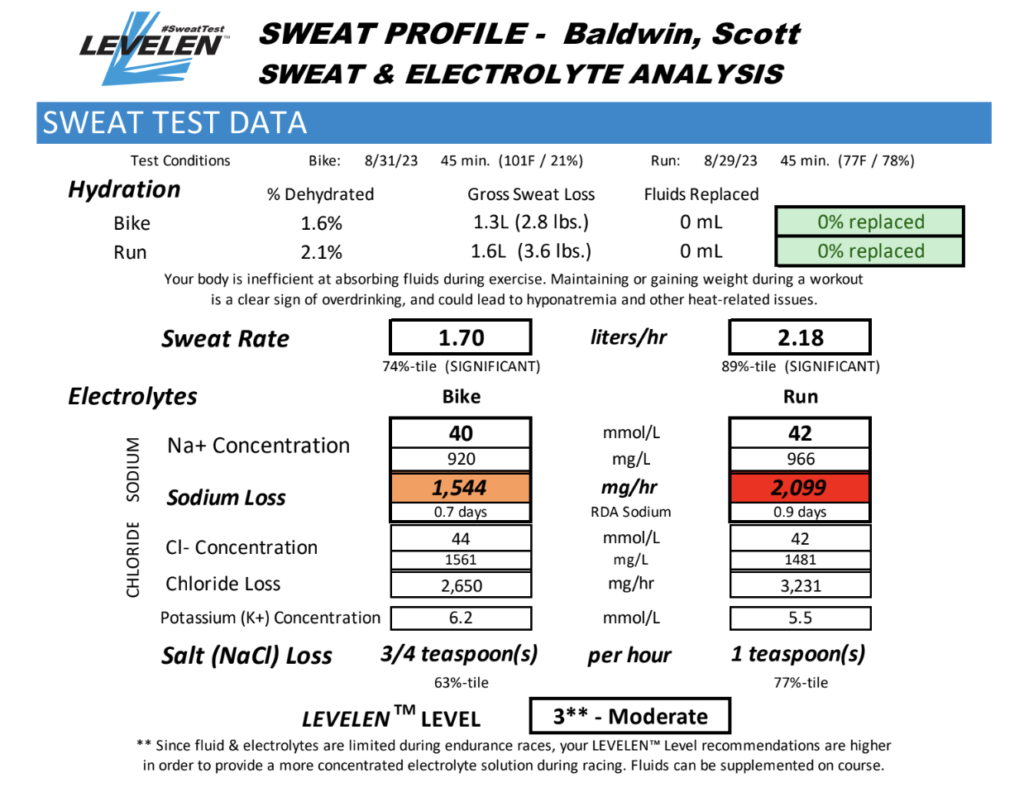
Sodium isn’t just about preventing cramps. Sodium drives thirst, which drives fluid intake. Sodium keeps fluid in your plasma where it can do work and helps with carb absorption.
Athletes with higher sweat sodium concentrations, the ones you see leaving white salt lines on their kits are losing dramatically more sodium per hour than their low-salt peers, and if they’re replacing it only with plain water, they’re diluting what’s left. That’s how you get hyponatremia.
When Does This Get Better?
The good news is your body is remarkably good at adapting to heat. The slightly inconvenient news: it doesn’t happen overnight, and you have to actually expose yourself to the heat for the adaptation to occur. It’s why northern athletes may not perform so well in races in the southern hemisphere.
Heat acclimatization or the physiological process by which your body becomes more efficient at operating in hot conditions takes a consistent two to three weeks of meaningful heat exposure to take root, and closer to four to six weeks to fully develop. But the changes that happen during that window are significant and real. You’ll see that:
- Plasma volume expands, meaning your blood can carry more oxygen and do more cooling work simultaneously
- Your sweat rate increases and your sweating response kicks in earlier, buying you more thermal runway
- Your core temperature at a given effort drops
- Heart rate at the same workload decreases
- You start losing less sodium per liter of sweat as your kidneys and sweat glands get more efficient
If you’ve been training outside consistently since late May, you’re probably already a few weeks into this process and may start noticing things stabilizing soon.
Pace and heart rate start to feel more familiar and your first mile doesn’t feel like you’re running through thick soup quite as dramatically. And that is not mental but real physiology catching up to your body adapting.
But here’s the thing, acclimatization only sticks if you stay in it. If you spend two weeks at altitude, then head back to an air-conditioned office at sea level for ten days, then head back outside, you’re largely starting over.
The adaptation is real, but it’s also perishable. Consistency of heat exposure is the variable that matters most.
Can I Speed This Up?

A few things actually work:
- Heat Soak Sessions: Saunas are everywhere these days so hit your local gym and deliberately sit in a sauna or hot tub post-workout for 20 to 30 minutes. There is solid research behind both as an acclimatization tool for athletes who can’t always train outside or want to accelerate the adaptation curve. It’s not a perfect substitute for real training in the heat, but it drives many of the same adaptations.
- Don’t Hide from Heat Entirely: Training in the cool of the morning is smart for your key sessions, but getting some easy mileage in the middle-day heat, especially early in summer, actively accelerates acclimatization. Your body can’t adapt to what it never encounters.
- Trust the Process and Keep Easy Days Easy: The athletes who overreach in summer and are trying to force the same training load they carried in spring often end up compromised by mid-July. Be the person who backs off intensity, focuses on consistency, and lets the heat be the stimulus that gets you out of the summer fitter.
Sometimes this just is the way and there is nothing you can do about it.
There are days in July where the heat index is 105°F and the humidity is sitting at 90%, and no amount of optimization is going to make your run feel good. Just suck it up and know its going to suck. Hydrate, fuel and just be consistent.
Summer doesn’t erase your fitness, it just might be hiding it but once those temperatures turn, you’re going to be like a rocket ship come Fall and beyond.
Leave a Reply
You must be logged in to post a comment.