

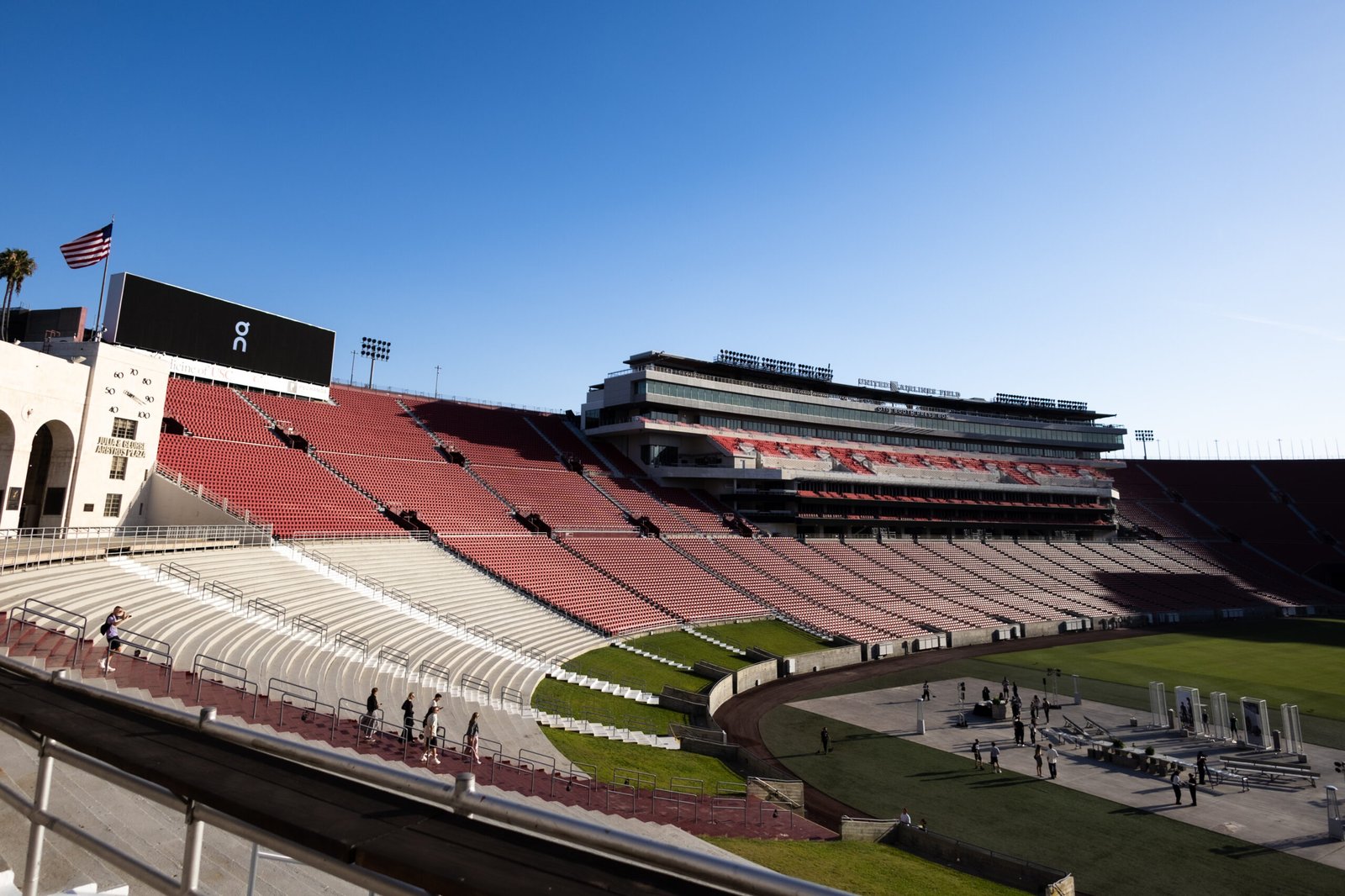
When you ask John (JB) Bolton what he wants people to remember about this team in ten years, he doesn’t hesitate. He doesn’t talk about medals or world rankings or shoe deals. He goes somewhere more spirited.
“I want them to remember that we was hot, we was fast, and we was one of the greatest sprint groups to be created,” he says. “Just like back in the day when you hear Santa Monica Track Club — that still rings bells now.”

The Santa Monica Track Club. If you know track, you know what that name means to the sport. It produced, Carl Lewis, Leroy Burrell, Mike Marsh, and others. They we’re a team that didn’t just win but defined an era, shaped a culture, and left a permanent mark on the sport that still echoes decades later. JB Bolton, standing in Los Angeles in 2026 with a brand-new professional sprint team behind him, is invoking that legacy with a straight face.
The Long Road to This Moment
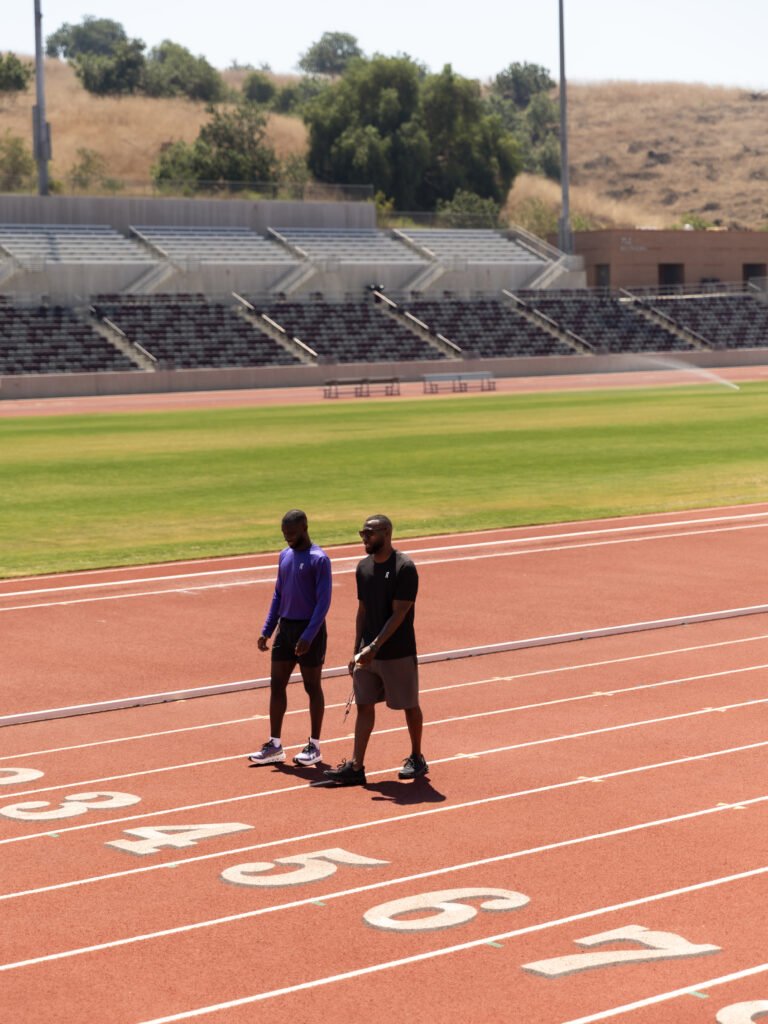
To understand why JB believes this is possible, you have to understand where he came from. Bolton grew up in Compton, CA and by his own description, living wasn’t easy and coaching was never in the plan. “I never even wanted to be a coach,” he says. “This was never my dream. I had a typical hood dream of all the kids growing up that was part of our environment.”
He fell into coaching and spent his first years just trying to pay bills, finally taking it seriously around year five. Then one day at USA Juniors, working his first season at Mt. SAC, he found himself in the warm-up area surrounded by the likes of John Smith, Bobby Kersee, and other established coaches who’d built careers he was just beginning to imagine. Then someone made a remark. JB doesn’t say exactly what was said, but the effect was immediate.
“It lit a fire underneath me,” he says. “I left the track that day, went back to that little sorry hotel next to Denny’s up in Ocala, and I just started writing programs. Writing cycles, trying to figure stuff out.”
It was completely non-traditional. No formal USA coaching pathway. No traditional certification route. Trial, error, obsession, and an almost adversarial self-motivation that he traces back to the battle-rap era he grew up in. “I try to find ways of arguing with my brothers about coaching, trying to get them to tell me I suck,” he laughs, “so I can come out here and show them.” Every summer, he’d go back through every athlete’s entry and exit times, holding himself accountable to the numbers. If the improvement wasn’t there, it hurt. He’d go fix it.
That process across junior college to USC to the Olympic level wasn’t a ladder he climbed so much as a wall he kept refusing to stop scaling. And now he’s here, in LA, with On behind him, three athletes he’s already coached, and a fourth in Benjamin Azamati who brings two Olympics and a 9.90 100-meter time to the group.
Why LA, Why Now, Why This Team
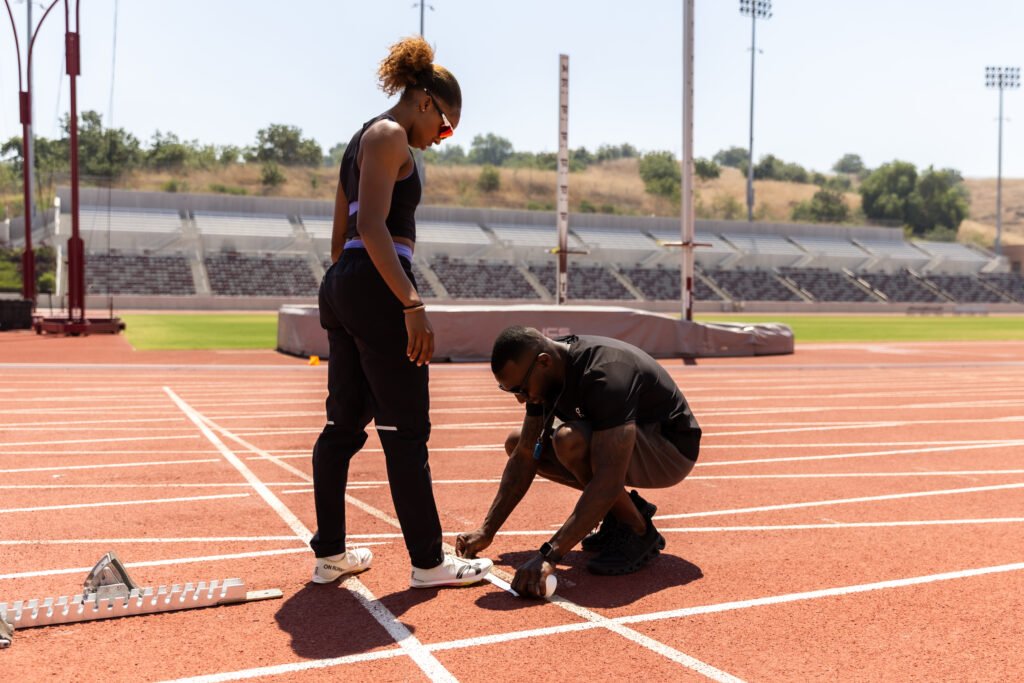
The Santa Monica Track Club wasn’t just great because of the athletes. It was great because of where it was, when it was, and what it stood for. The location and timing were never incidental, they were part of the identity.
Bolton understands this.
OAC Sprint is based in greater Los Angeles deliberately, two years out from a home Olympics. The city is already building toward 2028 in ways that go beyond infrastructure. Gears are churning and soon enough, the eyes of the world will be on LA. For a sprint team trying to build something that lasts, they’re building that story now.
“To have that support, to have the resources, just for a brand to have our back and support everything we do — it’s major,” JB says of the On partnership. “It makes life easy for me. I’m able to just come down here and do what I do.”
What he does, specifically, is break the 100 meters into five to seven phases depending on the athlete, run a weekly structure built around acceleration, plyometrics, speed endurance, recovery, and max velocity work, and stack 20 to 25 hill sessions every fall. He is technical, patient, and by his own admission relentless in the way he demands improvement from himself before he demands it from anyone else.
The roster around him reflects that intentionality.
Max Thomas is in his third year in Bolton’s program, and the development is showing — a 9.90 and a 20.02 in the 200m from the 2025 NCAA 100m runner-up. Samirah Moody is the reigning NCAA Outdoor 100m champion. Johnny Brackins is a 6x NCAA All-American in the hurdles. And Azamati, the veteran, brings the kind of big-stage presence that changes what a young group believes is possible just by showing up to practice.
What Legacy Actually Looks Like
The Santa Monica Track Club didn’t set out to become a legend. They set out to be the best. The legend came later, built on a foundation of results, culture, and a shared belief that what they were doing mattered beyond the finish line.
JB is thinking the same way. There are no major championships this year — no Worlds, no Olympics. Just a group of athletes learning a program, learning each other, and getting in sync and pushing their limits. The pressure will come soon enough and the stages will get bigger than they’ve ever been a part of. And while it seems far off, the 2028 home Olympics looms over everything like a fixed point on the horizon.
But right now, in Los Angeles, in the heat JB says his group actually prefers, the work is being done daily, and the foundation is being laid.
Ten years from now, if JB gets what he’s after, people will say the name OAC Sprint and feel what track fans feel when they say Santa Monica.
Because they was hot back then. And OAC was hot, now.
Leave a Reply
You must be logged in to post a comment.