

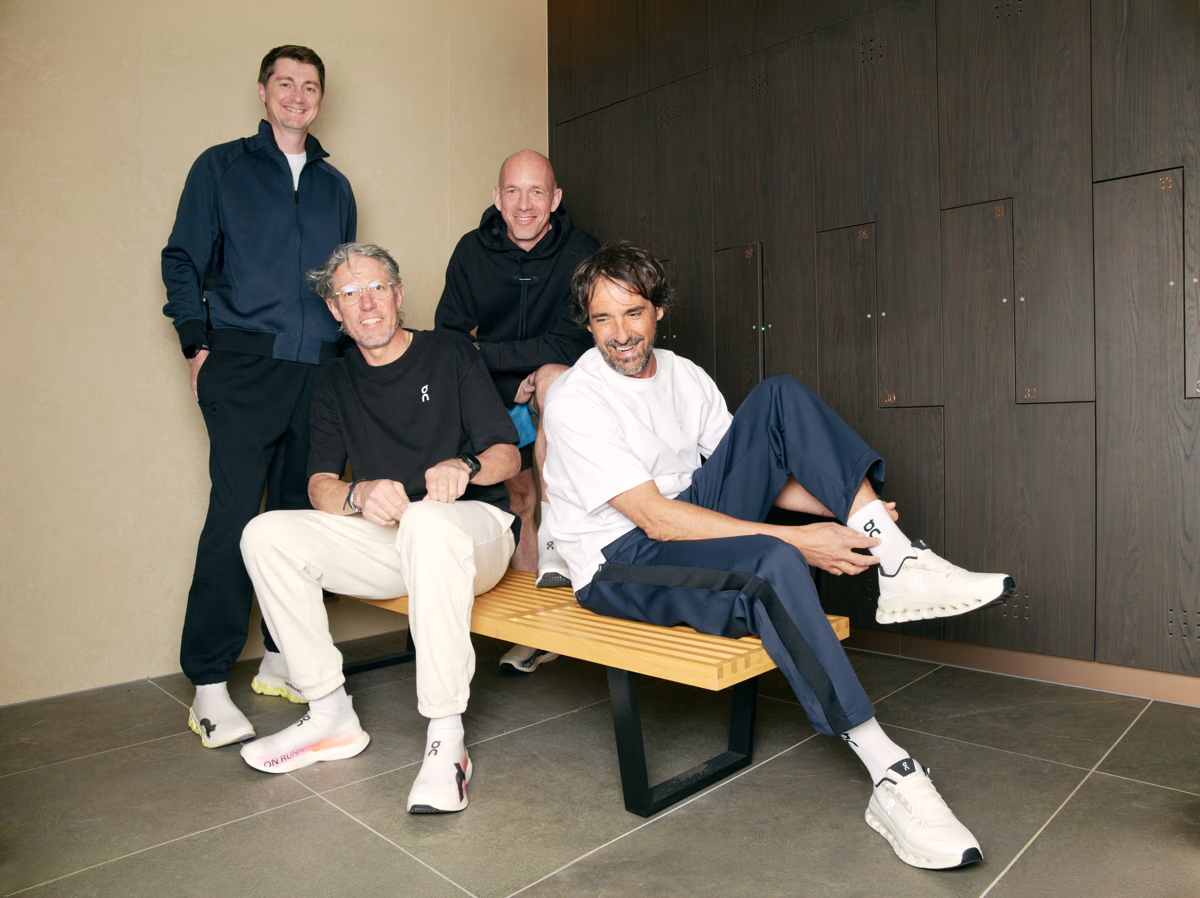
At face value, the news from On is straightforward.
The company is transitioning leadership back to its roots, with co-founders David Allemann and Caspar Coppetti stepping in as Co-CEOs. The current CEO, Martin Hoffmann, will step down after helping guide the company through IPO, global expansion, and a period of significant growth.
The official messaging frames this as a natural evolution; aligning leadership with the next phase of the company, reconnecting founder vision with execution, and maintaining agility as the business scales.
All of that makes sense on its own.
But leadership changes like this rarely happen in a vacuum, and they tend to say as much about the environment around a company as they do about the company itself.
A Category Under Pressure
To understand the timing, it helps to zoom out.
Because at nearly the same moment On is making this move, Nike is dealing with a very different kind of headline.
Following disappointing results and a prolonged turnaround effort, CEO Elliott Hill reportedly vented internally, saying he was “so tired” of talking about fixing the business.
That kind of language stands out, not just because it’s unusually candid, but because of where it’s coming from.
Nike isn’t just another brand. They are the category leader, the company that has historically set the tone for performance footwear and apparel.
And right now, even Nike is feeling the strain.
The company is navigating declining profits, softer demand in key markets, and the ongoing complexity of resetting its business after years of aggressive growth and channel shifts. The turnaround is taking longer than expected, and the pressure is showing.
When the most dominant player in a category starts to sound fatigued, it’s usually a signal that something broader is happening.
Timing Is Rarely Accidental
Seen in that context, On’s leadership shift feels less like routine succession planning and more like a response to a changing landscape.
Over the past several years, On has gone from a challenger brand to a global player. Even dominant.
It has scaled quickly, expanded into new markets, and built a strong position across both performance running and lifestyle, teaming with greats including tennis GOAT, Roger Federer.
But that kind of growth inevitably introduces complexity.
Early-stage momentum is often driven by focus. Things like tight product lines, a clear brand identity, and a strong point of view. As companies scale, those edges start to blur.
More and different markets require more variation.
More distribution creates more pressure to produce. Growth targets introduce new layers of decision-making.
That’s typically the moment when companies either lean more heavily into systems and process… or return to the people who built the original vision.
On is choosing the latter.
What “Founder-Led” Really Signals
When founders step back into operational leadership, it’s rarely about nostalgia. It’s about reasserting clarity.
It’s often said, “nobody will love a company more than a founder.”
Founders tend to have a different relationship with the business. They are often more opinionated about product, more selective about expansion, and more focused on protecting what makes the brand distinct. That can be especially valuable when a company risks becoming too diffuse as it grows.
For On, that distinctiveness has always been a core part of its appeal. The brand’s design language, product positioning, and disciplined approach to distribution helped it stand out in a crowded category.
Reinstalling David Allemann and Caspar Coppetti as Co-CEOs suggests that maintaining that clarity is now a priority as the company enters a more complex phase.
The Other Side of the Decision
At the same time, this move introduces a different kind of tension.
Martin Hoffmann played a central role in scaling the company. His tenure brought operational discipline, financial structure, and the kind of execution required to support rapid global growth. Those capabilities don’t become less important as a company gets bigger—in many ways, they become more critical.
Stepping away from that model is a deliberate choice.
Running a global brand at scale involves layers of complexity that go far beyond product and positioning. Supply chains, regional dynamics, inventory management, and investor expectations all require coordination and consistency.
Founder leadership can bring speed and conviction, but it also has to coexist with that operational reality. Balancing the two will define how effective this transition ultimately is.
From Growth Story to Staying Power
What makes this moment particularly interesting is how it reflects a broader shift in the category.
For much of the past decade, performance brands benefited from strong tailwinds.
Running participation increased, wellness culture expanded, and direct-to-consumer models unlocked new growth opportunities. Brands could scale quickly, often without having to make hard tradeoffs.
That environment is changing. Just ask every cycling company.
Growth is becoming more measured and in this economy, consumers are more selective.
Competition is deeper, with both legacy players and newer entrants pushing for share. Margins are under more pressure, and execution matters more.
In that context, the question is no longer simply whether a brand can grow, it’s whether it can sustain that growth without losing its identity.
A Pattern Grows
Taken together, what’s happening at On and what’s happening at Nike start to look less like isolated situations and more like different responses to the same underlying shift.
Nike is approaching the moment from the perspective of scale. Its focus is on operational reset, doing things like streamlining the business, improving performance, and working through the realities of being a massive global organization.
On is approaching it from the perspective of identity. By bringing founders back into leadership, the company is signaling that maintaining its core point of view is just as important as continuing to expand.
Both approaches are valid and both also carry risk.
And both reflect a category that is moving out of a pure growth phase and into something more complex.
The Takeaway
I’m just a guy who nerds out on this stuff but reads up on everything happening in the industry.
Leadership changes often get framed as simple progressions, but they tend to reveal more when viewed in context.
On Running’s decision to hand the company back to its founders is not just about continuity. It’s about recognizing that the next phase will require sharper decisions about what the brand is, and what it is not.
At the same time, Nike’s very public frustration with its own turnaround underscores how challenging that phase can be, even when you do very un-Nike things like acquire SKIMS and bank on Kim Kardashian.
Taken together, these moments point to a larger reality.
The performance category is no longer defined by how fast brands can grow. It is increasingly defined by how well they can navigate complexity without losing their edge, trust, and allure.
And that is a much harder problem to solve.
Leave a Reply
You must be logged in to post a comment.